

The School Corridor as a Mirror of the Regime
David Borenstein and Pavel Talankin’s Mr. Nobody Against Putin (2025)
Vol. 159 (November 2025) by Natalia Ashurovskaya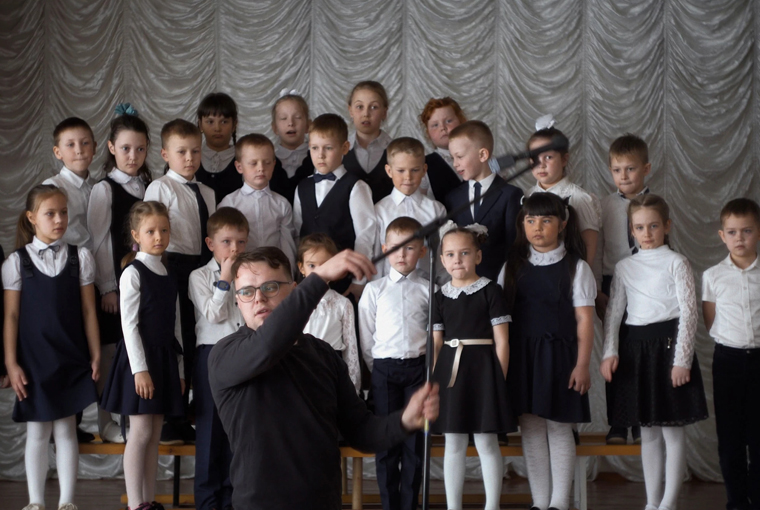
Few films manage to capture how the political system transforms everyday life – not through loud decrees, but through routine practices that gradually become the norm. Mr. Nobody vs. Putin is one such film. This work, filmed by Pavel Talankin at a local school in Karabash and then edited together with David Borenstein, an American director based in Denmark, shows the transformation of Russian education in the early years of the war not as a loud political process, but as a slow, sticky infiltration of ideology into routine.
The film’s premiere at the Jihlava International Documentary Film Festival provoked a rather unusual reaction from the Czech audience: prolonged applause, which even the festival director noted with surprise, numerous questions for the directors, and discussions in the foyer that continued for several days. It seems that it was not only the poignancy of the topic that caused such a reaction. Apparently, viewers saw Talankin’s story not so much as another variation on the theme of ‘Russian hell’ – a visual brand that has become firmly established at international film festivals in the past decades – but rather as a more universal story: a story about how a school whose purpose is to develop the ability to think and ask questions turns into a mouthpiece for the authorities. Talankin and Borenstein’s film is interesting precisely because it shows this process in its embryonic stage – before the new norm has had time to be formed and therefore still causes confusion.
Pavel “Pasha” Talankin is a gentle, ironic, liberal-minded teacher from the city of Karabash in the Urals who is beloved by his students. He is a true patriot of his homeland in the noblest sense of the word – he loves his native land and his job. But while Soviet and later Russian education has always reflected the priorities of the state, the full-scale invasion of Ukraine in February 2022 marked a turning point: the familiar, low-level ideological framing quickly hardened into a systematic and centrally orchestrated program of propaganda. Until 2022, he filmed major school events – assemblies, open lessons, amateur performances, graduation ceremonies, and competitions. But after the outbreak of the war, an order came from the Ministry of Education, and as a school videographer, he was required to film militaristic propaganda lessons in Russian schools and children marching with mock rifles. Shocked by the events unfolding around him, Pasha almost quits his job when fate brings him together with Copenhagen-based filmmaker David Borenstein. As a result of their creative partnership and his function as a school videographer, Pasha is able to show the world what is really happening in Russia through the prism of a school in a small Russian town.
It is curious that the hero’s name – Pavel in the Greek tradition – means “small.” This etymology unexpectedly resonates with the image of Pasha in the film: a figure who is almost invisible, almost a “nobody,” as the title of the film suggests, yet precisely this ‘small’ person becomes capable of resistance – of refusing to participate in a lie and of acting where others choose silence.
The very first minutes of the film, where Talankin warmly describes Karabash – one of the most polluted cities in the world – set an important tone: this is the story of a man who loves a place from which he will later be forced to flee. The homely, almost intimate tone contrasts with what will happen next: the cheerful school corridor where children used to dance turns, a few months later, into a corridor where those same children march with flags and machine guns. The space remains the same, the characters are the same, but the scene changes completely.
One of the film’s strengths is its ability to show how quickly a new system of school ideology emerged in Russia after 2022, without any loud decrees. “Patriotic assemblies” become mandatory, Wagner Group members visit schools to talk to children about the war, and teachers read manuals on the so-called “denazification and demilitarization of Ukraine,” although some educators still have difficulty pronouncing these words. This does not look like violence in the classical sense – rather, it is an endless stream of minor requirements that must be fulfilled ‘for the record.’ And that is precisely the reason why it is effective.
Mr. Nobody vs. Putin is neither an exposé nor an investigation. It is an observational film. It is an everyday look at how an ordinary school becomes a laboratory of state ideology. As a school videographer, Pasha documents the carefully staged reality of Putin’s regime, capturing puzzled children participating in a grenade-throwing competition, recent graduates who collectively shave their heads in support of their friend who recently received a mobilization notice, and the funeral of another friend who died in the war and was returned to his native Karabash in a coffin.
Masha’s storyline – a schoolgirl whose brother was mobilized and killed – is one of the most powerful in the film. Her journey from anxiety to grief is a microcosm of what is happening across the country. When Masha stands at her brother’s grave in the finale, it becomes clear that war is not an abstract concept in this school – it affects families, breaks bodies, and destroys the lives of those who yesterday were sitting at their desks.
This work is one of the most convincing attempts to show Russia from the inside, not through heroic or tragic events, but through everyday practices of consent. The film does not directly accuse or comment. It shows.
And that is probably why the film makes such an impression: because it allows us to see how a generation is being shaped that will never know that it could have had a choice. Perhaps the most disturbing moment in the film is not the propaganda events themselves, but the system’s reaction after the film’s release, which Pavel shared during the press conference after the screening: after he left his post and the country, a closed meeting was organized at the Karabash school, at which teachers are effectively forced to “behave as if Talankin never existed.”
This operation of ‘forgetting’ is one facet of authoritarian logic. Opponents of the regime become ‘nobodies’ long before they are declared enemies. Their names are no longer spoken, their classes are closed, their contributions are removed from the collective memory. Under such conditions, the very act of filming is an act of resistance.


Leave a Comment