

How Come It’s All So Silent Out Here?
Nikola Ležaić’s How Come It’s All Green Out Here? (Kako je ovde tako zeleno?, 2025)
Vol. 160 (December 2025) by Anna Batori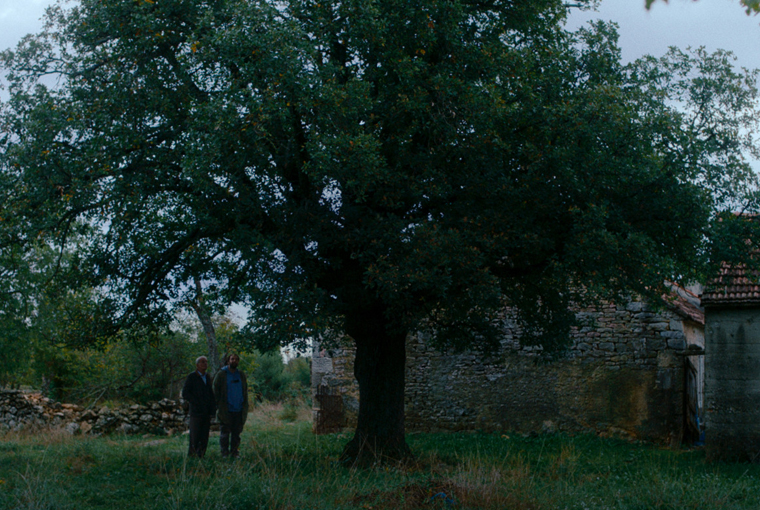
There appears to be a growing trend in Eastern European cinema that explores father-son relationships against a backdrop of the region’s rich and troubled history. Vladimír Michálek’s Of Parents and Children (O rodičích a dětech, 2008), Vlado Škafar’s Dad (Oča, 2010), Ognjen Sviličić’s Armin (2007), Arsen Anton Ostojić’s No One’s Son (Niči ji sin, 2008), and Cristi Iftime’s Marita (Marița, 2017) are just a few examples that, through differing perspectives, focus on the tension between troubled generations, where communication between fathers and sons seems to go off. This is a long-awaited turn in the region’s cinema that not only portrays male figures brimming with testosterone, but also displays vulnerable and emotionally complex men who are eager to understand their own histories.
Nikola Ležaić’s How Come It’s All Green Out Here? aligns itself with this trend through the depiction of a father-son road trip that quickly transforms into a metaphorical journey of memory and grief. Ležaić’s film revolves around the disillusioned Serbian filmmaker Nikola (Filip Đurić) whose daily routine gets interrupted when he receives news that the exhumed remains of his grandmother – who had fled to Serbia as a war refugee during the 1990s – may be returned to her native village in Croatia. Accompanied by his father, Mirko (Zoran Čavić), and other family members, Niko embarks on a long journey through the former Yugoslavian territory to reunite with long-forgotten friends, neighbors, and family members in the vast, rocky landscape of Dalmatia.
Ležaić’s film establishes a clear tension between traditional values and the alienated life of the individual in the modern urban and digital maze. In the first half of the film, Ležaić emphasizes Niko’s monotonous, almost robotic routine. The young man is seen filming a commercial, repairing his new car’s electronic system, sitting in traffic, or taking his pregnant wife to the doctor. These long sequences are often accompanied by extended silence, as if Niko were simply enduring his daily routine without any meaningful connection. In simple terms, it is clear that Niko hates his life and the 21st century world of advertising. He also covers brand labels on his clothes as a form of rebellion against the industry – and himself as a supplier to the consumer system he despises. Unhappy in his marriage and dissatisfied with his work that does not allow him to realize his artistic ambitions, the family trip to Dalmatia appears to be a welcome opportunity to escape his existential crisis – only to bring up an intergenerational one in the post-war landscape.
Niko remains profoundly disconnected from both his family and his own history in the grief-torn rocky mountains of Croatia. He is unable to grasp the emotional gravity of his family’s forced displacement from Croatia, nor can he relate to the experiences of relatives who lived through the ethnic violence of Operation Storm in the 1990s. Interestingly, his detachment is not just circumstantial, but a chosen state. When they arrive at the family village, he pointedly withdraws from the communal dinner, choosing isolation over connection. He repeatedly mentions that he does not eat meat because “it causes cancer” and refuses to drink the locally cherished rakija, further distancing himself from the traditions and social rituals that bind the community together. At the funeral, when the crowd decides to exhume the grandfather’s bones to make space for the grandmother – a scene steeped in dark satire – Niko suddenly breaks into a fit of laughter. It is the only genuine emotion he displays throughout the entire film, which underscores both the absurdity of the moment and Niko’s emotional repression.
Niko shows no real desire to fit in, and just as his daily routines in the city are marked by monotony and detachment, he carries the same mechanical, emotionless gestures with him to the countryside. In parallel, the film aestheticizes Niko’s outsider status through extended sequences of stillness and silence, often showing him quietly observing the landscape or the remnants of deserted homes in the village. In one scene, he places a blanket on his grandmother’s bed – where a brand-new mattress, complete with a warranty tag, silently speaks to the suddenness of her flight. Yet the camera remains fixed on Niko in a long, motionless shot that withholds any clear emotional cues from his expression. In another scene – arguably the film’s most striking one – Niko walks through the woods and catches sight of windmills in the distance. Here, silence feels fully earned, as an over-the-shoulder shot subtly fuses past and present. On this scarred, once-bombed landscape, capitalism begins to take root, while memories fade into obscurity. In this moment, Niko becomes a symbolic extension of the windmill’s mechanical rotation – detached, repetitive, and caught in a system of motion without direction.
Unfortunately, Ležaić’s film mirrors this very condition and adopts a similarly detached and repetitive aesthetic that, while thematically resonant, risks emotional stagnation. The film’s highly episodic structure, extended periods of silence, and descriptive shots of the village and the surrounding mountains have the potential to contextualize the alienated father-son relationship in a richly textured setting. However, for want of (meaningful) dialogue, the family dynamic remains largely superficial and metaphorical.
Ležaić for instance introduces the image of an oak tree as a symbolic gesture toward familial bonds – a ghostly echo of Pintilie’s The Oak (Balanța, 1992). Niko often gazes at trees and at one point asks his father what happened to a young one whose dry roots are still visible in the ground (to which the father responds that it was probably dug out). In another scene, father and son are shown standing silently beneath a massive, ancient oak tree. During their drive home, Niko then hesitantly asks his father what is on his mind, to which the father quietly replies that he hopes the oak tree “won’t be cut down.” Though rich in symbolism, without proper engagement between the characters, such lines fade away – much like the fragile connections they are meant to signify.
Following his debut with Tilva Roš (2010), Ležaić’s How Come It’s All Green Out Here? is not only a story about the delayed exhumation of a grandmother, but also a symbolic excavation of the director’s own past in commercial directing and music videos – potentially signaling a return to a more introspective, auteur-driven cinema. Yet, in the absence of meaningful interaction and emotional resonance, even the film’s beautifully composed landscapes and layered intermedial metaphors struggle to carry the weight of the intergenerational trauma it aims to confront. How Come It’s All Green Out Here? ultimately remains a quiet meditation on inherited silence – a contemplative, but emotionally distant reflection on loss and memory.

Leave a Comment