

A Childhood’s Dream of One Last Summer
Nastia Korkia’s Short Summer (2025)
Vol. 162 (February 2026) by Jack Page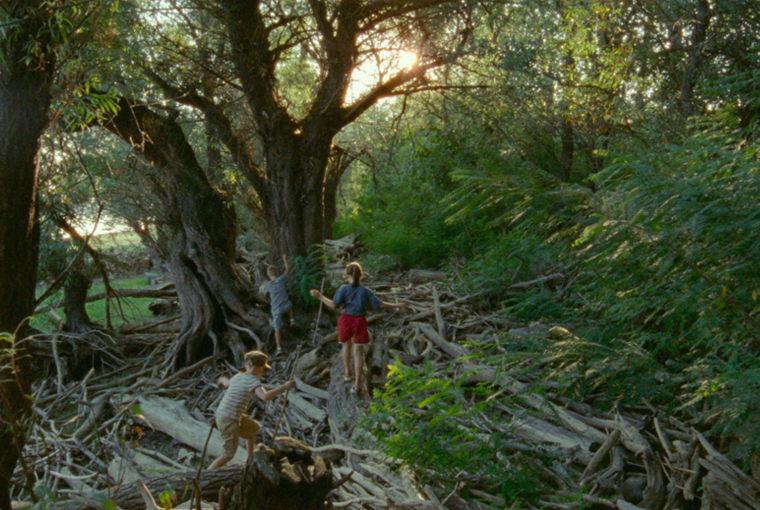
In director Nastia Korkia’s debut feature, eight-year-old Katya spends a lazy summer holiday with her grandparents in the idyllic Russian countryside. Shielded by her innocence, Katya is unaware of the global events unfolding outside of her protective bubble of nostalgia. Disrupted by a dangerous young man who terrorizes the local village, Katya’s summers will never be the same again.
Katya’s pastoral getaway is like any typical childhood summer. She befriends two young boys from the neighborhood and they immediately begin to explore their natural surroundings on a daily basis. As if traversing an obstacle course, they climb dead trees, leveraging themselves with broken branches. Their tiny bodies look minuscule in comparison to the colossal tree trunks, a gentle visual reminder of their vulnerability and recklessness. For these kids, the slightest of stimuli can lead to adventure: pulling loose teeth, visiting the grocery store, investigating the greenhouse. In the garden they find a rusty box of sharp objects and attempt to hook worms they recently dug up. All three children bare the same telltale signs of playground antics: grazed knees, filthy elbows, and dirt under their fingernails. The location and year of the film’s setting is never specified, so the generality of Katya’s summer break enhances the recollective nature of the film. Her childish activities resemble the hazy memories of our own idle school holidays. The film’s tone and rhythm are also reflective of those dwindling echoes and impressions of our youth that we try to reclaim in our imagination. There is even a shard of glass that Katya (Maiia Pleshkevich) frequently toys with, bending light beams and preserving rainbow prisms. This symbolic glass prop could be a recurring motif inspired by the ephemeral nature of nostalgia and memory, seemingly translucent but impenetrable, illusory, and unreliable.
Short Summer teases narrative developments that require the audience to piece information together. Her grandparents, for example, inexplicably sleep in separate bedrooms. They act distant and removed from one another. The dialogue they share is often curt and cryptic. At first, the spectator is as oblivious as Katya. Their relationship’s ambiguity may stem from the longevity and easiness of having grown old together. The truth, however, is revealed when her grandfather files for divorce. He has been having an affair with a younger woman in the local town. It is a subtle style of linear storytelling that circumnavigates traditional routes of dramatic exposition that mainstream cinema is so dependent upon. The clues are plainly laid out in the open, waiting for the audience to connect the dots without any obvious direction.
Similarly, the mysterious ex-soldier’s appearance is the first of many nods to the backdrop of the Chechen war, which is also hinted at through TV news reports and radio announcements overheard in the background of a scene. But these signals are found throughout the film, such as in the greenhouse, where one of the buried treasures the children find is a large piece of shrapnel. Or upon collecting legal documents for divorce at the courthouse, Katya and her grandfather encounter a distraught widow who requires her husband’s death certificate in order to claim benefits. She leaves disappointed and empty-handed with the advice that she must contact the Ministry of Defense directly. In another seemingly mundane scene, the children are playing football in a small field by a railroad track. As the long shot lingers on the game, behind them a roaring freight train rattles past. Some coaches carry tanks, others artillery and varied military vehicles. The sheer loudness of the train and the exhaustive number of carriages causes a brash disharmony in the scene. The children continue their game, nonplussed by the ferocious train dashing through their football field. Although camouflaged, the global context of the Chechen war is always hiding in plain sight ready to disrupt Katya’s quaint country life.
Katya’s carefree days are quickly upended by a malevolent presence in town. A veteran suffering from severe PTSD is wanted in the area. A police radio informs the spectator that the suspect is to be considered extremely dangerous. In an earlier scene, a stranger wearing a blue uniform wanders into a man’s backyard. After a short grapple on the ground, the man in blue bludgeons his victim to death and steals his wallet. Only when the children read the description on the wanted poster many scenes later is it confirmed to the audience that the ex-solider and the man in blue are one and the same.
Katya’s encounter with the ex-solider could be considered her rude awakening. Her sheltered life thus far is thrust into discontent once the threat becomes real. Ignorant of the world’s dangers, Katya is forced to face her fear quite literally head-on when the man in blue breaks into her house. In the technically impressive scene, Katya and her friends are playing hide and seek. As she begins counting down, the other children frantically disperse in search of a hiding place. Once they have all disappeared from sight, the camera pans very slowly from the kitchen door to the right. The camera steadily tracks the erratic movements of the menacing ex-soldier who stumbles in and out of frame, limping into the hallway and ransacking the kitchen cupboards. As the criminal continues to smash pots and pans in his wake and grabs leftover food, the panning shot almost comes full circle to the kitchen table where Katya is hiding underneath. The snarling man grabs her from under the table and places her on its surface. She struggles but she does not scream. Placing her hand on his forehead, the anger of the soldier dissipates and they stare at each other in silence. Their altercation is kept a secret from the others and she leaves the village behind her in the back seat of a car. The car radio talks of terrorists, hostages, and the deployment of troops. Her grandfather confirms that the holiday house will be demolished within the year. Reflecting out of the car window with a look of unease, Katya seems to consider this is her final summer at the countryside and the beginning of her transition into adulthood, with all of its unknown emotions, fears, and responsibilities to come.


Leave a Comment