

A Manual for (Eastern European) Populism
Gábor Holtai’s Feels Like Home (Én itt érzem magam otthon, 2026)
Vol. 163 (March 2026) by Anna Batori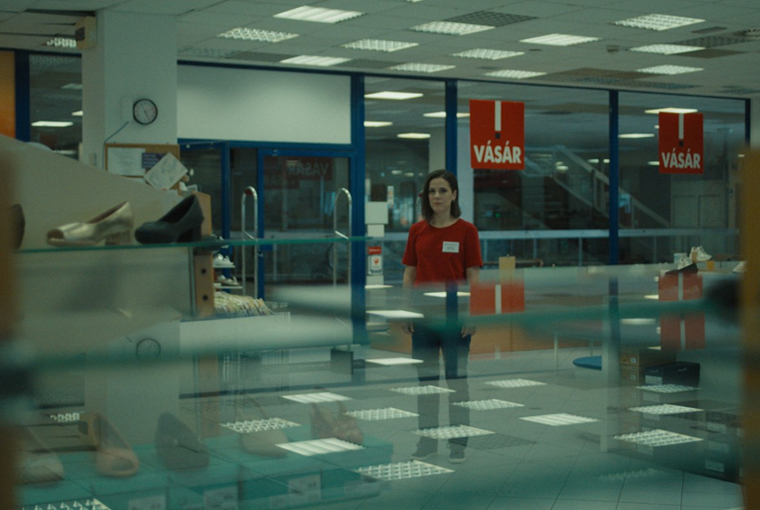
For years, Hungarian film culture has been haunted by a bitter and recurring question: how can quality independent cinema still emerge within the autocratic framework of the Viktor Orbán regime? How can filmmakers defy the alignment of funding decisions and professional institutions with politics as well as the consistent favoring of big-budget productions – typically historical spectacles designed to promote nationalist cohesion – despite their at times striking artistic weakness? In the meantime, another question continues to cloud Hungarian public life: how can a system so deeply rooted in corruption, and so persistently hostile to the very idea of European solidarity, sustain itself for sixteen years? What psychological structure – or perhaps what deeper layer of the Hungarian collective psyche – continues to reproduce and legitimize this political force?
Gábor Holtai’s film offers an explanation for the sustenance of Orbán’s regime while brilliantly avoiding overt political positioning. Instead, it delivers a low-budget independent parable – made by young filmmakers with almost no financial resources – about the inner mechanics of a family. Through the interplay of power games and the inversion of traditional familial roles, the film gradually constructs a complex yet deeply recognizable anatomy of the Eastern European psyche.
At the center of the story stands Rita (Rozi Lovas), who has just lost her job when she is abducted on her way home. She wakes up in a dark room where Marci (Áron Molnár), a man entirely unknown to her, attempts to convince her that she is in fact his sister who had merely “wandered off” but has now finally been brought home. From this point onward, her name is Szilvi. Although Rita initially does everything she can to escape captivity, the sustained psychological terror, sleep deprivation, and the withholding of food gradually force her to assume the role of the missing daughter/sister. To perform it convincingly, she is given a manual – not only for Szilvi’s character, but for the family to which she has supposedly returned. She must study, in meticulous detail, a notebook containing profiles of each family member: their habits, favorite meals, and behavioral patterns. Rita is eventually allowed to meet her “lost family,” presided over by Papa (Tibor Szervét). The older man governs the household with unyielding severity and reinforces his authority through cautionary narratives about the dangers of the outside world, while insisting that true safety only exists within the confines of their home – “where there is love.”
Papa is not merely a tyrant but a recognizable post-socialist patriarch whose authority rests less on charisma than on the internalized obedience of those around him. Rita gradually enters the logic of the game and begins performing the role of Szilvi, while the boundary between her actual and assumed identity becomes increasingly unstable within the prison-like structure of the family.
One of the film’s most memorable scenes unfolds when Rita is finally allowed to go shopping at a nearby store. The moment she steps outside, escape briefly appears possible, as though the terror might end the instant she crosses the threshold. Yet it soon becomes clear that the street– owned entirely by Papa – operates under the same rules as the family forced unto Rita. Shopkeepers and passers-by move past the woman with lowered eyes, refusing even to acknowledge her as she desperately explains that she has been abducted.
The system, then, extends far beyond the nuclear family, where each abducted individual is assigned and compelled to perform a designated familial role. The terror permeates the wider social environment as well, thus sustaining and legitimizing the same order. The result is a bitter diagnosis not only of Hungarian public life but also of a broader social condition in which intimidated ordinary people avert their gaze to protect their own fragile survival.
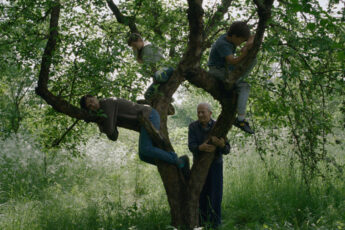
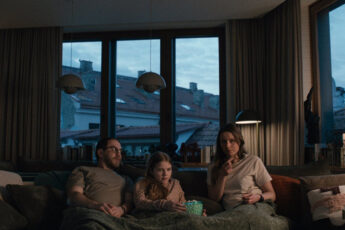
This diagnosis is reinforced by the family members themselves, each embodying a recognizable social type deeply embedded in Hungarian cultural memory: the alcoholic uncle, the unhappy sister-in-law who beats her son, the deeply frustrated accountant trapped in her own bitterness, and the mute younger sister who has long since surrendered to her fate. Each occupies a strictly assigned position within the family structure, performing the roles scripted by Papa in the name of a carefully staged domestic harmony.
Rita aka Szilvi’s task is to “remain” Papa’s favorite and write poetry for him. She fulfils this demand by hurriedly copying down the lyrics of a party song – an act that earns Papa’s enthusiastic applause. The scene reveals with bitter precision how authority functions here: cultural value itself has ceased to matter, so long as power is affirmed. “If Papa is happy, everyone else is happy.”
Of course, every system contains cracks, and Rita – assisted by Marci – eventually begins to find them. The deeper question, however, is what an isolated individual, stripped of friends, work, and any meaningful social ties, can actually do with freedom. Does she return to the prison and choose performance over uncertainty, or continue alone, abandoned to homelessness and social invisibility? The film’s most unsettling suggestion is that captivity eventually becomes legible, while freedom remains terrifyingly abstract.
Holtai’s film confronts remarkably complex questions within the framework of melodrama, while simultaneously examining the human relationship to power itself. In many ways, it feels like a hybrid of Yorgos Lanthimos’ Dogtooth (2009), Dan Trachtenberg’s 10 Cloverfield Lane (2016), and William Wyler’s The Collector (1965).
It has been some time since a Hungarian film offered performances of such extraordinary precision, where every gesture, hesitation, and silence carries dramatic weight. One of Holtai’s most intelligent formal decisions lies in refusing visual relief. The camera remains trapped within interiors, often framing bodies all too closely, denying both the characters and the viewer any stable spatial orientation. This sustained visual confinement gradually produces the same perceptual fatigue that governs Rita’s experience: the spectator, too, becomes subjected to repetition, uncertainty, and emotional dislocation.
The oppressive atmosphere is further intensified by the exquisite sepia-toned cinematography of Dániel Szőke, whose subtle play with light intermittently suggests the possibility of escape only to withdraw it again. The apartment itself also contributes to this suffocating effect: an interior in which time appears to have stalled somewhere within socialism, a claustrophobic domestic space from which the film never truly departs. The claustrophobic visual strategy is further reinforced by abrupt sonic closures. Scenes repeatedly end in sudden acoustic shocks, recalling the sound dramaturgy of Lanthimos or Haneke, where sound itself becomes an instrument of control.
Yet the film is not without structural unevenness. Its final movement becomes noticeably prolonged, as though the narrative hesitates before committing to its own resolution. Similarly, Rita’s gradual transformation into Szilvi occasionally feels too abrupt: while the film carefully constructs psychological coercion, certain shifts in her emotional alignment arrive faster than is justified by the preceding build-up. These minor imbalances, however, do little to diminish the film’s overall rhythmic confidence and the sustained tension of its carefully constructed world.
Holtai’s film was released at a moment when Hungarian audiences no longer watch political allegory from a distance, but from within its lived vocabulary. The more unsettling question is whether viewers recognize themselves in its parable. In the context of the approaching Hungarian elections, the film’s implications become even sharper: might Papa simply be replaced by another Papa, someone ready to perpetuate the same family dynamic and the same Eastern European post-socialist machinery in which he remains indispensable to the imagined safety of the “family”? Is there any hope of stepping outside this inherited structure and choosing the uncertainty of the unknown? The true discomfort of Feels Like Home lies in the suggestion that the prison depicted on screen is recognizable precisely because, for many viewers, it already resembles home.

Leave a Comment