
Cristian Mungiu’s Fjord arrived at the Cannes Film Festival carrying the weight of expectation. Already having won the Palme d’Or with 4 Months, 3 Weeks and 2 Days and emerging as one of the central figures of the Romanian New Wave, Mungiu has built his cinema around moral ambiguity, institutional violence, and the contradictions of modern European societies. Yet few anticipated the intensity of the reaction his latest film would provoke after winning the Palme d’Or this year.
In France especially, Fjord quickly became one of the festival’s most divisive titles. Three out of four critics from Cahiers du Cinéma dismissed the film with one of them giving it the rating “not worth the trouble.” Commentators on the radio station France Inter criticized what they perceived as the film’s reactionary undertones and simplistic depiction of Scandinavian liberal progressivism.1 Writing in Libération, Olivier Lamm lamented that Mungiu had turned Norway, “the vanguard of progressive values that reactionaries have made their bête noire, and the main driver of their electoral success,” into the villain of his story. Lamm went further, suspecting that “Cristian Mungiu, yesterday a declared adversary of Catholic fundamentalists… has turned into an anti-woke agitator.”2
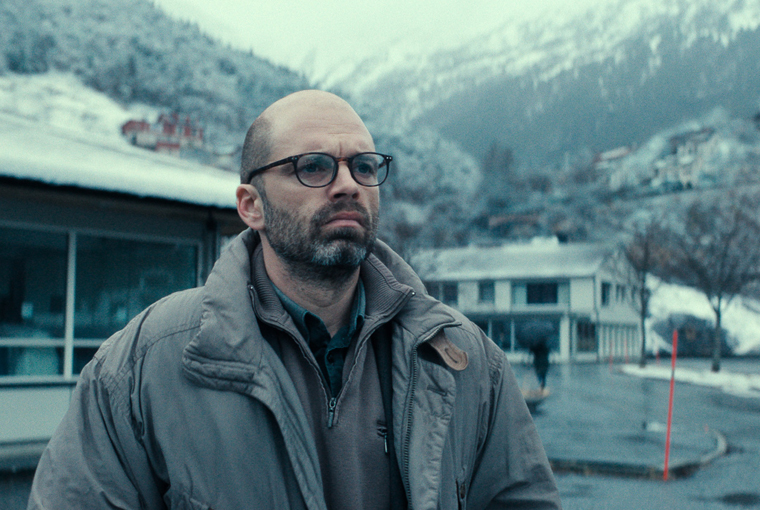
In Fjord, Romanian aeronautical engineer Mihai Gheorghiu (Sebastian Stan) and his Norwegian wife Lisbet (Renate Reinsve) relocate with their five children to a small Norwegian fjord town after meeting through an evangelical church community in Bucharest. The town appears idyllic. Mungiu’s wide-angle cinematography transforms the surrounding landscape into a space of serenity and openness, while the local community warmly embraces the newcomers in what seems to be a show of Scandinavia’s openness towards immigrants. As time passes, however, the lenses tighten, and the viewer begins to notice the violence of the surrounding mountains. Winter becomes harsher, and avalanches cascading down the cliffs mirror the gradual shift in the community’s perception of its new residents.
The Gheorghius’ strict evangelical parenting – nightly Bible recitations, technophobia, conservative views on sexuality and family – begins to generate suspicion. When their teenage daughter appears at school with bruises from a wrestling class, Child Welfare Services intervene. Without evidence of abuse, the children are removed from the household, including the couple’s infant baby. Lawyers, social workers, prosecutors, and even sympathetic neighbors progressively turn against the family as it becomes clear that the couple’s worldview appears unacceptable within the moral framework of their social environment.
Contrary to the many accusations directed at the film, Mungiu does not portray the evangelical family as heroic victims or moral exemplars. Their world is held up for ridicule in scenes that invite the audience to laugh along. In one, the family’s pastor gives a preachy speech with fireworks bursting on a TV screen behind him, the whole frame thick with kitsch. Mungiu cuts to the family’s lawyer at home, who plays back a video of the scene for her husband, and the two of them laugh. However, the angle is wide enough to reveal an oversized television with a fireplace screensaver, and the joke turns back on the people telling it. What interests Mungiu, then, is not innocence versus guilt, but the mechanisms through which ideological polarization transforms disagreement into mutual dehumanization.
This is where much of the hostile critical reaction becomes revealing. In contemporary Western Europe, criticism of religious conservatism already occupies a position of overwhelming cultural legitimacy. Liberal society finds it easy to condemn religious beliefs when the affected groups possess relatively little institutional power. But the condemnation usually flatters the people doing the condemning. Take France. Its bans on the headscarf let laïcité double as a flattering self-image: of a people who freed themselves from clerical authority and now guard that freedom against newcomers who would reimpose it. However, the certainty of being right is also what makes it usable against minorities.
Fjord may unsettle critics because it points at such contradictions. Instead of scrutinizing the conservative outsider, Mungiu examines the liberal majority itself: its institutions, its moral certainties, and its growing inability to tolerate forms of life that fall outside the progressive consensus. The irony, of course, is that this dynamic mirrors the very subject of the film. Throughout Fjord, characters repeatedly insist on their neutrality and moral rationality while exercising forms of coercion justified in the name of tolerance, child protection, and social harmony. Social workers, prosecutors, educators, and local officials rarely appear as malicious figures acting on their individual beliefs. Rather, they function as extensions of an institutional logic that no longer perceives itself as ideological at all.
Mungiu pushes beyond the framework of earlier Scandinavian social critiques such as Lars von Trier’s Dogville. In Fjord, intolerance no longer emerges from group psychology or small-town cruelty, but from bureaucratic systems convinced of their own ethical superiority.
This may also explain why the film provoked particularly intense reactions in France. Coming from a Romanian filmmaker, effectively a cultural outsider examining Western Europe from its margins, Fjord disrupts a familiar hierarchy in which Eastern European cinema traditionally critiques its own (post-)Communist failures while Western liberal democracies remain the implicit horizon of moral progress. Here, the foreigner turns the camera back toward the “native,” exposing contradictions many would prefer to see reflected elsewhere.
Late in the film, religious activists vandalize the wall of a school with the slogan “Satan speaks through their mouths.” Next to the school, a local festival is taking place commemorating indigenous victims of Scandinavian colonialism. Public personnel conceal the graffiti beneath a banner from the event. The scene lends an image to moral self-righteousness as a form of symbolic violence: acknowledging one historical injustice allows another to slumber underneath.
Fjord clearly touches a nerve when it addresses the growing tension between Western Europe’s liberal self-image and the increasingly coercive mechanisms through which liberal societies attempt to preserve moral consensus. In a climate of culture wars and political polarization, the hard truth to swallow is that those who name the hypocrisy are sometimes the least sympathetic messengers: indoctrinated evangelicals, anti-woke illiberals, or far-right agitators. The easy response is to treat the source as proof that the criticism is wrong. It is not. A bad messenger can still carry a true message, and refusing to hear it because of who speaks is itself the intolerance the film is about. Acknowledging the contradiction would make room for the freedom of expression and the culture of democratic debate that liberalism claims as its founding values, and from there, one might hope, a more tolerant society.
- Cahiers du Cinéma (2026). “Fjord de Cristian Mungiu”. Cahiers du Cinéma, Cannes 2026 Competition Ranking, 18 May 2026; France Inter (2026). “Fjord de Christian Mungiu”. Le Masque et la Plume, Radio France, podcast episode, 24 May 2026. ↩︎
- Lamm, O. (2026). “Cannes 2026 : dans Fjord, les fervents contraires de Cristian Mungiu”. Libération, 18 May 2026. ↩︎



Leave a Comment