

Contradictions of Co-Production
Tamara Stepanyan’s In the Land of Arto (Le Pays d’Arto, 2025)
Vol. 167 (September 2026) by Daniel Schwartz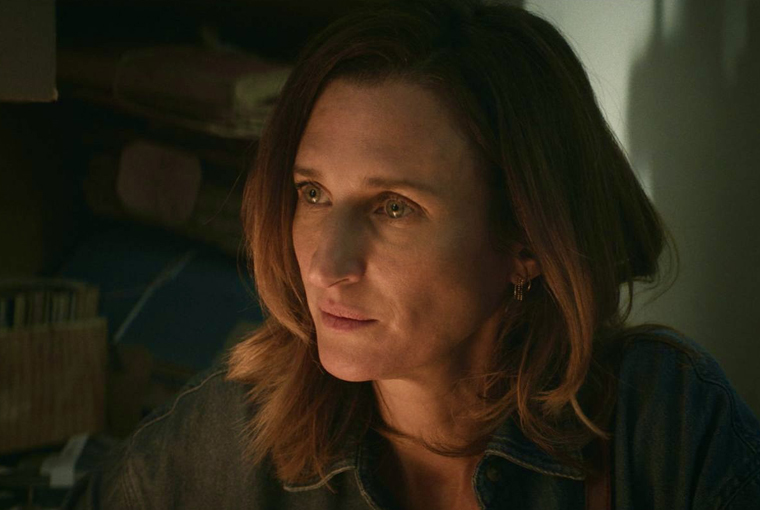
This year’s Golden Apricot Film Festival opened with Tamara Stepanyan’s In The Land of Arto. A maker of solid documentary films (Village of Women; Embers), Stepanyan is one of Armenia’s most promising directors. Unfortunately, her debut fiction feature collapses under the contradictions of co-production. Produced in France and filmed in Armenia, the film struggles to motivate its plot in an attempt to render the generational trauma of the Nagorno-Karabakh conflict palpable to a wider (read: West European festival) audience. A French woman, Céline (Camille Cottin) arrives in Gyumri (Armenia’s second largest city) to certify her husband Arto’s death and thereby guarantee Armenian citizenship for her children. She’s surprised to discover, however, that no record of her husband exists. With the help of a friendly taxi driver, who just so happens to speak French, she learns that her husband was in fact a deserter from the First Karabakh War (1988–1994) and that many of his former friends blame him for their comrades’ deaths. What follows is a road movie intended to take Céline, the consummate outsider, into the heart of an Armenian national tragedy. Through her eyes, the viewer will begin to grasp, intellectually and emotionally, the consequences of a war largely ignored by the West.
Unfortunately, the film does not deliver. Throughout, we see the stitches of the plot. Chekhov’s gun appears in the first third as a pistol Arto’s comrades hand Céline as evidence of his desertion. Her chanced-upon local guide Arsiné (Zar Amir Ebrahimi) draws a map of Armenia on a chalkboard to orient the audience and set up the journey to come. Céline must go to Karabakh (the film was written before the complete loss of the territory to Azerbaijan following an Azerbaijani offensive in September 2023). Along the way she meets shell-shocked soldiers, weapons smugglers, Russian “peacekeepers,” and even a famous Armenian rapper. But her decision to travel to the epicenter of the conflict remains a mystery, not to mention a logistical impossibility. As good viewers, we should suspend our disbelief. Yet this proves difficult in a film with so many classic road-movie clichés. In the end, the mystery is not resolved, and the ambiguity of Céline’s journey creates little space for reflection.
Whatever ghost Céline is facing (her husband’s suicide; his alleged desertion) does not require a visit to a territory under siege. Moreover, it certainly does not require that Céline take part in the war by helping Arsiné smuggle drones. The absurdity of the adventure is matched only by the awkwardness of the encounters with locals. In an abandoned building, Céline is nearly assaulted by a mentally challenged young man whose purpose in the film is at best symbolic and at worst superfluous; at a border checkpoint, she’s reluctantly entertained by an Armenian soldier who bursts into the French national anthem in a sad bit of comic relief. Such bizarre moments are accompanied by dialogue that sounds stilted in French, English, and Armenian (another pitfall of co-production). I don’t believe dialogue should be ‘natural’ (whatever that means), but it should do more than just advance the plot. One gets little sense of who the characters are from their lines. They remain stick figures throughout, delivering a viewing experience that oscillates between boredom and cringe.
The reliance on famous French actors and cameo appearances also doesn’t help the film. The appearance of the acrobatic Denis Lavant as a shell-shocked soldier (codename: Rob) only serves to pull the viewer further out of the film’s reality. His pirouettes and gesticulations hint at his roles in Beau Travail and Holy Motors, but they feel largely out of place in a film anchored in a concrete historical moment. Similarly, the keffiyeh around Lavant’s neck feels like a forced gesture of solidarity. (To my knowledge, soldiers in Nagorno-Karabakh did not wear keffiyehs.) This is not to say that comparisons between Karabakh and Palestine are not justified; only that in the film they appear unmotivated. The keffiyeh is to Lavant the actor as Lavant is to the film as a whole: an extravagance that comes from without. It does little to deepen the viewing experience or the subject matter. Its appearance feels cheap despite its message of solidarity being welcome.
That said, the film certainly has its positives. The fact that the question of Arto’s ‘desertion’ is never resolved allows the film to address issues of nationalism and patriotism without suggesting that every good man has to be a soldier. Quite the opposite. In Arto’s desertion one gets a sense of how the conflict weighs on the collective psyche. The pressure to continue the struggle is countered by a desire to move on, to find peace even if it is not just. This creates an untenable psychic situation. Still, what can be gleaned from Céline’s reconciliation with Arto’s suicide doesn’t prevent the film from feeling like the cinematic equivalent of an NGO: filled with good intentions but flat in perspective. Surely, Armenians who’ve been living with the conflict all their lives – and who could point out that the antiquated train Céline takes to Gyumri only goes from Yerevan to Sevan – do not need maps of Armenia drawn on chalkboards. (They might even mention that there is a modern train that goes to Gyumri.) Such lessons in geography are intended for European audiences, who have, for the most part, ignored the conflict. Yet delivering it in the context of a fiction film is extremely difficult. In The Land of Arto tries while attempting to communicate something of the trauma Armenians have lived through. The attempt is laudable, but the vehicle is flawed. This road movie ultimately serves up the usual reheated clichés about war. Watching it made me realize how much the financial advantages of co-production can also prove to be a curse.

Leave a Comment