

“I Feel Like I’m Herding Cows.”
Laila Pakalniņa’s Scarecrows (Putnubiedēkļi, 2025)
Vol. 159 (November 2025) by Jack Page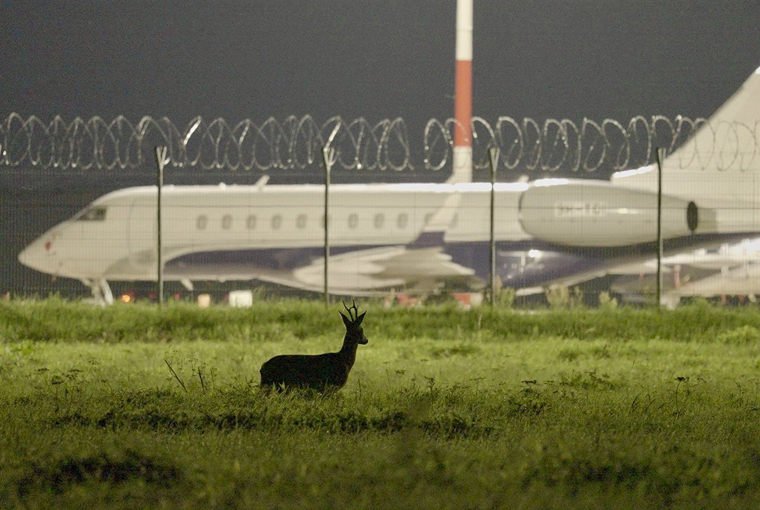
Scarecrows” is the nickname given to the elite team of wildlife wranglers that clear the runway at Riga International Airport every day. Providing around-the-clock care for trapped, injured, or lost animals and keeping the plane schedule on track is no meager feat. Scarecrows is a contemplative and intriguing documentary on a life less lived, quietly hidden from the public eye, and ignored by the travelers who need the team’s service the most.
The film’s first shot is exemplary of the Scarecrow team’s daily routine. It is New Year’s Eve at six a.m. in the morning. A car windshield is blotted with raindrops that trickle down until wiped away by the squeaking wipers. The crackling sound of a walkie-talkie and the tapping of rain fill the interior as one of our protagonists is about to clock in for their pest control duties. The mischievous tone of the soundtrack – with its offbeat piano notes and the rattle of maracas – compliments the sharp, jittery movements of the fox cub caught in the car’s headlights. Before it’s driven away in a high-speed pursuit, the creature hops and dives into the vegetation hunting for food. It is a profoundly unexpected marriage between nature and the man-made world, yet the images seem perfectly organic and balanced. Since the feature is not very dialogue-heavy, the documentary will rely on similar set-ups throughout, catching the audience off-guard with the aesthetic beauty of the Riga airfield.
Although the airport is home to the heavy traffic of the familiar Air Baltic 747 Boeing models and other elaborate machinery and vehicles, filmmaker Laila Pakalniņa finds ample opportunity to display the resplendent mise-en-scène. A pink skyline frames the outline of the gates and cages that enclose the airport. An enlarged full moon is often center frame in the background, illuminating the runway and casting shadows across the airfield. The camera captures the airport’s changing imagery through all four seasons and just like nature, the airport adapts to the varying conditions. Surprisingly, there are few close-up shots of the animals themselves. Caught in the red-and-white glow of the touchdown zone lights, the glowing faces of rabbits and owls are momentarily held, before their twitching eyes reflect the light back into the camera lens and it cuts to the next scene. The style of cinematography employed is innate and observing. The long takes allow for the action (or lack thereof) to move in and out of frame, where only the depth of focus is manipulated to capture a creature’s portrait as it looms its head. Conversely, there is also frantic handheld camerawork during the chase sequences. Situated beside the driver, the camera shot shares the point of view of the passenger, flipping between the car windscreen and the reaction of the Scarecrow behind the wheel as they hunt down their prey. It’s an exhilarating (if harmless) display of action that helps punctuate the rhythm of the documentary that is otherwise a considerably slower paced feature.
Although the job of the Scarecrow team is often inglorious and thankless, they still take their responsibilities very seriously. From preventative measures to high-risk safety breaches, they truly are the chosen few who relay information back to the radio tower and green-light arrivals and departures. In one scene, they are sent to inspect an “unconfirmed collision,” where they take photographic evidence on their mobile phones and collect eyewitness statements. Like any investigative journalist, they must build a lucrative report about the incidents regardless of their severity. When they find the dead carcass of the goldfinch culprit, they performatively snap their gloves as if examining the dead body in a crime scene. The documentary also includes seemingly innocuous case studies, such as a worm outbreak and bee infestation. The Scarecrows quickly validate these events as being quite dangerous for fear that they will attract swarms of birds into the flight path and so must be managed urgently. There are of course some alternative and ham-fisted techniques that they employ to spook the wildlife as well. Hooting the car horn to scare deer, chasing hares by foot, kicking objects to see if anything scurries out, throwing rocks into puddles, and shooting flares into the sky, are all moments of comic relief that illustrate the team’s unpretentious resourcefulness. That is not to say they are unqualified either, as they effortlessly converse about local species and their environment. However, it is their savvy tracking skills like finding the burrowing mouse tracks in the freshly fallen snow and their gruff work ethic that adds a humanist aspect to their characters (rather than any official training or specialized knowledge). After all, the Scarecrows are portrayed as very ordinary workers, sharing a smoke break or indulging in junk food in their downtime.
One of the final shots of the film is a lingering take on the hustle and bustle of busy passengers passing through the airport lounge to their boarding gates. Their silhouettes are reflected in the glass windows, making it appear even busier and more crowded. Little do they know that if it wasn’t for the hard work undertaken by the Scarecrows every single day, each customer would be at a standstill.


Leave a Comment