

Mother’s Milk
Emine Emel Balcı’s I’m Here, I’m Fine (Buradayım İyiyim, 2025)
Vol. 161 (January 2026) by Savina Petkova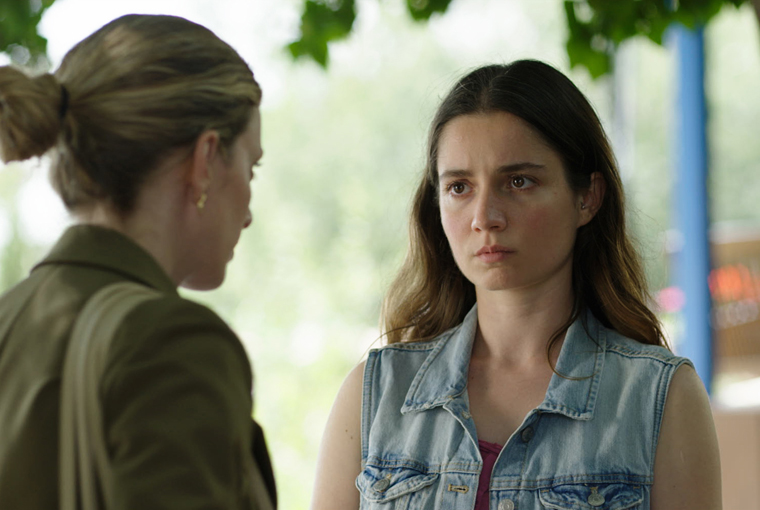
Society has a lot to say about motherhood and chances are that if you’re a new mother, everyone around you will make their opinions known, assessing your small successes and big failures with discomforting ease. This is the kind of scenario Filiz (Bige Önal), the protagonist of Turkish director Emine Emel Balcı’s sophomore feature I’m Here, I’m Fine, finds herself in. In the film’s opening scene, Filiz roams around a big, empty house, picking at the white wallpaper that’s peeling in slithers; her attire and the briefcase in her hand suggest this is her workplace – the occupation of a real estate agent. It’s easy to notice her professional composure waning, even this early on, as her eyes dart up and down the mansion staircase with two male clients at the top and in a quick but desperate move, she deftly removes her bra without even unbuttoning her shirt, to aid the deal. What she doesn’t take into account when resorting to such a trick of visible femininity, is that her breasts may start lactating in an offensive reminder that she’s a mother first, and only then a woman.
I’m Here, I’m Fine, which had its international premiere as part of Thessaloniki International Film Festival’s Survey Expanded: Fragilities strand, is another example of the recent ‘wave’ of films about new mothers and postpartum depression, joining the likes of Salve Maria (dir. Mar Coll, 2024), Nightbitch (dir. Marielle Heller, 2024), and Die My Love (dir. Lynne Ramsay, 2025) – all films by women filmmakers whose female protagonists defy all societal expectations, be it with their actions or simply intentions. Positioning an anti-social heroine in a Turkish context is a high stake for I’m Here, I’m Fine, but the film finds its own way to rebel against representational norms. Instead of thoughts of infanticide, human-animal transformations, or nervous breakdowns, Balcı’s film puts forward a lonely and misunderstood woman who finds new meaning in helping another woman. Şule (Elit İşcan, who starred in Deniz Gamze Ergüven’s 2015 film Mustang) appears only in the second part of the film, but her plight, even though left ambiguous, becomes the most important thing for Filiz.
It’s an unexpected move on behalf of the writer-director to endow a secondary (female) character in trouble – as Şule’s subplot suggests domestic violence – with the role of a savior, but the script makes the shift work in its favor. By dislocating the central significance of motherhood, the film offers the protagonist a way out of postpartum depression, crucially without simplifying the transference or its implications. In other words, I’m Here, I’m Fine succeeds in being both a film about motherhood and not, in equal measure. While a lot of postpartum narrative films zoom in on the couple and the challenges it faces, Balcı casts a wider net. Filiz is at times frustrated by her husband, more often with her in-laws and the raucous they bring, to the point where she feels forced to shout out demands of privacy. While this familial enmeshment is to some extent culturally determined, the way it functions in the film sets up a larger societal framework which enables Filiz to want to help Sule, regardless of the dangers that may pose.
The protagonist works in real estate – selling to male buyers and families – while looking to buy a second-hand car for herself so she’s not bound by her husband’s vehicle. That car sale turns out to be fated, since the potential deal reveals to her the situation Şule is in (being forced to sell her own car by her possessive, abusive partner), but what’s more intriguing here is the exchange of properties and assets the two women find themselves caught in. Without making it too obvious, Balcı addresses the patriarchal codes of treating women as properties, and shapes the rest of her film around their rebellion. However, it has to be said that instead of simply ramping up a reactionary feminist plot to criticize modern-day Turkish society, I’m Here, I’m Fine straddles that line very well, with poise and genuine interest in not only its female characters, but most importantly, in the relationships that form between them.


Leave a Comment