

Do What You Can
Srđan Kovačević’s The Thing to Be Done (Ovo što treba činiti, 2025)
Vol. 162 (February 2026) by Zoe Aiano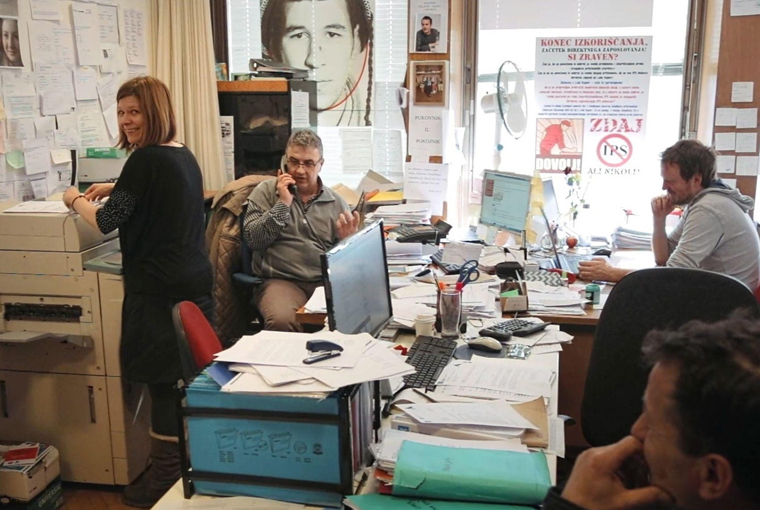
Located at the intersection of the Balkans and the EU, Slovenia is perfectly situated to exploit workers trying to move up the geopolitical pay scale. Srđan Kovačević’s documentary The Thing to Be Done reveals the extent and breadth of the strategies used to underpay or not pay the workforce continually arriving over the border in search of better living conditions, or simply to make ends meet. And this is in the context of a country “so small we could clean it all over night,” as one of the characters observes.
Fighting precisely to do this clean-up is the Workers’ Advisory Office, a cramped and chaotic room from which a team of three social workers – Goran Zrnić, Goran Lukić, and Laura Orel – tirelessly work to inform people of their rights and how to ensure they are respected. As they repeat again and again, they are not a union, they’re completely independent. They also avoid the term migrants – the people they assist are workers, deserving of the same dignity and respect as any other workers regardless of where they come from. Each visitor who turns up at their door serves as a case study of the tricks of the trade that employers leverage to coerce people into accepting unethical and untenable working practices.
The advocates help the employees to untangle the complex bureaucratic webs and encourage them to stand up for themselves. Goran Zrnić in particular, the oldest of the three and Bosnian himself, is a master of the art of tough love. Anyone who seems to be wavering in their resolve is sent to him to be firmly but good-heartedly bullied into taking action. The employers, for their part, are simply bullied. He uses his charisma selectively and is definitely someone you want on your side. In a particularly satisfying scene, he holds up two phones at the same time, resoundingly berating an unscrupulous company representative on one while his client listens in on the other.
The majority of the film takes place in a direct cinema style, with the camera wedged in among the desks of the office, against the constant background noise of ringing phones and heated discussions. It’s not the most cinematic setting but we get a strong sense of the place, and Kovačević manages to make it compelling on an emotional level. Even though most of the workers seeking assistance only appear once, meaning that the dramaturgy is structured across many encounters rather than following the progress of a few, there is a humane quality that captures the poignancy of their predicaments.
On several occasions, we see tough-looking men crying, moments that are handled in such a way that there is no sense of embarrassment or humiliation. Rather, these intimate glimpses hammer home just how great the stakes are for these people and the extent to which their identities are tied to their work and ability to provide. The main narrative strand outside of the office concerns a struggle for workers at the port of Koper who had been trapped in a lower status position, forcing them to work longer hours for less money, in some cases for decades. When one of the men talks about the effect that it’s had on his life and his family, it’s truly devastating. Although normally stoically calm and collected, the advocates also occasionally crack. In one memorable scene, Laura thinks she’s made a mistake that will lead to someone being deported, or rather that will fail to stop them from being deported. Her clear distress highlights both her concern and also the frustrating and exhausting nature of their mission.
The tone is balanced very well throughout the film, shifting between all these states in a way that no doubt mirrors the waves of energy that flow through the course of their efforts. It is also impressive that it successfully sustains interest despite the fact that there is a constant need to explain relatively complex and potentially very boring legal contexts. The merit for this should be divided equally between the protagonists, who have clearly refined the skill of laying out details in a comprehensible way, and the filmmaker, who must have invested a lot of time and patience to be able to catch the right moments to tell the story of this place in all its depth. The weakest part of the film is actually where it’s trying hardest. Juxtaposed with the naturalistic scenes, which make up the bulk of the documentary, are a series of montages set to traditional workers’ rights songs from various places. While it rationally makes sense to emphasize the political stance in this way, and is in that sense commendable for staying true to the film’s underlying ideology, it comes off as slightly jarring and heavy-handed, undermining the subtlety of the other scenes.
There are two obvious morals to be drawn from the film. The first, and depressing, conclusion is that these dynamics of exploitation are not specific to Slovenia and can be found everywhere. The second, offering a glimmer of hope, is that one office and three people can achieve a lot. The Thing to Be Done is a labor of love that pays homage to the social workers’ labor of love, and will perhaps inspire others in its wake.


Leave a Comment