

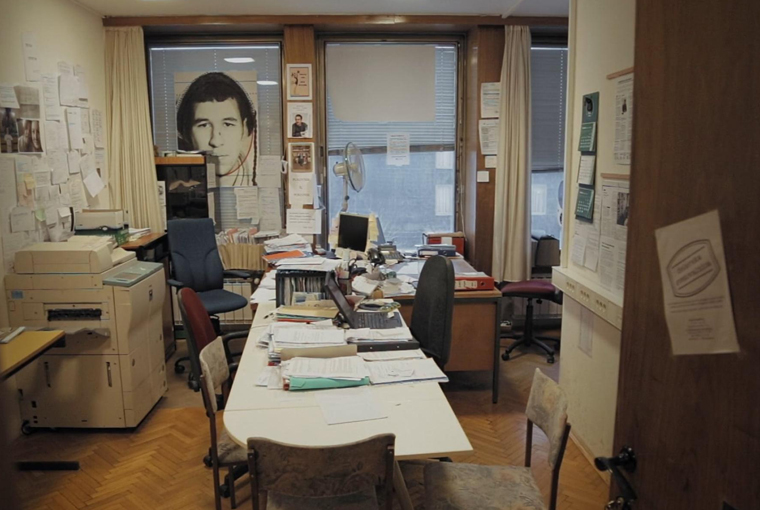
If it has become somewhat of a routine for this journal to cultivate a form of Berlinale bashing (2023, 2024, 2025), this year’s edition of the event played out like a parody. It all started with jury president Wim Wenders stating in a press conference that filmmakers should “stay out of politics.” The comment triggered immediate backlash, and led Arundhati Roy to withdraw from her participation in the festival. The official livestream cut out precisely when the journalist asked a question about Palestine, with organizers later insisting the interruption was due to “technical issues” and denying any censorship. An open letter signed by prominent figures (including Tilda Swinton and Javier Bardem) followed that accused the festival of avoiding to address the genocide in Gaza.
Midway through the event, directors and participants claimed that pro-Palestinian voices were being restricted. Festival director Tricia Tuttle rejected those accusations. The dispute reached its peak at the closing ceremony on 22 February, where several award winners used their speeches to criticize Israel and German policy in the Middle East. One speech by filmmaker Abdallah Al-Khatib described Germany as complicit in “genocide,” prompting a walkout by a federal minister. Political actors and cultural officials responded within days, opening discussions about the festival’s governance and the conditions tied to public funding. Reports circulated that Tuttle would be removed from her position. At the end of the festival, Tuttle remained in office, Abdallah Al-Khatib received a major award for his film as well as a criminal complaint over his speech, and the federal government moved to introduce an advisory forum and a code of conduct for publicly funded cultural events.
It is somewhat ironic that the so-called “political festival” appears to be political only so long as the politics are not happening in its own backyard. In Wim Wenders’ clumsy remark lies an attitude of arrogance. The festival welcomes films from conflict regions when they align with a narrative of Germany as a defender of freedom. But when artistic works turn toward Germany’s own contradictions and political tensions, the tolerance narrows. Heaven forbid that the victims confuse their perpetrators!
Then again, Wenders may have a point, since not all films are like Abdallah Al-Khatib’s Chronicles from the Siege, an account of the daily life, resistance, and survival of Palestinian refugees during a siege. After all, most festival participants appear to “enter politics” out of an unhealthy degree of self-interest, more so, in any event, than to serve the proclaimed cause, whether by provoking jury members, staging protests, or signing open letters. Such signaling not only drowns out the space for real politics, introduced by positions such as that of Mr. Al-Khatib, but clearly also backfires once the government feels obliged to step in. The fusion and confusion between the festival and the German government makes it easier for state officials to read statements on stage as matters of public authority rather than artistic expression, and act on that basis.
Although Tuttle denies that she faces any kind of interference or oversight, it is hard to believe that the members of the “supervisory forum” will not have an impact on the festival’s behavior, in the very least through a kind of Hawthorne effect. Germany’s Kafkaesque laws on antisemitism have already impacted festival participants. Will the Berlinale be able to cater to its different audiences? A firm message about freedom of speech in 2024 would have probably gone a long way. Instead, the festival has chosen to publish statement over statement where the hope is that audiences will cherry-pick what they would like to hear. With the political environment slipping ever steeper into forms of authoritarianism, this strategy of pleasing all sides might have worked this year (giving the award to a Palestinian while downplaying political interference), but it offers little reason to think the festival will ever have the backbone to confront future red lines.
Not far from the Berlinale Palast stands the Maxim Gorky Theater, one of the few remnants of the GDR that, although housed in a building by Prussian architect Karl Friedrich Schinkel, has still kept its East German name. In the early 1930s, Gorky defended Soviet cultural policy under Joseph Stalin by arguing that writers loyal to the system faced no restriction at all. From his position, state control appeared as guidance rather than censorship precisely because it did not affect him. (In today’s German cultural climate, with its authoritarian administrative oversight and selective handling of memory culture, it would hardly be surprising if a bureaucratic body were to question whether the theater’s being named Maxim Gorky still reflects the values of the present, while insisting, of course, that nothing of substance is being curtailed.) Gorky felt no restrictions as long as he remained in line with power. As for the Berlinale, its new code of conduct appears to make such conformity a condition for taking part.
***
For her coverage of the recent Trieste Film Festival (16–24 January), Margarita Kirilkina reviewed Yulia Lokshina’s Active Vocabulary, which reconstructs the story of a teacher from a Russian village forced into emigration, and Vytautas Katkus’ The Visitor about a man who revisits his old home for business yet finds a new sense of belonging. Martin Kudláč saw Better Go Mad in the Wild, Miro Remo’s poetic winner of Karlovy Vary’s top prize last year about two unequal twin brothers. At DOK Leipzig, Zoe Aiano caught Srđan Kovačević’s The Thing to Be Done about a group of people battling labor exploitation. Finally, we are publishing Jack Page’s review of Nastia Korkia’s debut feature Short Summer, in which a child visits her grandparents in the idyllic Russian countryside and finds traces of war and destruction.
We hope you enjoy our reads.
Konstanty Kuzma & Moritz Pfeifer
Editors
Note: Due to delays in our publication schedule, this issue was published in the month of March 2026.

Leave a Comment