

“Turns Out the World Looks Different From What I Thought.”
Emi Buchwald’s No Ghosts on Good Street (Nie ma duchów w mieszkaniu na Dobrej, 2025)
Vol. 166 (Summer 2026) by Jack Page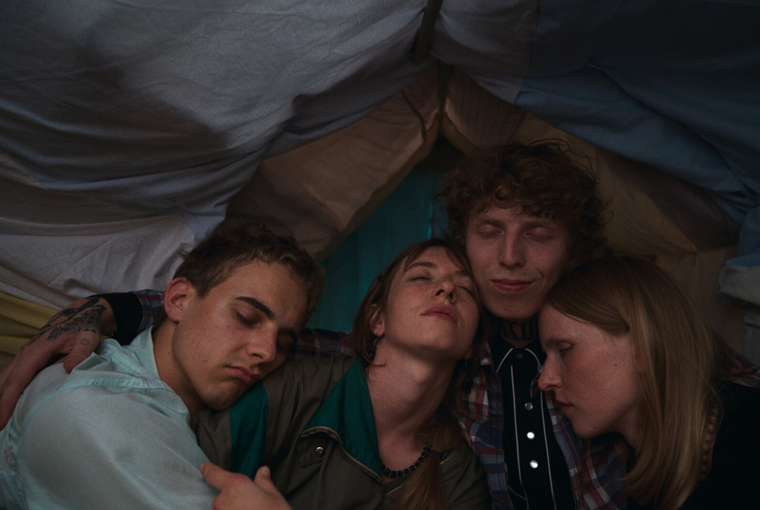
Four siblings arrive at a pivotal moment in their lives as they border adulthood, navigating their own sense of independence alongside their familial needs for one another. But as they seek to carve out their own individual paths in life, they risk distancing themselves from their inner circle. The bond between these brothers and sisters can be lifesaving, but the reliance upon one another is also self-destructive.
Jana (Karolina Rzepa) is the eldest sister, motherly and protective of her other siblings. She is often the child that takes the most collective responsibility for the group and is forced to act as the boring voice of reason. Nastka (Izabella Dudziak), her younger sister, is feisty, rebellious, and impulsive. She describes their family as “a four-person mass” and longs for autonomy, exclaiming “I’m done thinking about myself in the plural!” Franek (Tymoteusz Rożynek) is the eldest bother, a disassociated youth who worries his siblings with his drug abuse and self-harm. Conversely, the youngest brother Benek (Bartłomiej Deklewa) simply feels too much. His awkward neurosis and juvenile vulnerability require vigilant surveillance from Jana and Nastka.
Their dynamic is one of chaotic solidarity. Their unwavering compassion for one another cuts through the bickering, tantrums, and dramatic displays of hysteria. In fact, there is a shared acknowledgement between the siblings that seems to predict the shift in attention, trauma, or responsibility. Their hive mind knows when it’s someone else’s turn for affection or when a family member needs a little more help than the rest of them.
When Jana’s art exhibition is destroyed in an electrical fire, Nastka and Benek take it upon themselves to assuage her pain and exhaustion by taking her for a long drive. As she sleeps soundly in the backseat of the car, it is revealed that the family has a long-running history of mental illness and this is Jana’s third mental breakdown.
After Franek’s attempted suicide, both Nastka and Benek reach out to their brother but in dramatically different ways. Benek writes a handwritten letter for Franek to read in the bathtub. It is an overly sentimental note that describes the sadness he feels since his brother has become so distant. Although coming from the heart, it is verbose and mawkish and Franek reads it with a disaffected stare. Nastka, on the other hand, spontaneously ditches her date on the way to the cinema, sprinting into a car park only to erupt in a ballistic and damning speech over voicemail. She calls her brother selfish and foolish, imparting a deluge of insults and tough love.
After a number of frequent anxiety attacks, Benek seeks medical advice from a cardiologist and a therapist. When the results are inconclusive, he asks Jana for counsel. She explains that it could be the work of a “Worror,” a ghoul that sits on victims’ chests in their nightmares and that the only way to banish the evil spirit is by inviting it to breakfast. Following his sister’s instructions, Benek returns to his parent’s apartment on Good Street to exorcise his demons. Upon his arrival, billowing white bedsheets are draped across the chairs, tables, and armoires. These anemic objects lend the interior a ghastly sterile atmosphere, dispelling any fond memories the rooms once held. Stripped of their color and function, the spectral masses have become dead artifacts of the past. Makeshift ghosts line the hallways and corners in an emblematic haunting of the flat. At the breakfast table, Benek shares a cup of coffee with a golem. They sit in silence smoking until the monster exits the premises as Benek ushers the creature out the front door.
Since Jana’s art exhibition was burnt down, she moves the venue to her parent’s apartment on Good Street. Her introduction describes the art piece as a “playground for your struggles.” The rooms are transformed into makeshift forts accompanied by various atmospheric sound recordings. The intention of the artist is to build an immersive and interactive environment but also a therapeutic one. Jana defines her ideology thusly: “Whatever the emotions are within us, here you can treat them more like clouds gliding across the sky rather than the ghosts that can possess us at any moment.” Ghosts are an apt metaphor for traumas. Both can be haunting presences in our lives capable of great pain and suffering. Yet they can also be ephemeral and unknowingly we chose to give them as much power over ourselves as we deem fit.
The final sequence of the film is a 360-degree pan around Jana’s manmade fort in their parent’s bedroom. The walls consist of knitted blankets and old bedsheets with patterns familiar and nostalgic to the siblings. There is an element of safety in the womb-like structure with the chirping of birdsong and muddy footprints in the background. The space is like a living memory, radiating the comfort and adventure they shared when playing together in the forest. Inside, the four siblings are arranged in a cluster of arms and hands. Their heads rest against one another’s shoulders in a clumsy yet affectionate embrace. The composition of their pose is figurative, wherein the shared weight distribution of their body parts allows them to stay balanced together in their ensemble. Leaning equally and harmoniously against their fraternity, the siblings have found a unity that quite literally keeps them upright.
Leave a Comment