

Clouds Contre Clouds
Andrey Zvyagintsev’s Minotaur (2026)
Vol. 166 (Summer 2026) by Anastasia Eleftheriou
Not so much because of its title, Zvyagintsev’s return to Cannes took on a mythological dimension. Following a severe post-COVID coma that led many to assume the end of his filmmaking career, the director, now residing in France, presented Minotaur in competition at the festival. Of course, the film’s title does invoke Greek mythology while the story adapts Claude Chabrol’s Une femme infidèle (1969), in which a husband kills his wife’s lover, and the murder revamps the couple’s ailing relationship. Unlike Zvyagintsev’s earlier works (Leviathan, The Return, Loveless), Minotaur is an explicitly transnational production (France, Germany, Latvia).
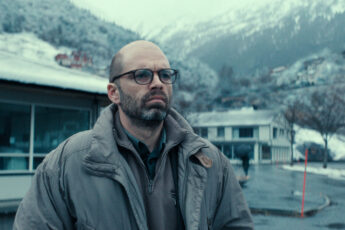
Although it was shot in Latvia, the story takes place in an unnamed but contemporary Russian city. The political context of war emerges only indirectly through television reports about the war in Ukraine and billboards in the background on the streets. Gleb Morozov (Dmitriy Mazurov) is the CEO of a transport company with local power and influence. Emotionally opaque, he spends most of his time at work. At home, in a generic upper-middle-class villa in the woods – a modernist compound in cool colors that could be anywhere really – his wife Galina (Iris Lebedeva) appears to care for their teenage son while spending most of her days alone at home, on her cellphone, or making small trips to the nearest town while depending on her husband’s car in what seems to be a rather boring and lonely daily life.
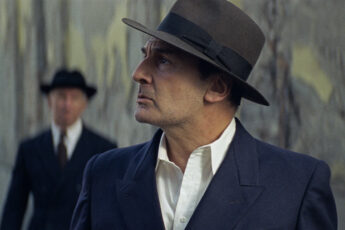
Gleb suspects that Galina’s daily trips into town conceal an affair. His suspicions prove correct: she is involved with a divorced photographer. Gleb sets out to confront and kill him, after which the film follows the disposal of the body in patient detail. If this were the whole story, it would be a faithful remake of Chabrol’s film, in which a domestic tragedy unfolds in much the same way, although in the French film the lover is a writer rather than a photographer. Zvyagintsev therefore shifts the metaphor toward image-making and representation rather than intellectual life when Gleb kills the young photographer by striking him on the head with his own camera. Both films offer little psychological distance or moral comfort, and despite the evident pointing to patriarchal structure and violence, we are not invited to empathize with any member of the privileged couple.
Chabrol’s film is a critique of France’s postwar suburban bourgeoisie, where betrayal and violence seem to be the only forces capable of breaking emotional stagnation. The film ends with the husband being arrested, although we do not see it happen. We only see him tell his wife, “I love you so much,” and understand that she will not testify against him despite possessing evidence of his crime. The ending leaves room for multiple interpretations, in particular the film’s patriarchal claim that violence is a necessary ingredient for the survival of romantic life. This ambiguity is also shown cinematographically: the final image rests on the wife and son as Charles walks toward the waiting officers and glances back, the camera pulling away while the zoom lens closes in on them, the family at once receding and pressing closer.
Minotaur goes further. A parallel narrative unfolds as political allegory. Alongside other businessmen, Gleb is summoned by the mayor and asked to provide the names of fourteen workers to be sent to military recruiters, men who will then be dispatched directly to the front. Gleb knows the request is not optional, but his business depends on its workforce, so he devises a strategy to satisfy the demand by sacrificing innocent people while protecting his employees and, ultimately, his own interests.
The officers investigating the murder of Galina’s lover come across evidence that would solve the case, but they cannot pursue the investigation because higher authorities have instructed them to ignore it. The same war that forced him to hand over his workers now conceals his crime, since a missing man alarms no one in a country that feeds its young to the front. The contrast with Chabrol turns on whom the state protects. Chabrol leaves the marriage unresolved, but not the crime. Zvyagintsev retains the structure and removes the reckoning: his murderer is never in danger because the apparatus that should judge him would rather go to lunch.
By the end of Minotaur, the reconciled couple travels to Crete – a return to the original setting of the myth. Upon landing, their son photographs the cloudy sky, then renders the image in black and white through a filter and shows it to his parents. Two readings emerge, though they do not seem contradictory. There is no punishment for the crime; the murdered photographer-artist returns symbolically through the son to haunt Gleb’s guilt. Or the Mediterranean sky resembles a battlefield, each cloud suggesting an explosion, haunting the couple’s performative happiness. In either case, the message is clear: Gleb’s actions are an inherent mechanism of Russia’s corrupt and violent system, and protecting his job and his family – and therefore, by extension, his country – requires violence and cowardice. Russia’s future, like the couple’s, is doomed either to live with its guilt or to fear revolution.
Unlike Zvyagintsev’s earlier work, and unlike Chabrol’s, Minotaur builds meaning primarily through political allegory. This precision risks imprisoning the film within a specific historical moment, and the viewer within a single reading. The mayor’s office, decorated with a portrait of Putin, leaves little room for ambiguity. Yet within the Russian cinematic tradition, observational cinema can exceed allegory. As Tarkovsky, from whom Zvyagintsev continues to borrow, suggests in his notion of “sculpting in time,” cinema can transcend the moment and open onto a more universal space. This is why Leviathan, operating more as metaphor than allegory, remains so enduring: its temporality is unstable, its political references diffuse. Its ambiguity strengthens its political force rather than weakening it.
In these times, there is increasing pressure for filmmakers to state their positions clearly and increasing frustration when they do not (see Fjord). This expectation is itself worth questioning – especially when clarity is demanded by audiences embedded within the very systems being criticized. Who, in the end, will watch Minotaur without already knowing that Russia is a corrupt hellhole? And if the aim is to draw a parallel between bourgeois domesticity and complicity in criminal societies, why are we not given more space to see this more universally and to reflect on our own societies as well? Is it because the director, exiled in France and financed by French institutions, carries his own hesitation about what he is expected to say through the film – and therefore seeks to eliminate ambiguity? After all, in France, the murderer is arrested!
Whatever the answer, the contemporary critical demand for explicit political positioning in cinema raises methodological questions. The expectation of legibility risks reducing film form to discursive statement. When Godard’s dialectical montage in Notre musique, for instance, stages the Israeli-Palestinian conflict through champ-contrechamps photographs, he does not resolve the tension through didactic clarity. Perhaps the clouds over Crete should stand neither as a hint at the resurrection of art killed by authoritarianism, nor as the bombs dropped by Russia on Ukraine. Perhaps they are both – and perhaps something else emerges as well: in the comfort of ‘our’ European plane seats, we gaze at a seemingly endless sky. But beyond our subjective frame, the only smoke that reaches Crete from across the Mediterranean is the smoke of bombs burning Gaza.

Leave a Comment