

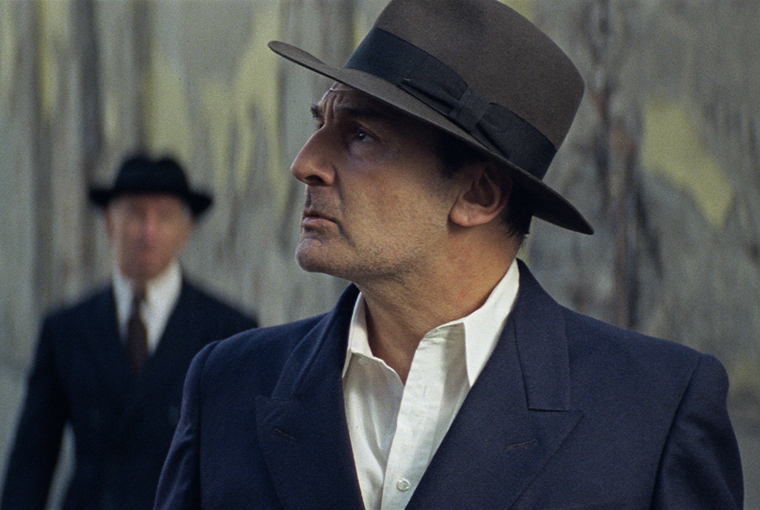
Closer to the mainstream than he would ever admit, László Nemes recounts the final years of French Resistance leader Jean Moulin in a ‘French’ film that falls into all the clichés the director of Son of Saul had previously resisted with persistent – and not insignificant – arrogance throughout his career.
Not that it particularly matters to anyone that the film is more cliché than novelty, since Moulin is, both in appearance and in essence, a commissioned film rather than a ‘dream’ project for László Nemes – a director who at least in theory seems ideal for the task, having been identified with World War II mainly due to Son of Saul, the film that introduced him to the international stage and brought him huge success back in 2015.
Even among those who remain skeptical of the overwhelming experience that Son of Saul undoubtedly was, few would disagree that Nemes’ decline after that film has been just as, if not more, spectacular. Only three films later (including Moulin), the aura of Béla Tarr’s former assistant – who once appeared as the whiz kid / savior of European poetic cinema – has faded faster than the collective memory his films supposedly aim to awaken.
The repetition of the aesthetic motifs of Son of Saul (claustrophobic framing, obsessive focus on the central figure, constant ‘human-like’ movement of the camera, the blurred background etc.) proved remarkably ineffective in Sunset (2018), while the ambition to overturn traditional linear storytelling and emotional engagement made Orphan (2025) ultimately resemble a Hollywood film shot by a self-exiled Central European director working in America.
Meanwhile, the not-so-orphan Nemes – who has been adopted by France – has grown into a director who constantly rails against the contemporary film industry, modern cinema, and even alleged antisemitism that supposedly cause his films to be ignored by juries in film festivals and distribution companies worldwide. He thereby adopts a posture of victimhood that he imposes, consistently and self-importantly, on most of his characters.
His return to World War II, after two detours dedicated to both pre-World War I Budapest in Sunset and post-Hungarian Revolution Hungary in Orphan, does not bring him back to the tight framing of Son of Saul, but instead turns out to be a more mass-appeal film that continues, almost mathematically, his decline. Despite its proven visual craftsmanship, and one might even say historical necessity, with France again on the brink of a far-right government, Moulin is a film that bears the marks of a typical, lifeless biopic that speaks louder than it resonates, and in its constant attempt to escape genre clichés, ends up burdening itself with even more of them.
Divided into two distinct parts, with the first – shorter one – also being the more interesting of the two, Moulin opens like a wartime spy thriller set in occupied France, with the ‘hero’ of the story parachuting into French territory, ready to unite those who will resist the Vichy collaboration government and ultimately Nazism. Any resemblance to Jean-Pierre Melville’s masterpiece Army of Shadows (1969) quickly fades once Moulin is arrested after a series of leadership disputes, clandestine meetings, and underground operations, and is transferred to Gestapo headquarters in Lyon.
What initially feels alive and absorbing, with figures constantly in motion, swallowed by cigarette smoke, dim light, secret encounters, and the charged energy of resistance, gradually gives way to a surprisingly flat interrogation drama (if that can even be called a genre), with Moulin facing the notorious Klaus Barbie, the “Butcher of Lyon” – a not entirely unexpected plot twist which, under normal circumstances, would have opened the curtain on a gripping man-to-man performance between the two. Instead, the film settles into a familiar pattern, as Nemes leans heavily on the depiction of torture and, paradoxically, despite his expertise, fails to take advantage of the interior spaces of the prison cell and of Barbie’s office to create a truly claustrophobic atmosphere.
At the center of it all, the real question and perhaps the one that most closely touches the film’s larger ambition (which ultimately is smaller than the name it is attached to both in front and behind the camera), is that of identity. The identity Jean Moulin hides from Klaus Barbie in order not to reveal his real name and thereby risk exposing information that would fatally harm the work of his comrades still out there. Moulin plays roles and adopts identities, partly real, the most intriguing of which is that of a decorator, in perhaps the film’s most unexpected but underdeveloped scene of attraction between torturer and prisoner, where Moulin sketches how he would turn Barbie’s office into a bedroom.
The viewer never truly learns who Jean Moulin was and above all why he was a resistance leader, just as we never fully learn the story of Klaus Barbie, though one can gather aspects of his character given that Jean Moulin was his most ‘prestigious’ prisoner. Nemes aims not only to present both of them as ‘ordinary’ individuals who simply chose sides, but also to detach them from their historical dimension, maximizing their identities into archetypes.
The conflict between them – the film’s only real spectacle – is framed as a confrontation between absolute good and absolute evil. Yet the more the characters are forced into this archetypal structure, the more hollow they become.
Moulin fares slightly better, partially demystified into a modest, human figure who resists only because he knows he will eventually break under torture – played by Gilles Lellouche with restrained understatement rather than ‘star-like’ heroic grandeur. Barbie, on the other hand, is reduced to a grotesque caricature we thought belonged to a (cinematic and especially television) era long forgotten, a Nazi functionary reduced to rage and brutality – Lars Eidinger’s performance here becoming a cautionary example of what to avoid when portraying a Nazi (or the ultimate evil).
As the torture of Moulin escalates, from sadistic psychological games to physical cruelty, Nemes, you can sense it, even despite of an ‘in your face’ ear-biting scene, tries to resist slipping into exploitation, revealing his first clear concession to mainstream storytelling. Yet even when Nemes restrains himself, resorting to implication rather than visual exposition, traces of excess remain, notably in the heavily mastered sound design.
Other compromises are equally evident: despite the constant shouting, there is little real dramatic tension; unlike the hardcore focus of Son of Saul, here the camera looks at the surrounding space in a conventional way, without any interest in the elements that envelop its central protagonists; scenes alternate like detached episodes in a diary of a condemned; the appearances of female characters are, to use a euphemism, somewhat ‘problematic’ (they either appear as symbols of male desire or as casualties of male behavior) and the film, lacking a center of gravity and ultimately soft in its own harshness, concludes without having moved even an inch beyond its stated aim of not being a mainstream French heroic film about the leader of the French resistance.
Each time Nemes tries to distance himself from the typical biopic – or, in this sense, hagiography – he moves closer to a conventional retelling of the story, whose greatest vulnerability lies not in its failed meta dimension of a mainstream film made with auteurist ambition, but in the fact that in the end it’s a pompous and lifeless film.
Shot on 35 mm (and screened in the same format at its Cannes premiere, as was Sunset in Venice back in 2018), Moulin is aesthetically striking, compelling the viewer to call it ‘beautiful’ even as it depicts horror. Yet, beyond its grain and carefully crafted lighting that embraces the muddled atmosphere of the 1940s (kudos to László Nemes’ longtime director of photography Mátyás Erdély), it goes no deeper than its own extended runtime. Ultimately the film is unable to reveal the man, hero, or anti-hero behind Jean Moulin, or, even worse, the ecumenical and timeless urgency of his martyrdom.
In continuing his obsessive role as a formalist ‘historian,’ Nemes ultimately empties both history and form of their substance. Jean Moulin’s story feels more powerful on Wikipedia, and form alone has never been enough to sustain a film that attempts to portray a hero without heroism, to teach (or warn?) contemporary France without revealing anything beyond the obvious. With Nemes entrusted with the project as a World War II ‘specialist,’ the film might ultimately have worked better in the hands of a more conventional French director, someone who would dare to look up the story of Jean Moulin with both less distance and more risk, but also the willingness to accept that there is nothing inherently wrong with making a heroizing film about a hero. Especially, when compared with a mainstream commissioned film that constantly tries to prove it is something else.


Leave a Comment