
A Political Allegory Lost in the Process
Mihai Mincan’s Milk Teeth (Dinți de lapte, 2025)
Vol. 169 (November 2026) by Antonis Lagarias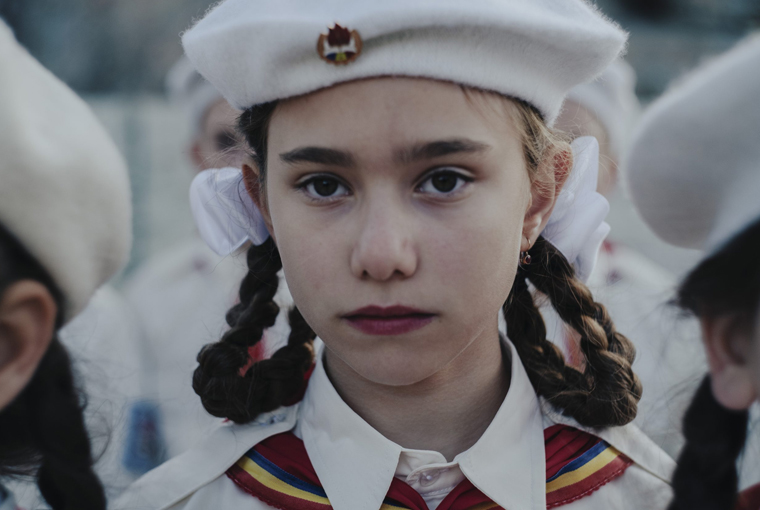
Domestic and social drama, sparse dialogue, a camera following the expressionless face of the main actor or actress across various locations, a serious tone, austere realism with the occasional ‘poetic’ and dream-like shots, views of landscapes, faded color grading: it is easy to identify narrative and aesthetic tropes that characterize the so-called “festival film.” The term, widely discussed in both the press and in academia, describes a cinematic genre in its own right.1 These films often feel similar to one another, with viewers thinking they have seen the same film twice, or at least some of its scenes. One of the main unifying elements of such films is their funding structure. With national film centers financially collapsing in many countries across Europe, co-productions often become a requirement for unlocking European funds, resulting in international script residencies, pitching events at film festivals, supervision by expert committees, shooting locations spread across different countries, and productions split into multiple parts. The unspoken truth is that for funds to be secured across all the different partners and committees, the film project needs to satisfy multiple different agendas all at once. Sometimes, this may not be a serious problem. At other times, this may be the reason behind the abovementioned uniformity, with films appearing to lose their spark somewhere along the way.
Milk Teeth, a co-production between Romania, France, Denmark, Greece, and Bulgaria that screened in Venice’s Orrizonti section, arguably belongs to the latter kind. The film’s opening scene silently stages the turning point that drives the rest of the plot. Maria (Emma Ioana Mogoș), age ten, is playing with her friends in a green field among grey apartment blocks, in 1989 Romania. She sees her sister, Alina, who is carrying a bucket full of walnut shells to the trash can. The camera closes in on Maria’s eyes: this is the last image she will ever have of her sister. Alina inexplicably disappears and the parents’ efforts to find her fail. The rest of the film follows Maria as she grows up in a world that has just become drearier. Director Mihai Mincan describes his film as an attempt to convey a “feeling of loneliness.”2 Maria wanders around the empty house, playing or eavesdropping on the adults’ discussions of the ongoing investigation. Together with her friends, she goes looking for her sister herself. At night come feverish nightmares triggered by stress related to both her sister’s disappearance and what gradually turns out to be the collapse of the Communist regime – it’s 1989 after all. On paper, the film sets out to explore how a tragic coming-of-age story may intertwine with the wider repercussions of the Romanian Revolution, connecting the personal and the political in less expected ways. On screen, except for its detailed sound design and some atmospheric visuals of green fields and abandoned factories, it largely amounts to a collection of ideas translated into short scenes within a loose narrative and formal structure.
Take, for instance, one of the first sequences after Alina’s disappearance. Maria wakes up and reaches for the space next to her, where she finds nothing but a pillow. The next shot shows her staring at the walnuts in the kitchen, an object now forever associated with the memory of her sister. In what is presumably a game they used to play together, she knocks on the wall, but now there is no answer from the receiving end. The last shot shows her touching a picture of her sister. All four consecutive scenes point to the same feeling – absence – yet stacked together they become redundant. What was presumably meant to be poetic and evocative turns into a heavy-handed metaphor. One wonders how, after years of development, the final cut still settles for such a repetitive structure.
In fact, metaphors keep recurring throughout the film, especially when it comes to the period’s politics. When Maria and her friends explore an abandoned factory, looking for clues that could lead to Alina, an old radio echoes through the empty corridors, praising a socialist workers’ utopia. The children do not seem to hear the radio. Its sounds are reserved for the audience, to signal the gap between political utopia and a collapsing reality, an irony the film underlines with sound rather than trusting the viewers to notice it on their own. Later, in a dream-like sequence, Maria is chased by a photographer who turns out to have secret pictures of her and her sister. As Maria flees, she finds herself in the ruins of the same factory (or at least a similar one). What guides her to safety is a walnut, glowing with light. The trope is familiar: generate images as a stream of thought where trivial everyday objects become metaphors or acquire metaphysical qualities. The walnut here becomes a token of her lost sister, still guiding her from afar. The photographer, on the other hand, is perhaps the afterimage of a crumbling surveillance system built to pursue political dissidents, a system that, by 1989, had also failed. This scene, like the pillow, the walnuts, and the wall before it, is meant to function as a poetic exploration of the inner state of a traumatized child. None of these connections, however, have any real consequences for the characters. Setting the story in a politically charged period only functions as a clin d’œil for festival audiences expecting to see political films. Otherwise, the link between the period’s political turmoil and Maria’s story is hardly noticeable.
Another scene shows Maria in the room of a girl from the neighborhood who claims to know something about Alina’s disappearance. The girl’s room, filled with objects and even a slice of Chantilly cake, evokes wealth, in contrast to the modest means of Maria’s family. She even has a record player. The two girls dance together to Gershon Kingsley’s “Pop Corn,” but once the girl starts treating Maria condescendingly, offering what seem to be lies about Alina, Maria storms out of the room. The scene attempts to explore an aspect of social hierarchy under the Communist regime, with the girl from the neighborhood assuming a position of power over Maria, displaying her wealth and trying to manipulate her. Maria rebels. But, as before, the scene presents just one idea among many, a glimpse of social stratification that does not seem to lead anywhere.
Of course, not every film set in 1989 Romania needs to be obviously political. Yet everything, from the director’s statement to in-film references such as the dates printed on screen, shapes expectations of a political story. In his statement, Mincan describes Maria as standing for what he calls the “lost generation of children,” for whom the revolution never delivered what was promised.3 By the end of the film, though, this pretense remains unexplored. What did Maria and the children of this “lost generation” really want? How did the revolution change them? These questions go unanswered. The only clear idea comes in the final scenes, where Maria and her father seem unable to communicate anymore, pointing to a growing generational gap. If Maria’s story is supposed to function as a metaphor for an entire generation, the film is too vague to say anything specific about 1989 Romania.
Incoherence is not only thematic but aesthetic as well. On the one hand, the costumes, makeup, and hairstyling all strive towards some kind of realism, to convey a plausible image of what the period ‘looked like.’ On the other hand, the cinematography belongs to a more distanced kind of cinema: extreme close-ups of details and unnatural framing in the dialogue scenes make everything look cold and analytical. As a result, most of the scenes come across as staged theater, or as a kind of re-enactment, as if drawn not from reality but from a photograph that has faded with time. Handheld shots with children playing and running occasionally break this pattern, yet these moments are few and scattered across the edit, feeling like an alien element at odds with the rest of the film’s formal structure. Otherwise, the film is full of slow, repetitive camera movements closing in on the actors’ faces, lingering for long seconds at a time to convey an inner struggle. This mise en scène constantly prevents realism from emerging, which even the strong performances cannot avert.
Yet European film critics seem thrilled: “It’s a great example of filmmaking that takes its time to process, ponder and elaborate on events without having to pack its scenes with high-octane action.”4 This opposition – slow equals good, action equals bad – is of course reductive. Slow-paced films can indeed be contemplative and meditative and, if done right, rarely feel repetitive or boring. Likewise, fast-paced films are not necessarily superficial. That a contemplative argument is used to justify the film’s problems of pacing says more about a certain festival criticism that tries to convince readers that some films are masterpieces, just too intellectual to be understood by ‘non-savvy’ audiences.
Admittedly, making a film that is at once intimate and political, realist and poetic, is no easy task. In the end, Milk Teeth struggles to come together as a whole. Further, being a co-production between multiple European countries, one can imagine, while watching the film, the different strings that pulled it in so many conflicting directions. All the right boxes have been ticked, both in terms of narrative (there is the political setting, a family story, a generational allegory) and style (slow-paced auteur cinema, poetic contemplation), yet here form and content are but loosely connected. Perhaps Milk Teeth is a case in point, exposing the limits of the kind of transnational European-style cinema that festivals expect to see. So much effort appears to have gone into securing funds and pitching to committees that there was no time to properly develop the film itself.
- Falicov, T. L. (2016). The “festival film”: Film festival funds as cultural intermediaries. In M. de Valck, B. Kredell, & S. Loist (Eds.), Film festivals: History, theory, method, practice (pp. 209–229). Routledge. ↩︎
- Orciari, V. (2025, August 31). Mihai Mincan • Director of Milk Teeth. Cineuropa. https://cineuropa.org/en/interview/482744/ ↩︎
- La Biennale di Venezia. (2025). Director’s statement. https://www.labiennale.org/en/cinema/2025/orizzonti/din%C8%9Bi-de-lapte-milk-teeth ↩︎
- Orciari, V. (2025, August 29). Review: Milk Teeth. Cineuropa. https://cineuropa.org/en/newsdetail/482647/ ↩︎
Leave a Comment