
The Discipline of Looking
Martin Kollár’s Chronicle (Letopis, 2025)
Vol. 160 (December 2025) by Natalia Ashurovskaya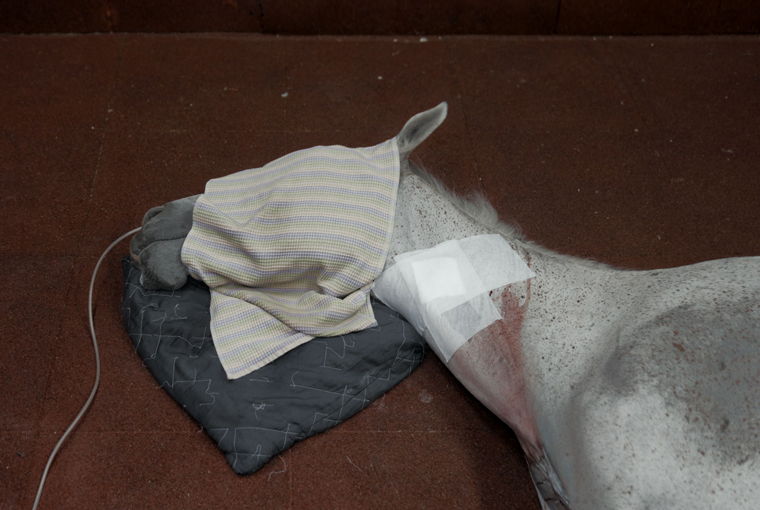
Can documentary cinema today afford the luxury of being unintelligible? Almost every contemporary film strives to clarify something, to build an argument, to propose a clear thesis. Martin Kollár’s Chronicle begins with the opposite gesture: instead of explanations, it offers pure observation, leaving the search for meaning to the viewer. This is neither an aesthetic game nor evasiveness, but a position. Kollár eliminates commentary, interviews, and direct speech. He does not specify locations, does not connect events through cause and effect, does not lead us toward conclusions. Instead of giving us understanding, he gives us the gaze, the point of view.
At the Jihlava International Documentary Film Festival, where the film was featured in the Czech Joy section and received the award for Best Cinematography, the screening provoked a particular kind of silence in the room. It was not the heavy silence of shock, but the concentrated quiet that appears when viewers understand they are not being led anywhere. Kollár does not provide a thesis; he offers us images and trusts them, and us, to do the work.
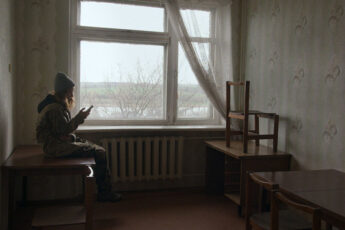
This decision becomes clearer if we remember that Kollár is first and foremost a photographer. His way of seeing and narrating is shaped not by the logic of montage or dramaturgy, but by the composition of the frame. He trusts in the intrinsic value of the image: he does not explain a gesture but records it; he does not interpret space but selects the distance and angle between camera and object at which meaning arises from formal features themselves. This photographic optic determines the rhythm of Chronicle: each episode exists as an autonomous visual fragment – a found scene that requires neither causal justification nor insertion into a sequential plot. The film is composed of discrete observations: rather than making one another intelligible, they gradually accumulate, forming a structure of perception as opposed to a story in the conventional sense.
The film begins with a hunter patiently sitting in a shelter for an extended period of time, lost in the winter landscape, then raising his rifle and aiming into the empty whiteness. No shot follows; we move to the next frame-scene. Now we see a lifebuoy being carefully pulled out of a hole in the ice on a frozen river. We know nothing about whom it was meant for, what happened, and who was involved in the response. Then we see a horse – a massive, heavy body – slowly, almost theatrically collapsing onto its side under anesthesia. The movement is stripped of all dramatization: no panic, no commentary, no explanation of what had happened to the horse, who is treating it, or how the procedure will continue. Kollár captures only the moment of the fall – as a pure physical fact, a gesture that holds within it both care and helplessness, and the strange, frightening beauty of the passage from consciousness to unconsciousness. The plot does not continue. We move to the next frame-scene… In Chronicle, everything that could become drama exists in suspension: a possible story appears, but does not unfold.
Kollár consistently avoids individual stories: Chronicle has no central character, no biography one might follow, no personal drama capable of structuring the narrative. Instead, there are many small, almost accidental scenes, each of which is devoid of meaning in and of itself. But taken together, they begin to form the portrait of a society. I believe this is precisely why the English title of the film is “Chronicle”: Kollár builds his film according to a logic closer to that of medieval chroniclers than to contemporary documentarians. Medieval chronicles never sought to understand the motivations of characters, to explain the causes of wars, or to describe the inner experiences of witnesses. The chronicler simply recorded what occurred – weather, fires, strange incidents, everyday minutiae – without selecting material according to a criterion of ‘importance.’ It was precisely this absence of hierarchy that turned a chronicle into a mirror of its era that could sometimes turn out naive, but was utterly honest all the same.
Chronicle follows a similar approach. Kollár does not single out what is conventionally considered ‘important’: the film was shot over eight years, and during that time anything that entered the frame was recorded. In the world of the film, no event is more deserving of attention than another. A police raid is captured with the same calm as a boy walking his dog, and a slaughterhouse scene with the same even impartiality as a priest blessing a new building.
This creates a particular sense of time: it does not move forward as it would in classical storytelling. Instead, it accumulates, builds layers, ultimately becoming a visual archive of the state of a society. Kollár is equally interested in people and in their strange, sometimes absurd practices. Between two typical village houses stands a giant snow sculpture of Christ – white, motionless, its arms outstretched. On a stepladder beside it, a man methodically files the icy figure, shaping it. He works with absolute seriousness – as if on something important, undeniably necessary – though the task appears almost absurd. This image contains two layers of senselessness: the man invests hours of labor into a material destined to melt, and simultaneously – in the 21st century, long after science dismantled the notion of a ‘celestial throne’ – he continues to reproduce a traditional religious symbol, as if the world outside had not changed. And it is precisely this double absurdity that makes the scene expressive: within it lie persistence, seriousness, humor, and a deep human need to imbue with meaning that which appears, by all logical signs, to lack meaning. Kollár captures this quiet paradox with the delicacy of an observer who understands that irrational effort is just as much part of human nature as is being driven toward order and rationality.
This radical refusal to explain things changes the viewer’s aesthetic experience. We see a country (never named, yet recognizable as Slovakia) where events unfold as if by themselves: nothing is highlighted as being central, nothing is endowed with meaning – and precisely for this reason, each phenomenon begins to speak more loudly. Every scene is a small logical loop: it shows something but explains nothing; it is formally complete yet open to different meanings. Kollár, unlike classical documentarians, does not strive for a comprehensive picture – he aims instead to reveal the strangeness of the fabric of reality itself, that zone where the ordinary and the absurd become indistinguishable.
Gradually one gets the sense that Kollár is not creating a film about Slovakia but an archive for the future – a collection of images that will one day testify to how we lived, what frightened us, what we did automatically, what absurdities we accepted as being normal. Here the author returns the responsibility for interpretation to the viewer: he does not lead, direct, or persuade. He merely records. His refusal of authorial omniscience is an invitation to co-contemplation. In an era when everyone demands of a director an answer to the question “What did you want to say with this film?”, Chronicle offers a different gesture: look – and accept that meaning is not given, but born only in your gaze.
Leave a Comment