

Between Reality and Narratives
Robin Kvapil’s Change My Mind (Velký vlastenecký výlet, 2025)
Vol. 160 (December 2025) by Natalia Ashurovskaya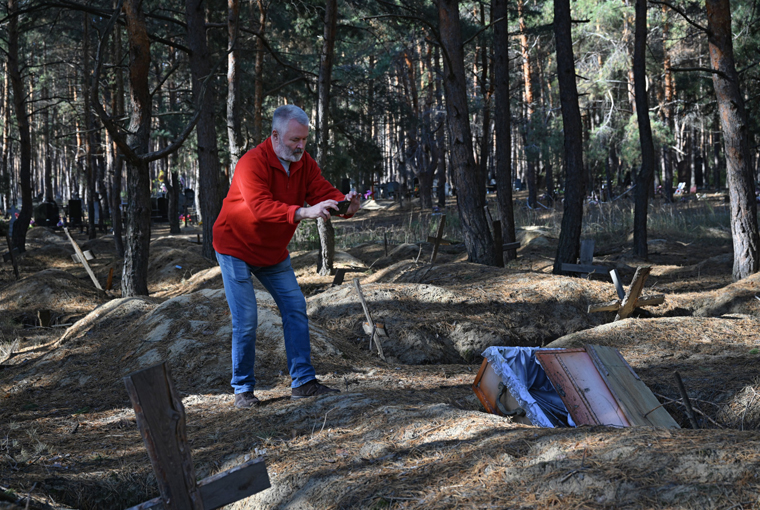
What if you tried to change someone’s mind and nothing happened? Not because the arguments are weak, but because the very idea of ‘persuasion’ is impossible when the realities of different people repel each other like water and oil. Change My Mind by Robin Kvapil is built around precisely this phenomenon, registering it as a gloomy yet undeniable facet of today’s reality.
The film begins with a Czech-language announcement that almost sounds like an ordinary pro-Russian post on social media: “Do you believe that the war in Ukraine is a hoax? Do you think the media lie about the number of casualties and the consequences of the ‘special military operation’? Come to the casting and become the hero of a new film.” Around sixty people responded. Three were chosen – Nikola, Ivo, and Petra, middle-aged Czechs who sympathize with Russia and repeat the Kremlin’s narrative about the war. Together with the director and his crew they go to Ukraine. There, they step out of the space of online comments into a place where sirens sound, rockets fall, and crosses stand over mass graves in the forest near Ukrainian cities.
On paper this looks like a perfect experiment: to confront the fierce confidence of so-called “dezoláts” (a Czech word for pro-Russian-minded commoners) with the indisputable fact of war, killing, and grief. In practice, Change My Mind turns into a film not about enlightenment, but about how monumental beliefs turn out to be, and what unknown powerful force holds them in place.
Kvapil is a recognizable figure in the Czech Republic. He is a theater director, a documentary filmmaker, and a political activist. Several years ago, he helped create a campaign against Miloš Zeman – a pro-Russian, populist president whose decade-long rule became a symbol of polarization in Czech society. Now, after a shift in generations and attitudes, Kvapil speaks openly about how his own liberal faith in “dialogue with everyone” and in the possibility of rational persuasion turned into a trap. He admits that while he and his supporters were endlessly trying to explain and listen, the other side was preparing not for conversation but for war – informational, political, and sometimes literal warfare. This admission becomes the emotional nerve of the film: Change My Mind is not only about the three dezoláts, but also about the collapse of the director’s own illusions.
The word “dezolát” is a term that has firmly entered Czech vocabulary in recent years. It is not a scientific concept but rather a social media nickname born out of polarized disputes after the pandemic and the beginning of the war. The word dezolát, formed from the French désolé – “I’m sorry, but…” – has acquired a specific nuance in contemporary Czech: it refers to people immersed in a world of conspiratorial explanations in the spirit of the claim that things aren’t so clear-cut, of “alternative facts” and pro-Russian narratives. A dezolát is not just someone with a different opinion, but a person for whom personal resentment, distrust of institutions, and a feeling of being unheard form a closed ideological system. As a consequence, they appear resistant to verifiable facts and lived reality.
At the very beginning, the film reveals its main idea: the difference between positions is not a difference in arguments, but a difference in realities. The participants openly self-identify as “dezoláts,” and do so with a certain sense of pride, like the people who claim that they have “awakened” and now see the world “as it really is.” This self-identification makes the film’s task fundamentally more difficult: it is not about accidental ignorance, but about an identity built around negation and resistance to the information sources accepted in this society.
Formally, Change My Mind is a road movie: a minivan with the protagonists travels from the Czech Republic to Kharkiv, Kyiv, Izium, the Donbas, and back. Along the way, the group stops in hospitals, bombed-out neighborhoods, schools moved underground into metro stations. But unlike the classical ‘hero’s journey,’ here there is neither a clear arc of transformation nor catharsis. No one returns as a different person. Each episode is an attempt to overcome an invisible wall, and each collision with this wall leaves bruises and scrapes both on the protagonists and on the director himself.
The film avoids visual pathos. No grand statements, no dramatic editing decisions. The camera records space calmly, almost indifferently. At the same time, the director rejects the tricks typical of social experiments. There is no hidden camera, no editing traps, no dramaturgy of pretending to lead people through stages of realization. On the contrary, the structure of the film is deliberately transparent: the participants know where they are going, they themselves film part of the material on handheld cameras, their remarks are heard without voice-over commentary.
The film doesn’t justify anyone’s position. But it doesn’t fully demonize them either. In each of the three characters portrayed by the filmmaker, something human breaks through from time to time – laughter, fatigue, sympathy, an embrace of a child. That is why it is so painful to hear how the same people, a few scenes later, call a mass grave “propaganda,” and a rocket strike on a hospital “staged.”
The key nerve of Change My Mind is the collision of an undeniable fact with a consciousness that has already chosen what to believe. On screen – real destruction, burned houses, mourning, the wounded, and children studying in the metro because their school above ground is not safe. And yet the mechanism of denial proves stronger.
Again and again, the film captures the same loop. The protagonists see something that logically undermines their worldview. For a moment there is hesitation, a pause, sometimes tears. Then the mind’s protective shield switches on, as if to say: “Well, yes, this is terrible, but désolé, this is… propaganda / staged / both sides are guilty / Russia had no choice.”
Kvapil almost physically shows the limits of proof. Yes, you can bring people to a hospital in Kyiv a couple of hours after a missile strike. You can show them mangled apartment buildings, graves, witnesses. But you cannot force them to abandon a narrative in which Putin is merely defending himself and the West is the main enemy. As some Czech commentators very accurately note, these people’s position is not so much pro-Russian as it is anti-Western: Russia here mainly figures as an antagonist to a despised, liberal state of affairs. In this sense, Change My Mind is not about misguided beliefs, but about a value-based divide. And this divide is one that no facts, in and of themselves, can mend.


Leave a Comment