

Existential Withdrawal
Ivan Salatić’s Wondrous Is the Silence of My Master (Otapanje vladara, 2025)
Vol. 165 (May 2026) by Tajana Kosor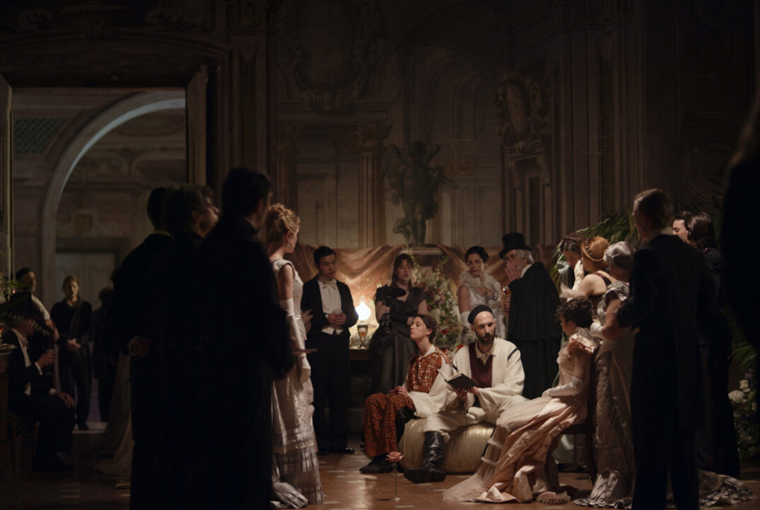
Instead of a Prologue
Ivan Salatić’s sophomore feature, which premiered in Rotterdam’s Tiger Competition in February 2025, is first and foremost a film that embodies a refined and restless form of nostalgia. The director himself describes this nostalgia as prosodically violent, infused with a perennial yearning for transformation. The film traces the protagonists caught in a feverish dream – a tension between the impulse to create a new reality and the inability to fully sever ties with the past. This duality fractures conventional temporal codes, producing a charged space where two lived realities collide and combust, opening up a territory for dislocation and play. In 19th-century Montenegro, the land is isolated, the soil plagued by traditionalism and superstition. While the Ottoman threat looms around the corner, poet Morlak, whose character is based on the historical figure of Petar II Petrović Njegoš, leaves his homeland in search of a cure for an illness that ails him. Upon his arrival in Naples, Morlak (played by Marko Pogačar) falls deeper into his own dwellings under the torment of his ailment, whilst his company – led by the loyal servant Djuko (Luka Petrone) – develops jealousy and rageful spite from feelings of homesickness and alienation.
Although unfolding as a specific chronicle, Salatić’s film resists narrative propulsion in favor of atmosphere and stillness. It is an articulation of a realm where memory, myth, and political imagination assume the same space. At its core, the film operates within the framework of historical reimagination – an evocative but precarious terrain. With every shot, Salatić sets out to reframe the array of the Adriatic coastline of the 19th century through a contemporary lens, thus positioning the film within a speculative tradition of ‘parallel histories’ – in this case of two countries, Montenegro and Italy, but also far beyond their designated landscapes. These parallel histories are not ones that attempt to set the record straight; they ask instead what kind of future becomes possible once we intervene in the past with poetic intent. As with many other films of the same directory, one must pose the question to what extent this exercise is effective if its poetic intent is not immanent in the historical material or properly made visible on-screen.
Linguistic Dissonance
There is much to be admired within the dreamscapes of Salatić’s formal logic and the aesthetic that follows it. The period setting of the film is filtered through poetic and linguistic tendencies that deliberately estrange the historical. They become a focal toy and a gateway for modernism to break and enter – a language neither fully archaic nor modern but invented, dislocated, and broken. Here, fragmented and faltered speech isn’t deemed a failure, but rather a space where comprehension dissolves into a poetry of estrangement: Brechtian Verfremdung, a dialectical rupture painting a sonic landscape of the (re)imagined dream. The film’s visual language is composed with equal rigor. Static shots dominate, evoking the tableau vivant and conjuring the ghost of silent cinema, or even pre-cinematic forms such as painting. There are distant echoes here of Straub-Huillet, perhaps even the work of Sergei Paradjanov; directors similarly concerned with the possibilities of poetic historicism vis-à-vis their lands and beyond. In this register, the landscape does not serve as a setting, but presumes the role of an active participant in the temporal dislocation the film strives for. Salatić’s choice to work with non-professional actors emblems this formal estrangement into the layer of performance. The acting is honest, stripped down, often flat or hesitant, and thus eschews naturalistic illusionism. This deliberate dislocation from polished expression draws the viewer away from empathetic immersion and towards a critical distance. Speech and gesture become indices of power relations and historical residue rather than vehicles of interiority or dramatic motivation.1
The film’s visual architecture further supports this dynamic. The static formal affinities evoke Straub-Huillet’s austere compositions where the image’s stillness holds the possibility of ideological confrontation. These images, frozen in time, function not as scenic decor but as charged sites where subtle expressions and the quiet tension of power unfold. Moments of restrained violence, most notably the sudden eruption of the servant Djuko, derive their force more from the formal tension between silence and rupture than from classical narrative buildup. The language, designed to be neither fully archaic nor entirely modern, easily contributes to a further feeling of estrangement, as does the use of fragmentary dialogue. This formal uncanniness disrupts the film’s efforts to create a space for historical reflection and critical engagement. Instead of functioning as a bridge between past and present, the peculiar performance style and disjointed language act as a hindrance, thwarting full engagement with the film’s themes of power relations and historical residue. Salatić’s approach thus proves potentially unsettling, prompting the audience to question not only the narrative but also their role as viewers. The tension between artistic intention and audience reception exemplifies the challenges inherent in avant-garde cinema, where the pursuit of innovation can sometimes overshadow the aesthetic experience that draws viewers into the narrative world.
Performative Dissonance
The film explores an affective asymmetry – an emotional orbit between master and servant charged with the most basic human instincts: devotion, envy, fear, and complicated intimacy, a mutual complicity. This dynamic, without resorting to facile characterization, evokes a type of a love story: a relationship that is as much about unspoken bonds of power as it is about mutual (in)comprehension. The master is a genius, consumed by his inner world and its woes. Djuko, infatuated with his master and bordering on idolatry, doesn’t understand him yet wants to be just like him; in fact, he wants to be him. He is anxious, eager, restless. He thinks the master is not in his right mind when rejecting everything they have back home, everything that is safe and familiar. At the same time, he longs for the unfamiliar depths of the master’s genius. What we have here at its core is an inherent inability to understand the Other, as well as complicity – both have been established as the building blocks of love long before it took the shape modernity has assigned it. Such tension reflects a broader meditative scope on the possibility of reimagining history not as an exercise in factual reclamation, but as a speculative opening toward parallel universes of lived experience and memory – on the individual level as well as the universal one. This way, once again, Wondrous Is the Silence of My Master does not attempt to reconstruct the past: it unsettles it, sabotages the notion of historical truth, and opens up a window onto what could have existed, rather than what definitively was. This gesture resonates with a modernist sensibility, where history is not a foundation but a fragmented archive to be felt, ruptured, and poetically reanimated, and in this slate the film triumphs brilliantly.
Whilst the film perhaps shares (formally and linguistically) some of the ideological traits of Brechtian methods, the way Salatić employs them recalls the formal approach of Albert Serra – particularly in films like Story of My Death (2013) and Liberté (2019). Some key parallels featured besides non-professional performers: historical settings treated as aesthetic moods and inaccurately reconstructed; long takes and tableau compositions evoking a painting rather than a plot; silence, eroticism, or slowness as formal tools. Both directors treat history as a medium, not a backdrop, and both disrupt narrative coherence to explore time, ritual, and affective ambiguity. In this performative landscape, Salatić’s actors embody a strained authenticity, grappling with the emotional undercurrents that underpin the tonality of their interactions. Performances are imbued with a palpable tension, where hesitation and restraint manifest not only as stylistic choices but as a reflection of the complex power dynamic at play. This unsettling honesty heightens the audience’s awareness of the actors’ fragility and vulnerability, thereby complicating their perception of status within the relationship. As viewers, we are not merely observers of a historical narrative; we become voyeurs to the multifaceted intimacy brewing beneath the surface. It is in this portrayal of emotional discord that the film locates its most profound insights, capturing the duality of love that intertwines with servitude and allegiance and thus revealing a slippage in the boundaries between affection and domination. This space of performative dissonance aligns with Salatić’s broader thematic exploration, where the characters’ inability to fully articulate their experiences serves as a reminder of the limitations of language in expressing the depth of human experience. Ultimately, the performances transcend mere representation, inviting the audience to dwell in the ambiguity of human connections – an experience as precarious and rich as the histories they seek to interrogate.
Conclusion, or a Cracked Skull of Lived Experience
Wondrous Is the Silence of My Master quietly explores the challenges of memory, loss, and attachment. Ivan Salatić’s film lingers in our mind through moments in which language slips and time folds, demonstrating how difficult it is to fully grasp or leave behind the so-called ‘past.’ In this case, he might be reversing the old Derridean postulate – showcasing that our past is affected by our present-future inasmuch as our present and future are affected by our past. The careful, restrained formal style reflects the emotional complexities which underlie these postulates without offering neat resolutions. Instead, the film invites viewers to engage with history as a living, unresolved experience – one that is as much about what is missing or forgotten as about what is remembered. Furthermore, Wondrous Is the Silence of My Master also exposes the impossibility of fully mastering representation itself. Its meticulous compositional logic resists both interpretative closure and self-assurance, leaving the viewer suspended between immersion and analysis. This hesitation is not a shortcoming but an ethical stance – a refusal to convert historical or emotional residue into fixed meaning. Within this refusal lies the film’s placid radicalism: it acknowledges that the act of looking backwards can never be innocent, that every attempt to reinhabit the past is marked by distortion, distance, and desire. Salatić’s cinema accepts this condition not as defeat but as the very terrain of artistic inquiry, where even failure becomes a productive language of its own. In this sense, the film’s achievement lies not in its capacity to reanimate what has been lost, but in showing that loss itself structures a possibility of seeing. The silence of the master, as the title suggests, may not signify transcendence or closure but a space of listening – a fragile interval where meaning trembles between articulation and erasure. What remains is an invitation to dwell within that instability, to recognize that the historical and the personal are never conclusively reconciled. It is precisely in this suspended state – where memory hesitates, and narrative falters – that Salatić’s work locates its quiet power.
- On the Nature of Performance
The film’s use of non-professional performers invokes a form of enactment that deliberately resists polished illusion. Rather than inviting empathy through psychological realism, it cultivates a deliberate distance, rendering speech and gesture as fragments of social and historical tension. This approach transforms the actors into vessels of a collective migratory memory – where affect is often suspended or flattened, and meaning emerges as much through absence and disjunction as presence. Such a mode of performance unsettles conventional expectations of character, inviting the viewer into a space where the act of watching itself becomes an interrogation of power, language, and the traces history leaves on the body. ↩︎
Leave a Comment