

“Life Was Meant to Be Exciting, but It Turned Out Being Bullshit.”
Andrius Blaževičius’ How to Divorce During the War (Skyrybos karo metu, 2026)
Vol. 165 (May 2026) by Jack Page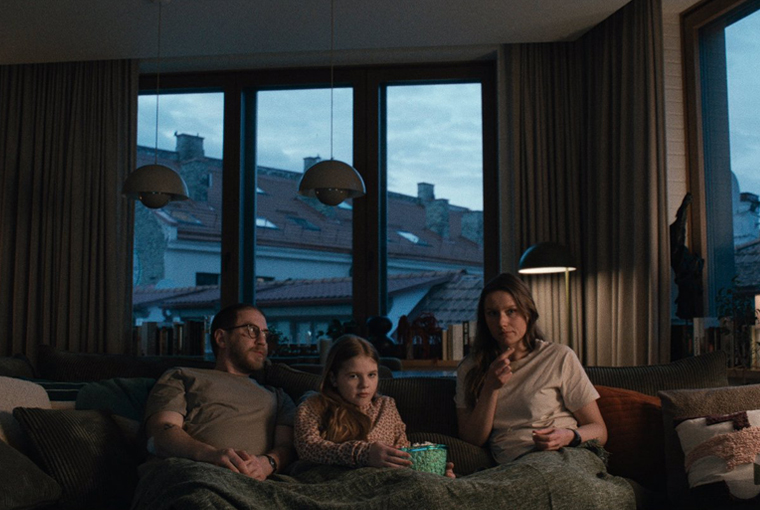
How To Divorce During The War opens with a static establishing shot of the Lithuanian capital, Vilnius. The city’s unmistakable gothic architecture is enveloped in a cold, misty dawn. The pointed mauve rooftops sit silently amongst the baroque church structures in an eerie stillness. The diegetic sound of a city slowly waking up can be faintly heard in the distance. It is an innocuous and pedestrian setting, sullied by the overcast weather.
Stay-at-home father Vytas (Marius Repšys) lurches into his office in his underwear. Lugubriously, he unboxes and assembles a new desk chair only to find it uncomfortable and immediately switch back to his battered old seat. Staring at his blank computer screen with a look of bewilderment, the failed screenwriter instead begins to shop for hats online. As if to curve his writer’s block, Vytas whiles away the hours tending to the household chores, ironing and cleaning the bathroom. His introduction demonstrates his mild-mannered character but also signals his pathetic tendencies. Boyishly eating cereal and watching TV, he is indubitably a bit of a loser. Importantly, he flips from channel to channel, ignoring the imminent broadcast of Russia’s invasion of Ukraine for a perfunctory interview with a fellow filmmaker.
In comparison, Vytas’ wife Marija (Elena Jakštaitė) is an overly ambitious social media content creator. Her much more stressful and answerable routine on set and in the studio office is suggestive of the couple’s disparate responsibilities. In the car on the way to their daughter’s weekly musical recital, Marija utters the words every husband fears: “We need to talk.” The argument that follows is a brilliant illustration of their characters. It exposes their ambitions, anxieties, and their persona, stemming precisely from their response to the situation. Upon hearing his wife wishes to separate, Vyas is overcome with a soppy sentimentality. He weeps, sniveling and snotty, lambasted by Marija. She herself is callous and unrestrained in her remarks. The baffled Vytas grovels for affection and explanation but is only met with the vindictive yet wholly reasonable maliciousness of his counterpart. For every tear that Vytas sheds, Marija’s remarks become crueler. She has become bitter, frustrated, and bored in their relationship. Their interaction is tragically realistic, blending guilt, despair, and uncertainty between both halves in an achingly candid scenario.
Unbeknownst to Vytas, Marija is having an affair with younger same-sex coworker Jurate (Indrė Patkauskaitė). Laying naked side by side in bed, the radio announces Russia’s full-scale invasion of Ukraine. Jurate whispers to her lover: “We are next.” It is an intentional paranoia that blends both the fear of their liaison being exposed and that of their country’s proximity to the war in Ukraine. As Vytas is forced to move into his parent’s house on the outskirts of the city, Marija impulsively agrees to house Ukrainian refugees in their apartment after seeing so many of her peers do the same. It is at this pivotal moment in the film that things become politically charged. Over time, there is an awkward push and pull between a shared Lithuanian, Ukrainian, and Russian presence. Vytas adamantly requests his parents to stop watching Russian news programming, insisting that the content is propaganda. In one of the film’s most comedic scenes, he becomes so frustrated at the television news reports that he proceeds to climb a ladder and destroy his parent’s satellite dish from the rooftop.
Marija feels so strongly about the plight caused by the invasion of Ukraine that she quits her job in defiance of her lucrative company’s ties to Russian funds. Yet her alliance is complicated by the messiness of the Ukrainian family of four in her cramped flat. Struggling to communicate exclusively in broken English or Russian, the new tenants refuse to socialize or clean up after themselves. Eventually, an unfettered Marja erupts after she returns to her apartment after a few absent days only to find unwashed dishes in the sink, leftover food out on the kitchen table, and a disheveled living room floor. Marija complains remorsefully to her girlfriend Jurate, who sheepishly informs her that she has been offered her old role at her ex-office.
Equally, a recently homeless Vytas finds it compulsory to throw a brick through any car window baring a Russian license plate. Ultimately, after washing himself in a nearby lake, he finds himself beaten and bruised by a gang of Russians he isn’t quick enough to flee from after launching said object through their vehicle’s windscreen. In one of his more desperate attempts to live under a roof while going through his separation, Vytas even calls upon his Ukrainian prostitute to move in with her and is swiftly denied. These scenes of interethnic relations are furtively embedded in the linear narrative of the divorce and simultaneously provide a trenchant political commentary alongside a morbidly comedic execution of a relationship in crisis. If all’s fair in love and war, there is certainly no winner here.
In scenes of creeping hostility or rising tension, the otherwise unheeded cinematography becomes acutely self-aware. Where once there was a documentary-like aesthetic, the camera zooms in trepidatiously. Often framing the two protagonists in a split-scene composition, the lens gradually suffocates its subjects, squashing these characters together as they are desperately trying to escape the confines of the mise-en-scène. It is a covert filmmaking technique that forces the audience to be complicit in the scene’s uneasiness, but as a result draws a profound intimacy out of the closeness they share with these deeply personal (and regrettable) moments. In the final sequence of the film, Vytas and Marija are reunited. They have both adopted the approach that if it’s not broken it doesn’t need fixing or ignorance is bliss. Whether you consider it fate, arbitrariness, or just plain laziness, the family equilibrium finds its way back again. Unconvincingly, for now, the war is no longer at home.

Leave a Comment