

Pacifism and War
Dmytro Sukholytkyy-Sobchuk’s Silent Flood (Tykha povin, 2025)
Vol. 165 (May 2026) by Margarita Kirilkina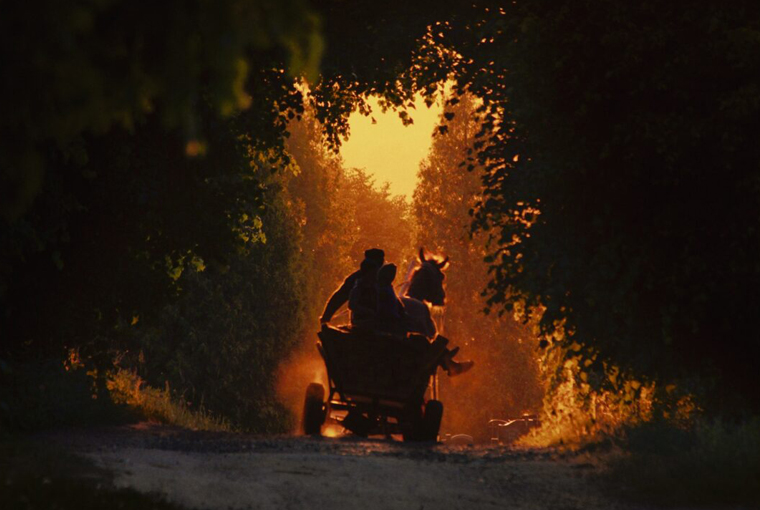
How should a pacifist react to war? The documentary film Silent Flood by Dmytro Sukholytkyy-Sobchuk, his second feature-length film after Pamfir, which had screened in Cannes in 2022, explores this very question.
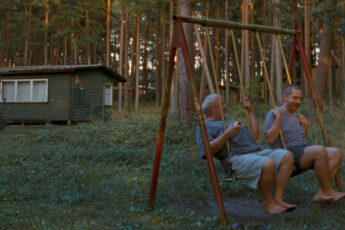
At the center of the story is a small religious community living on the banks of a river, as close to nature as possible: without internet, phones, or electricity. They cultivate the land and believe in God, and in return, they receive their daily bread and peace of mind, far from the bustle of civilization. The community was originally pacifist, and after the outbreak of war its members refused to join the army. Officially, they cannot even be conscripted, since by choice they do not possess passports.
Years ago, the land that feeds them was covered not only with fertile grain but also with mines left over from the Second World War. In the prologue, elderly voices off-screen recount dangerous childhood games played on this land, which concealed traces of past battles fought there. Some lost limbs, others their eyesight – war made itself known many years later, leaving behind an explosive legacy. Today, this land has once again become dangerous: entire fields are no entry zones, and nature once more harbors humanity’s destructive creations. In the epilogue, children share their own stories about modern mines. The Second World War and today’s war in Ukraine are treated as equivalent here, which makes the latter just as significant and just as destructive as it truly is – despite the growing tendency to speak about it less and less.
The film is divided into five parts entitled “Prologue,” “Paradise on Earth,” “Bread,” “Echo of the Earth,” and “Epilogue.” “The Paradise on Earth” explores the community itself, which Sukholytkyy-Sobchuk began filming from an ecological perspective before the start of the full-scale invasion of Ukraine by the Russian army. This closed community, which protects itself from the intrusion of the outside world into its well-established routine and guards the calm flow of its life, opens its doors to the film crew. We observe children at play, people at work, the functioning of the community, and their interactions with neighbors living close to civilization. The land provides food, fire gives light and warmth, and time flows like a silent flood.
The central part of the film is devoted to the production of bread, the main product yielded by the land. The only machine used by the community is a combine harvester; everything else is done by hand. A boy threshes grain with the help of a horse, women knead the dough, and it rises in straw baskets before being placed into a massive fiery oven. Human interaction with nature, and the harmony of this relationship, turn the place into an ecological paradise on earth. Yet the world that seems at first sight to be tamed turns out to be destructive to this tranquil life. The river periodically overflows its banks, threatening people’s lives, and modernity – with its war – breaks into their pacifism.
“Echo of the Earth.” A field catches fire, but this time the fire is useless, unproductive, meaningless. The peaceful flow of the river is interrupted by destroyed bridges. Civilization enters a state of war. The final part takes place amidst a military unit, with soldiers celebrating Christmas. The link between the community and the soldiers is bread, which the former send to the latter as their contribution. Here, a confrontation unfolds between two worlds: one that uses candles for light in order to remain physically and spiritually close to nature, and another where candles become a necessity due to the absence of electricity and the forced abandonment of civilization.
For the community, nature is home; for the soldiers, it is an uncomfortable earthen trench. Despite these differences, bread here is, in essence, a symbol of faith that binds all the people of Ukraine together.

Leave a Comment