
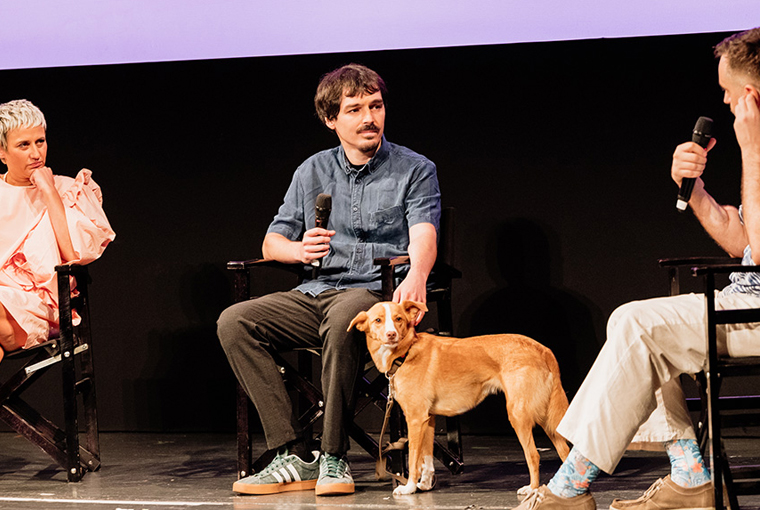
We met with Serbian filmmaker Stefan Djordjevic (spelled Đorđević in Serbian) at the Crossing Europe Film Festival in Linz (28th April–3rd May), where his doc-feature film debut “Wind, Talk to Me” won the 2026 MIOB New Vision Award. In our conversation, Djordjevic discusses his personal journey of grief, the theme of nature, and blurring the lines between fiction and documentary filmmaking techniques.
Wind, Talk to Me is a deeply personal film on many levels. What are the advantages and disadvantages of adapting one’s own life experiences to the screen?
The advantage was that it is a topic that I am very familiar with, so the subject I’m going to develop is something I’m going to know well. But the process was very complex and so was dealing with something so tough. At the beginning every time I would initiate something with the film – going through the documentary shots I did with my mum – it was still very sensitive to me, so I said to myself just take as much time as you need to make this film. It took six years to finish. The most complicated thing was to accept that somebody is not there and trying to find ways to articulate this sadness and put it in a more objective way. I know how complicated things can get with making films and I didn’t want to put my mum through this process, but after some time she said she would love the idea. I wanted to make a film where the audience shares the same experience as the family: that mum is still there.
The wind is often personified in the film. There’s a certain mysticism surrounding it as if it is a character in and of itself. Can you touch upon the inspiration and meaning behind the title of the film as well as the abundance of nature within the film’s aesthetic?
There is this dialogue with my mum at the end of the film that came naturally. My mum had never shared with me this idea that she was speaking with the wind. I just put the camera there and said I want to film a serious conversation with my mum and all of a sudden she started speaking with the wind as a character.
She had never spoken to the wind before?
No, and she never did it again after that. I knew she was connected with nature her whole life, but I didn’t know she feels it in this very subjective way that nature is a person and that she has communicated with it. With that dialogue, it shows the whole personality of my mum, it really took up everything she was. Even when I asked her if she really believed what she was saying she said yes, but she was afraid and ashamed to share it. She’s not just sharing her conversation with the wind, she’s sharing her whole life experience with me because she wants to leave me with the wisdom she received.
There are many metatextual references in the film, blurring the lines between documentary and fiction film. There’s a tension between reality and truth. Why did you decide to keep switching between showing the making of the film and following the linear narrative of Wind, Talk To Me?
It was also a natural thing because it was in the material with my mum. Sometimes the recording would go on and we would discuss things about the scene. I found it became alive, it’s reality. I really liked it because I found a lot of humor in it, when we would break the fourth wall and openly discuss if a scene was good or not or whether we should change it. When I made the decision to include my family, I needed to make everything feel alive and make the audience feel they are watching real people, not characters, that they are watching real life. The form, the structure of the film was developed through the material I shot with my mum. I was watching it so much, thinking how I can use everything that happened in a formative way for the film. So in these meta moments or behind-the-scene moments I was just trying to find a good approach inside of the structure while writing the script. Breaking the fourth wall with my nephew didn’t happen, but it did with my mum so I thought let’s make it a repetitive thing, like a visual style. I was trying to mix all of these forms into the narrative because I wanted to make it simple for the audience. With the material I shot with my mum I could easily have gone into making an atmospheric film, but I didn’t want to go in that direction. I really wanted for my grandparents to watch the film and for them to feel it, get the ideas behind the film.
Although the film begins as a journey of your own grief and trauma, there is a careful inclusion of the entire family’s sense of loss (particularly your brother’s). Why was it important to incorporate these additional points of view?
Although the film begins from a deeply personal place of grief and trauma, the loss inevitably extends to the entire family, each member experiencing it in their own way. It was important for me to reflect those differences in how we confront pain, because often the intensity of our own grief can lead us to judge others for not recognizing or expressing it in the same way. At the same time, the absence of visible emotion doesn’t mean the absence of feeling. In moments of vulnerability, we are rarely able to objectively perceive how others relate to loss, as we are overwhelmed by our own emotions. I wanted each person in the film to have a safe space to express not only what they felt, but how they chose to express it. While writing the script, I didn’t know exactly how this would take shape or how I would achieve it, but my family trusted the process and surrendered to the moment and in doing so, it brought us closer in the most beautiful way.
Is there any symbolic meaning to Lija the dog?
Lija came into my life shortly after my mother passed away, and in many ways, she became an emotional refuge for me. Although I adopted her from the street believing I was the one saving her, she ended up saving me far more than I saved her. She quickly became part of the family, and everyone grew to love her, as if she helped fill a certain sense of emptiness. At the same time, through the film’s language, I wanted to convey a feeling of care and love that carries an immense weight, and of the pressure we place on ourselves when we feel we must save the ones we love, even when it is ultimately beyond our control. This reflects the experience we went through with my mother in her final days, a process far darker than the natural idyll by the lake.
What is your favorite bit of wisdom or philosophy your mother imparted to you?
The final conversation in the film holds the essence of our lifelong exchange, how deeply she cared that we grow into conscious and compassionate people, but also that we learn to find peace within ourselves. She expressed this philosophy in a poetic way, through her way of describing how she speaks with the wind. Since her passing, I often find myself returning to her words. More importantly, each summer I spend time by the lake where she first shared that story with me. It’s a place where I can hear myself most clearly, but also where I can hear her, as if she’s still there, whispering through the branches.
Thank you for the interview.
Leave a Comment