

Loss, Grief, and the Life-Giving Properties of Nature
Stefan Djordjevic’s Wind, Talk to Me (Vetre, pričaj sa mnom, 2025)
Vol. 164 (April 2026) by Rohan Crickmar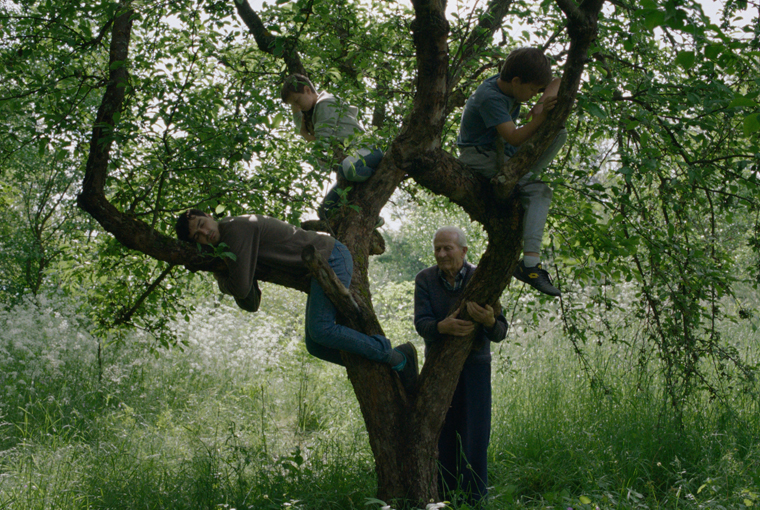
Actor-turned-director Stefan Djordjevic makes his feature debut with an understated, frequently mesmerizing, and surprisingly playful film. A self-reflexive exploration of the death of his mother and how it impacts his family, Wind, Talk to Me toys with the formal boundaries between fiction and documentary.
Opening with a curious sequence in which Stefan is shown intimately embracing a tree that looks as if it is almost outside of time, as a police officer inquires as to why he has left his vehicle, two key elements of Wind, Talk to Me are immediately established. On the one hand there is the film’s compelling evocation of a truly fecund and revitalizing nature (that we will discover is very much a cinematic approximation of his mother’s intimately felt connection to the natural world). On the other, this profoundly realized visual and aural reality, with all of its philosophical and spiritual undertones, is frequently played off against moments of straight-faced humor in the various idiosyncratic human interactions explored in the film.
Stefan is returning home to Bor, a small lakeside village in central Serbia surrounded by stunning nature. This was the place where his mother chose to spend the last years of her life. Having survived a cancer diagnosis by pursuing ‘alternative’ medical therapies and throwing herself into a strong relationship with nature, when the cancer returns after many years of good health, she chooses to pursue a similar process of healing. However, this time her condition does not improve. The sequences that feature the extraordinarily grounded presence of Stefan’s mother are actually documentary footage that the filmmaker shot during her last experience of the disease. They have a depth and immediacy of emotion that only enhance the film’s peculiarly hypnotic atmosphere of mundanity and wonder. Threaded through the film’s 100 minute run-time, they work in an allusive and poetic fashion that manages to dislocate any sense of linear time, making the absent mother’s presence at once both ghostly and eternal, almost as if she is communing with Stefan from beyond the grave.
The film also pulls in performances from Stefan’s extended family, from his actual grandparents and brother to his young nephews, as well as the close friend of his mother’s, who is deeply moved when seeing Stefan and his brother attempting to complete the renovations of the camp their mother had begun before her death. This is a bold move and one that richly pays off, especially when it comes to the oldest and youngest members of the family. In a carefully composed sequence with his nephews, Stefan first of all explains to them why he is filming himself in the branches of a tree, embracing it with a deep and resonant feeling. Then a discreet cut brings both of the boys into position upon the tree, in an extended sequence that plays out comically as the boy’s patience (and boredom threshold) is sorely tested by Stefan’s insistence on duration. They want to play and explore, but Stefan is making a film.
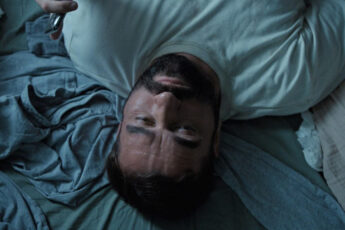
A bewitching series of nocturnal scenes seem to evoke an almost ancient sense of space and time. Stefan’s elderly grandmother is a somnambulist who frequently loses her way in the interior of her home at night. Shot with a concentrated intimacy and chiaroscuro lighting it manages to create a dream-like psychological space within the film that richly taps into themes of loss and memory. In an even more striking sequence we see a woman, possibly Stefan’s mother, trapped in the dark and cavernous depths of some underworld, crying out in what may be agony, frustration or simply ritual. These shots are so textured and densely composed that they exert a grip of a fascination upon the viewer that is both at odds with the quiet and slowly unfolding pace of the narrative, while simultaneously enhancing the timeless and endlessly fertile atmosphere of the film.
The film also uses sound design and the motif of a wounded dog who is brought into the family, cared for and eventually destroys the mother’s notebooks, as a means of approaching just how vital and life-affirming a presence Stefan’s mother was. Her words are heard as voiceover at various points throughout the film, offering up a hard-wrought wisdom that is born out of her experiences with her disease and how that has made her look upon the life-giving properties within the nature that surrounds her. In terms of the dog, here is a wild creature that manages to turn the mother’s words on a page into pulp, a process that for Stefan is the culmination of his sense of loss and also the point at which he becomes aware that his mother’s presence will always be felt within him.
Djordjevic’s at times diffident directorial approach manages to foreground many of the other family members within the film, opening it out from a deeply personal narrative to one that ultimately celebrates the bonds of family and kinship. As much as this is Stefan’s film, starting with him and focusing on his return to his mother’s beloved home, to grieve for and remember her, there is a remarkable degree of space given to the rest of the family. By the film’s closing image of a submerged tree whose branches protrude upwards from the heart of the lake, with a female figure (again the mother, or maybe the ghost of her) safely obscured amidst its branches, there is a sense that this spell-binding debut has managed to transport the audience into the heart of a family who have been brought together more powerfully by the loss of a loved one.

Leave a Comment