

Metamodern Folklore: Perverse Dreams and Pagan Excess
Raitis and Lauris Ābele’s Dog of God (Dieva suns, 2025)
Vol. 164 (April 2026) by Anna Batori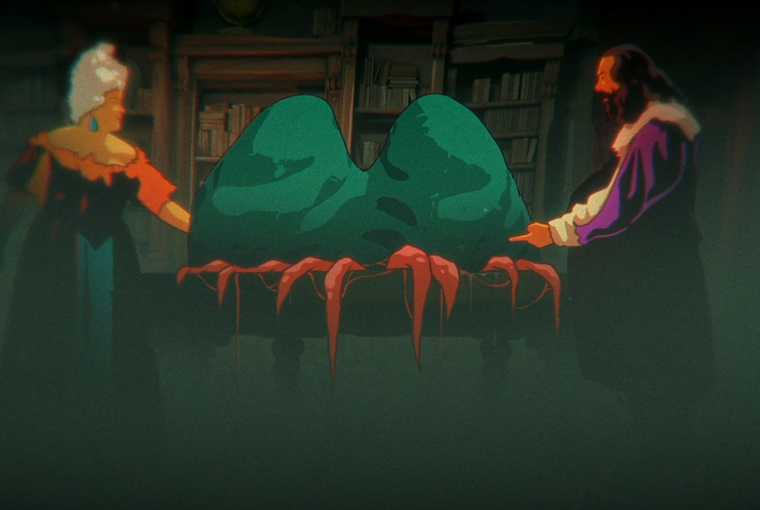
Set in a rain-soaked 17th-century Swedish Livonian village, Dog of God delivers a bold, transgressive animation on belief in which folklore, religion, and raw bodily excess collide. Inspired by the real-life case of Thiess of Kaltenbrun – an elderly peasant who, during his 1692 trial, claimed to be a werewolf in God’s service – the film flips the familiar myth on its head. Here, the werewolf is not a cursed monster but a kind of shamanic guardian, rooted in a forgotten Baltic worldview pushed aside by Christianity. It’s a provocative idea – a truly metamodern gesture that sets the tone for a film constantly shifting between irony and sincerity, grotesque spectacle and genuine spiritual curiosity.
Dog of God unfolds in a series of loosely connected episodes, and at times it feels deliberately hard to follow. For sure, Lauris and Raitis Ābele’s emphasis is less on narrative logic and more on the moods and sensations created by the film’s visual and tonal world. In that sense, the animation moves along three main threads, though its episodic structure serves less to build a coherent plot and more to create a psychedelic atmosphere.
On the one hand, Dog of God focuses on Neze (Agate Krista), a barmaid accused of witchcraft. The young woman is thrown into the river by the villagers, but later re-emerges as a kind of sexual rebel who unleashes an endless wave of erotic chaos across the village. But before this pagan orgy, Neze is pursued by a self-flagellating Christian pastor who is obsessed over exotic birds and a mysterious Golden Straw. The third storyline follows a local baron who, struggling with impotence, seeks help from Neze – only to find that the cure proves both unexpectedly successful and somewhat difficult to reverse. These seemingly scattered threads are eventually pulled together by the arrival of the enigmatic “Dog of God” (Einars Repše) who bursts into Neze’s trial with wild, mythical claims and a strange object known as the “Devil’s Balls.” He claims that he is a werewolf sent by God who descends into Hell to battle demons and witches in order to protect the crops and the community – even if, as he bitterly notes, the Russians got there first. From here, the film spirals into increasingly excessive and transgressive territory and culminates in a chaotic, carnivalesque explosion of sexuality that transforms the village into a pagan orgy.
Dog of God’s progression from juridical order to chaotic excess underscores the film’s central tension: the conflict between institutionalized religion and older, more fluid systems of belief grounded in nature, ritual, and the permeability of the human body. This tension aligns closely with metamodernism’s defining structure of oscillation. That is, the film neither fully embraces irony nor abandons it. Instead, it moves back and forth between parody and earnestness. On the one hand, Dog of God’s exaggerated sexuality, grotesque imagery, and absurdist tone evoke a postmodern sensibility, one that exposes the hypocrisy and violence of religious authority through excess and caricature. The pastor, for instance, is rendered as both a figure of moral rigidity and an object of ridicule. He can barely move under the weight of his own body and seems far more devoted to his exotic birds than to any genuine spiritual calling. At the same time, he subjects his young acolyte to repeated humiliation and punishment, giving this subplot an unmistakably disturbing undertone. On the other hand, the figure of the werewolf introduces a sincere, if unstable, alternative cosmology. His claim that he descends into Hell is presented not simply as delusion, but as a residual belief system – one that persists beneath the surface of imposed Christian doctrine.
This oscillation between the real and the imagined, the historical and the mythical is further reinforced by the film’s visual style. The use of rotoscope animation – tracing over live-action footage frame by frame – creates a liminal aesthetic in which realism and distortion coexist. In Dog of God, everything pulsates with phallic symbolism: the forest, the flowers, the torture devices, the crooked houses, even the winding village streets. The male organ leaks into every corner of the frame. The witch herself becomes part of this feverish erotic landscape – at one point slithering around the pastor in the form of a snake before transforming back into a woman immediately after his orgasm. The film’s relentless fixation on phallic symbolism eventually tips into outright absurdity. One recurring object, for instance, is a pulsating green mandrake – eerily resembling the monstrous blob from Chuck Russell’s The Blob (1988) – whose secretions function not only as aphrodisiacs, but whose sticky, gelatinous texture seems explicitly engineered to facilitate penetration. One of the film’s most unforgettable sequences captures the baron enthusiastically reenacting the exaggerated dubbed moans and rhythms of East German pornography around the mandrake, thus turning the scene into a delirious collision of folk horror, erotic parody, and psychedelic excess.
This visual instability mirrors the film’s thematic concerns by suggesting a surrealistic world in which reality itself is layered, contingent, and open to reinterpretation. Yet, despite its conceptual richness and striking visual execution, Dog of God struggles to sustain this oscillation at the level of narrative. Characters drift in and out of focus, and the werewolf – arguably the most compelling figure – not only remains underdeveloped but he also disappears for long stretches of the film. While the film’s rotoscope animation reinforces this instability – allowing bodies and spaces to shift between historical realism and hallucinatory distortion – the screenplay often fails to sustain the tension at a deeper level.
This limitation becomes particularly evident in the film’s treatment of excess. The extended sequences of sexual and violent imagery, while visually arresting, risk functioning as ends in themselves and turn the animation into self-Balkanizing fantasy. From a metamodern perspective, excess can serve as a means of reintroducing affect and intensity into a cultural landscape often characterized by irony and detachment. However, in Dog of God, excess occasionally collapses into spectacle, where (sexual) provocation substitutes for depth. The climactic orgiastic sequence, for instance, gestures toward a liberation from institutional control, yet remains ambiguously positioned between critique and indulgence. It is unclear whether the film seeks to celebrate this release of desire or to expose its underlying instability. Nevertheless, the film’s engagement with Baltic folklore and historical memory remains one of its most compelling aspects. By foregrounding a marginal, nearly forgotten cosmology, Dog of God participates in a broader cultural project of reclamation, one that resonates with the post-Soviet context of its production. The werewolf’s defiant testimony – his insistence on a worldview that has been systematically suppressed – embodies a form of cultural resistance that aligns with metamodernism’s renewed interest in meaning, spirituality, and collective identity. In this sense, the film’s oscillation is not just aesthetic but political as well. It reflects the tensions of navigating a troubled past and an equally uneasy present, caught between tradition and modernity. Ultimately, Dog of God remains suspended between provocation and meaning – its metamodern oscillation compelling, but never fully resolved.


Leave a Comment