

National Choreographies: Alcoholism, a Wedding, and Folk Dance
Csaba Káel’s Hungarian Wedding (Magyar menyegző, 2025)
Vol. 163 (March 2026) by Anna Batori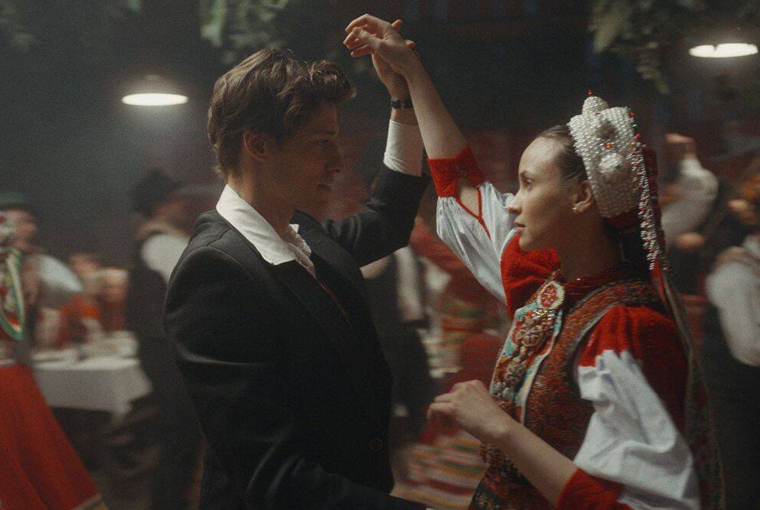
Financed with Hungarian state support and set in Transylvania, Hungarian Wedding belongs less to the category of fictional cinema centered on the story of a romantic couple than to that of a quasi-educational film on Hungarian ethnography, historical gastronomy, and natural landscapes. If one were compelled to assign it a category, dance film would perhaps be the most fitting label. Neither Hungarian cinema nor Hungarian audiences have likely encountered this much folk dancing within a single film.
Hungarian Wedding fits neatly into the right-wing, Christian-nationalist worldview of the Viktor Orbán era, shaped by what is known in Hungary as the System of National Cooperation (Nemzeti Együttműködés Rendszere, NER). One of the regime’s openly declared cultural ambitions has been the symbolic and political embrace of the Hungarian diaspora in Transylvania. The film draws directly on this ideological terrain. It is therefore hardly accidental that the production received around 2 billion forints in state support (approximately 5 million euros) while most independent Hungarian films are forced to operate with budgets ranging between 65,000 and 260,000 euros. The contrast makes visible a familiar logic of the current Hungarian film economy. Cultural legitimacy and generous public funding often converge where ideological convenience begins.
Set in the 1970s, Hungarian Wedding follows two university students, Péter (Tamás Kovács) and András (Zsombor Kövesi), who dream of gaining success with their band but can only afford a guitar if they first smuggle religious icons from Romania. During their journey to Transylvania with a presumed contraband purpose, András reveals that the main aim of the trip is different. They are heading to a wedding, where his friend is expected to propose to Kati (Franciska Törőcsik), András’ niece, so that she may finally cross the border permanently. Péter agrees, but the arrangement quickly becomes complicated when it turns out that Kati has already been promised to Gyuri (Barnabás Rohonyi), the son of the local police chief.
This simple story is so densely interwoven with landscape shots, extreme close-ups of food, and extended dance sequences that the narrative repeatedly loses momentum whenever these visual insertions take over. More troubling, however, is the image the film constructs of Hungarian identity when viewed from a twenty-first-century perspective. The dance scenes are accompanied by so much pálinka (national brandy) that the film could almost be described as a film about drinking rather than a wedding. This, apparently, is what Hungarianness looks like: whether necessary or not, one drinks. András and Péter arrive – alcohol is immediately served. They get drunk, wake up the next morning, and instead of coffee, pálinka appears again. A problem emerges with the police chief – that too is resolved through alcohol. At times, one has the impression that even going to the toilet would require another round of drinking. It is hardly a flattering image in a country where alcoholism remains one of the most persistent and socially devastating issues.
The film offers sunset drone panoramas of Transylvanian hills, folk dances captured from every imaginable angle, and only intermittently remembers its own love triangle. When Hungarians are not drinking, they are dancing. National identity is reduced to an oddly persistent formula: alcohol, choreography, and reproduction (because, as the film ultimately suggests, children must be produced for the nation). The film’s gender politics thus follow the conservative narrative conventions of NER. The men act, negotiate, travel, and drink, while Kati waits so as to be chosen. She circulates less as a character than as an object of exchange, whose marriage promises both border crossing and future reproduction.
Yet the film’s fragmented screenplay, simplistic dialogue, constant drinking, and advertisement-like gastronomic cinematography do not entirely erase one of its more convincing achievements. The care with which it pays tribute to Transylvanian folk costumes and the dances of Kalotaszeg (a region in Transylvania) is remarkable. In these moments, the film momentarily abandons its ideological rigidity and becomes attentive to texture, rhythm, and collective movement. The embroidery of the costumes, the density of color, and the precision of the choreography produce a visual richness that occasionally exceeds the limitations of the narrative itself. Dynamic editing, professional dancers, and the multilayered Transylvanian folk costumes – with the close-ups of their richly embroidered aprons, pleated skirts, vivid reds, deep blacks, floral motifs, and carefully layered textiles – partially rescue the narrative and produce an ethnographic spectacle that may well appear genuinely appealing to a non-Hungarian viewer.
Unfortunately, however, Hungarian Wedding very consciously avoids political tension and chooses instead to present Hungarian-Transylvanian relations in such idyllic harmony that one might almost believe this mutual intimacy truly exists. Yet this avoidance and romanticism become part of the problem. Rather than engaging with the very real tensions that continue to shape relations between Hungarians in Hungary and Hungarians in Transylvania, Káel’s film further reinforces them by effectively reducing Transylvania to folk costume and ritual performance. By collapsing an entire region into visual markers of tradition, it does little to complicate how Transylvanians are perceived in Hungary. Instead, it risks reinforcing the image of a community permanently suspended in an archaic Hungarian past.
Overall, Hungarian Wedding remains an enjoyable film for viewers who appreciate folk dance, traditional costume (and pálinka), and who are willing to overlook the fragmentation of its screenplay and narrative in favor of choreography and visual display. Although a truly nuanced cinematic engagement with Hungarian roots and Hungarian-Transylvanian relations still remains to be made, Káel’s film can nevertheless be seen as an initial attempt to package and export a recognizable Hungarian cultural brand for non-Hungarian audiences. Even if that brand, like the film itself, reveals its fractures at almost every turn.



Leave a Comment