

Liquid Sky (1982) as Émigré Optics: A Visual Manifesto
Vol. 163 (March 2026) by Ursula-Helen Kassaveti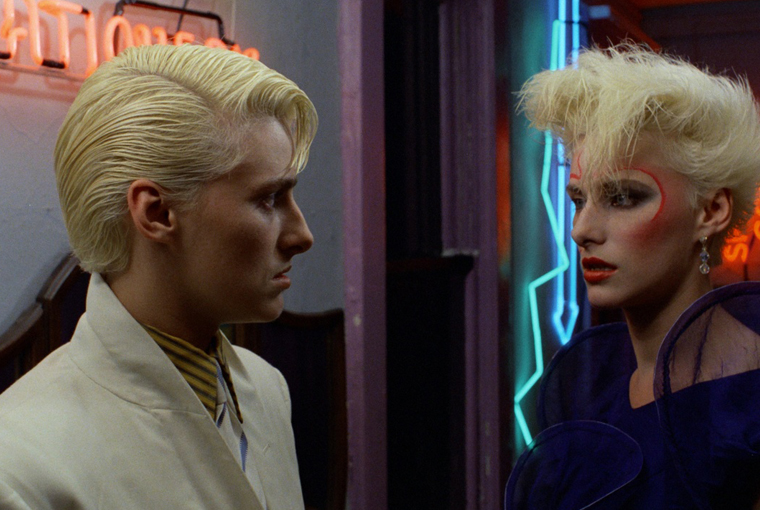
Slava Tsukerman’s Liquid Sky (1982) is a film that refuses to sit quietly in any category; one cannot escape this hallucinatory experiment bursting with color and form. Still, at its core, this low-budget and queer sci-fi allegory about life in exile embodies the experience of Soviet émigrés in the fractured image-world of the 1980s United States. The film approaches the topic of cultural displacement through an aesthetic logic by filtering the visual codes of its host culture through an estranged gaze. Such a refractive process primarily generates stylistic novelty, and articulates exile as a condition of perception.
At a time when postmodernism was oftentimes accused of irony or even detachment, Liquid Sky burned with sincerity. Its Art Deco geometries, echoes of German Expressionism, punk overtones, and synthetic colors, to name but a few of its characteristics, were the film’s unique convictions. Director Slava Tsukerman, production designer Marina Levikova, producer Nina Kerova, and cinematographer Yuri Neyman arrived in New York as outsiders. From this standpont, they encountered the city’s punk and fashion scenes as “translators.”1 The visual idioms of high and outsider art, new wave modelling, contemporary photography, and underground theater became a language they reassembled from various fragments to synthesize an estranged yet simultaneously familiar vision of the West. This short essay situates Liquid Sky within a broader history of Eastern European émigré filmmaking, where aesthetic excess becomes a mode of negotiating cultural translation under late Cold War conditions. It focuses on how the film’s distinctive visual strategies configure identity under conditions of displacement.
Liquid Sky’s story is almost absurdly simple. A small alien ship lands on a Manhattan rooftop, with its off-world passengers feeding on pheromones released in the human brain during orgasm. Margaret (Anne Carlisle), a new wave model adrift amidst drugs and exploitation, becomes the host for this process. Her lovers die at climax, leaving her terrified and disempowered. Carlisle also plays Jimmy (her doppelgänger), a spoilt, addicted male model sliding into despair who figures as a mirror of Margaret’s alienation. Around them orbit a gallery of the grotesque: Adrian (Paula E. Sheppard), her lesbian and manipulative roommate, sleazy dealers, and vapid fashion parasites. Margaret realizes what is going on, but she does not know who to turn to. Everything around her is superficially dirty, brimming with mannerisms and hallucinations. When she speaks out publicly about what is happening to her, nobody believes her, until a photo crew sees Adrian die as she is having sex with Margaret. The only solution, and her final one, is to ask the extra-terrestrials to take her with them. And so, it happens.
Apart from Margaret and her troupe, there are many other characters in Liquid Sky, some being central and some merely peripheral to the plot. Jimmy’s mother is the nymphomaniac Sylvia (Susan Doukas), who tries to seduce a scientist called Johann (Otto von Wernherr). Johann is aware that there are ETs in Margaret’s house, but no one believes him, either. There is also Owen (Bob Brady), Margaret’s drama university professor, with whom she had a Pygmalion-esque relationship in her early years in New York. One can argue that none of these figures is a character in the psychological sense. Instead, they serve as flat, stylized icons who are both performative and emotionless.
The ‘fancy’ surface of the film is bold and decisive, turning Levikova’s colorful production design into narrative.2 Levikova devised a chromatic dramaturgy with turquoise for morning, yellow for day, purple for night, and painted walls in silver colors so that light would ricochet through the space. The apartment ceases to be a simple décor and becomes a living diagram of Margaret’s disorientation and aimlessness. Liquid Sky’s chromatic geometry and metallic surfaces resonate with the Soviet constructivist understanding of space as an active, organizing structure.3 In constructivist practice, design operated as a material system capable of shaping perception and directing bodily movement within a socially functional framework. The apartment in the film functions as a comparable perceptual apparatus in which color and architecture regulate experience. Within this spatial logic, exile becomes inscribed in form itself, as design mediates the encounter between subject and environment.
While, outside, the city glows in toxic neon colors, Margaret dances to the sound of the Fairlight CMI synthesizer in the shadow of the Empire State Building (a typically Art Deco emblem), which represents the subcutaneous needle that directs the lives of her, Jimmy, and the other protagonists. All are incapable of being loved but can easily make love; drugs and multiple ‘fucks’ are the epicenter of their physical existence. In the meantime, New York clubs pulse with Kabuki make-up and angular poses, while Valerie, in a burst of despair, sings “Me and My Rhythm Box.” According to the script, alternative modeling appears almost natural. Like everything else that happens in the film, it gravitates towards the nighttime. Fashion operates as a parallel universe where everyone should wear a mask. Thus, even though Margaret works in the fashion industry, she is essentially located right behind it, and deploys it to conceal her real ego and the sensitivity behind her cynicism. This artificiality is also inherent in the angular shapes, vivid colors, and the bold combination in costumes and make-up – a décor to exaggerate the artificiality of the characters’ existence.
In the realm of this iconography, the film’s mise-en-scène operates as a primary site of emotional construction. It is the place where it “is useless to dream of revolution through content, useless to dream of a revelation through form, because the medium and the real are now in a single nebula whose truth is indecipherable.”4 Liquid Sky encapsulates this kind of truth, as through surface saturation, colors exceed pure signification and begin to be. Turquoise embodies calmness, while purple represents pure alienation. Against this backdrop, the film embodies “the waning of affect” and “new depthlessness,”5 and Slava Tsukerman transforms this cultural malaise (if any) into a method. This convergence aligns with the themes in Liquid Sky, as the flattening of emotions becomes a survival strategy for the blank-stare Margaret. Her stylized gestures, as well as her collapse into alien symbiosis, reveal a subjectivity that exists only as image. Style exceeds decoration, and becomes an ontology, as to exist is to be seen. The alien that extracts orgasmic energy literalizes this kind of logic, turning the body into pure surface, drained of interiority and converted into luminous signs.
Nevertheless, this visual translation has not been part of a single design. Liquid Sky can be considered postmodern, but profoundly diasporic, and its estrangement is far more than ironic. One can argue that it is existential, born out of the distance between the Soviet past and the American present. The émigré filmmaker and his team approach the West as a hallucinatory spectacle which dares to be both dazzling and cruel. The concept of the “third space of enunciation”6 finds a vivid cinematic form here, as the film is produced between cultures and is somehow ‘accented’; it is made under conditions of displacement, marked by stylistic fragmentation and hybrid form.7 Margaret, too, explores forms of Otherness through her encounter with extraterrestrial beings, whom she calls “Indians,” much as one might (pejoratively) call someone a weirdo. So, the film lies perpetually in the experience of translation, and its fractured mise-en-scène constitutes a visual grammar of exile. Marina Levikova, who at the time worked as a fashion and advertising illustrator for a variety of publications, designed interiors with mirrored surfaces and shifting transparent hues that visualize this in-betweenness. Her set design somehow evokes the synthetic perfection of airbrush illustrations, where idealized femininity floats in neon voids – for Levikova, the flickering of neon was almost a symbol of the ‘flickering’ life of the film’s characters. Liquid Sky brings these images to life, and fashion illustration becomes cinema; a surface that becomes the world. If the focus on the visual is held “as a place where meanings are created and contested,”8 Tsukerman’s film enacts that principle with almost religious intensity.
Liquid Sky’s radical visuality, through which exile is translated and reconfigured, is also inseparable from gender. Within this artificial cosmos, the latter dissolves as well. Anne Carlisle’s dual performance as Margaret and Jimmy erases any prescribed gender binary. Both characters act as aesthetic constructs, as they are angular and androgynous. If gender seems to be a “stylized repetition of acts,”9 then it is materialized and literalized in the film’s mirrored bodies. In one scene of the film, Margaret ponders about gender (“heterosexual, homosexual, bisexual?”), but opposes all available social constructs (“someone doesn’t depend on the kind of genitals they have”). She rejects the social expectations associated with gender – specifically being a good housewife – as she unravels her thoughts to her former drama professor, Owen.
In the end, Margaret becomes a part-human, part-alien interface, and her body acts as a techno-biological conduit for pleasure and annihilation.10 Her ascent with the aliens at the film’s conclusion completes its internal logic. Amplified through visual effects and extreme color polarization, Margaret’s departure articulates an alignment between subjectivity and image, in which existence unfolds through visibility and chromatic intensity. At long last, identity in Liquid Sky is fluid, performative, and operates as a visual code through performance and as a process of multiplication. This exploration of gender aligns with the 1980s’ evolving discourses on sexuality and identity, as mirrored in the popular industries of the time. The film thus becomes an emblem of these cultural shifts, and deploys its narrative and visual style to defy conventional gender roles.
Seen today, Liquid Sky offers a model for understanding exile as an aesthetic practice. From the perspective of émigré filmmakers working across cultural frameworks, the film transforms displacement into visual inventiveness. The film renders the West as an image-world sustained through fancy surfaces full of desire, and in doing so, it proposes cinema itself as a site where belonging is produced through vision. Liquid Sky is a cinema of simulation that becomes a truth, a cinema that is authentic, and something more than that. It is a world of silver walls and ultraviolet hues, walls and faces that act as a metaphor of alienation made visible, made alive. To watch it is to glimpse the West through émigré eyes, where the artificial is probably the real, and the only home left is the image itself. And one cannot escape it.11
- Trefz, L. (1984). “Photography for Liquid Sky”. American Cinematographer, February 1984, 62–69, p. 65; see also Russo, V. (1984). “Anne Carlisle and Liquid Sky”. Moviegoer, July 1984, 8–11, pp. 10–11. ↩︎
- (n.a.) (1984). “Interview with Yuri Neuman and Marina Levikova”, Zoom, 110, 68–71. ↩︎
- Lodder, C. (1983). Russian Constructivism. Yale University Press, pp. 73–76, Ch. 5; Gough, M. (2005).
The Artist as Producer: Russian Constructivism in Revolution. University of California Press. ↩︎ - Baudrillard, J. (1983). Simulacra and simulation (S. F. Glaser, Trans.). Semiotext(e), p. 58. ↩︎
- Jameson, F. (1991). Postmodernism, or the cultural logic of late capitalism. Verso, pp. 5, 11 ↩︎
- Bhabha, H. K. (1994). The location of culture. Routledge, pp. 37–38. ↩︎
- Naficy, H. (2001). An accented cinema: Exilic and diasporic filmmaking. Princeton University Press, pp.
10–14. ↩︎ - Mirzoeff, N. (1999). An introduction to visual culture. Routledge, p. 5 ↩︎
- Butler, J. (1990). Gender trouble: Feminism and the subversion of identity. Routledge, p. 179. ↩︎
- Haraway, D. (1991). Simians, cyborgs, and women: The reinvention of nature. Routledge, p. 163. ↩︎
- I would like to thank Marina Levikova for her kind interview for an earlier version of this article, conducted more than a decade ago (2011). ↩︎

Leave a Comment