

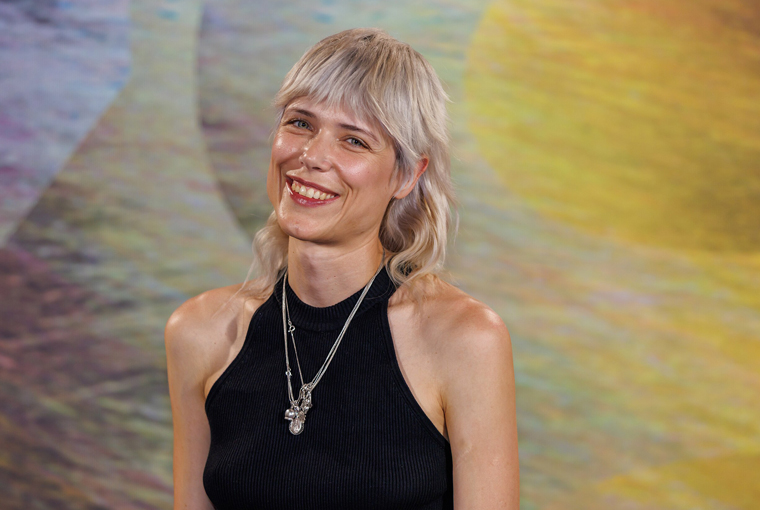
At the Thessaloniki International Film Festival (30 October–9 November), we met with Croatian director Hana Jušić to speak about her sophomore feature “God Will Not Help,” a period piece set in the early 20th century in an isolated mountain village. In our conversation, we discussed the feminine codifications of nature, her inspirations of making a film about a Chilean widow traveling all the way to Croatia to bury the remains of her husband, despite the unbridgeable language barrier.
In the interview accompanying the film’s press kit, you mentioned Wuthering Heights by Emily Bronte as an inspiration for the way God Will Not Help treats the relationship between humans and nature. But in that novel, and in general, I feel like so much of art has been superimposed over the relationship between man and nature, while ‘woman’ and ‘nature’ have been mostly equated. How would you describe your approach to representing the landscapes and femininity in that regard?
That’s a very interesting question because men, of course, are always symbolically connected to civilization and culture, while women are related to nature and the wilderness. They’re the id, not the Super Ego, but I actually didn’t have that in mind while writing the script. Now when you say it, I think it’s very true, because I composed a dichotomy. On the one hand, there is the Western [genre], where it’s the white men building a civilization, while killing the indigenous people who are connected to nature; on the other hand, there’s the dichotomy between men and women. In God Will Not Help, the two women [Teresa and Milena] are outside of traditional society, and through them, we see civilization as something alien to nature; something oppressive. Teresa, as a character, is placed in nature but she’s not really there – she has her mission to follow. It’s only through Milena that she allows nature to come closer to her in the course of the film, but at one point she is accused of being a witch – another dichotomy relating women to nature invented by men.
Both the women and the men carry the usual gender signifiers, but they also rebel against them. That, I think, doesn’t have that much to do with the presence of nature per se, but with the rhythm of the film and how these characters manage or fail to find one another. It seems like you have a very delicate understanding of human relationships, so I’m very curious, as a writer, how do you compose a script where the dialogue is made up of meeting points and misconnections?
I always find it interesting when you’re with people and someone opens up or a small misunderstanding happens and everybody feels awkward. Since I was a child, I was drawn to those moments – an emotional confession at the wrong time, rejection, or when someone mistakes kindness for sarcasm – these kinds of things are always so painful to watch, but very special. In this film particularly, what I wanted was for Teresa to be the catalyst for all the others to open up about their deepest fears and feelings. The whole film is actually one big misunderstanding between all of them! Only with Teresa and Milena, we see how in the end they choose to go along with the misunderstanding because there is already an emotional bond there.
Period films set in the early 20th century are very rare in Eastern European and Balkan cinema, unlike let’s say Latin American cinema. I’m from Bulgaria and my references would be historical epics on TV, but certainly nothing that is considered worthy of an arthouse film, with the exception of Goran Stolevski’s You Won’t Be Alone from 2022. How did you arrive at this particular time for a setting?
I studied English literature all throughout high school and I was very much immersed in Victorian literature, I also liked Russian literature so as soon as I enrolled to study filmmaking, I wanted to make a period piece set in the 19th or the beginning of the 20th century. However, I was frustrated because coming from the Balkans, all the film reference points are the same as those you mentioned: some big mythical male figures, dressed in period clothes, who are bravely fighting off the Ottoman army.
It’s the national myth, whichever country you come from in the Balkans.
Yes! Women, when they appear in these films, are only there to prepare food, to wash their feet, and to be raped. I knew I didn’t want to make an urban film set in that period too, so I was wondering how to connect to this period in terms of characters, storyline, but also costumes. All the costumes in those period films seemed like they were borrowed from the ethnography museum… I was very attracted to the possibility of breaking this myth, of coming to it from different sides; to take the shepherd figures we’ve seen in all those Balkan films and to make them into something else.
Can you say more about the production design work with Laura Boni and the costumes in particular, alongside Katarina Pilić?
It was a great departure point to have a main character who comes from another culture, so me and my costume designer Katarina Pilić researched together. Since many people came to Chile from Europe, we thought that the black dress Teresa wears in the film had to be given to her by someone else (it comes from an urban setting). From the beginning, I imagined her widow’s dress to be like the one from [Jane Campion’s] The Piano. For the villagers’ costumes, we had a lot of restrictions because from our research, we understood that all the local people in that region were supposedly carrying particular costumes from the day they were born to the day they died, but we decided to strip them of their ornaments, imagining that they went to work the field every day wearing only pants and a shirt. We didn’t want the shepherds to seem like they came from a book.
This is my very limited knowledge of ethnography. Aren’t a lot of these costume references we have in museums just people’s Sunday best, not what people would actually wear on a daily basis, because they would wear clothes until they disintegrate?
Absolutely, yes. That’s why we decided to go against that ethnographic approach and to follow your logic – I can’t understand why one would wear their one best set of clothes to feed the sheep! It was also interesting to note that since the shepherds in the film have no reference for dresses, they wouldn’t have known that what Teresa’s wearing is a widow’s dress.
Can you explain to me the significance of the panning shots your film so effectively uses?
We used circular pans to depict the past that is not a direct flashback or simply reminiscing. For example, when Teresa recites one of her long monologues, the panning shot is a stylistic device to enter another reality, but a reality that is in their vicinity, even if it’s a new universe.
That’s also a very evocative way to ground the viewer in a past which only exists in the characters’ stories. Why was it important for you to structure these monologues as confessions?
There is obviously a bit of artificiality in the film and while I wanted to play up the ‘wild’ aspects of nature and how organic the landscapes surrounding them are, the characters still feel like they’re on a stage. As if they themselves felt like they’re on a built stage and their monologues have a literary, formal weight to them – it was an alternative way to convey the character backstory, not like they teach you to do in film school.
Unlike a domestic audience, I can’t tell what kind of Croatian they’re speaking in the film. It’s clear that you as a writer-director have an intimate connection to language. I’m curious about the language games Teresa and Milena play to understand each other, because on the one hand, the words they communicate through are very rudimentary, like ‘bones’ and ‘death,’ but on the other, it’s very hard to share metaphors across languages.
It was our intention for the Croatian language Teresa learns to be very concrete – the words of the world surrounding the shepherd village – but I wanted to also instill references to violence, what she may have experienced or done, so that if you put the words together, they could have a poetic connection and basically build another, more truthful world for these women. It was important that the actresses themselves, who didn’t speak each other’s languages, would practice this communication technique during rehearsals for real. As in, Manuela doesn’t speak Croatian and Anna Maria doesn’t speak Spanish, and both had to explain to each other the meaning of the words from the script.
Finally, I want to ask you about the Biblical iconography in the film, which is also part of how Teresa learns the language – through the prayer book she carries. At certain points of the film, however, we see paintings in full and I was wondering, were those already existent artworks you found in your research, or were they specifically created for the film?
Our references were European (mainly Italian and Spanish) ex voto paintings from the 19th century and the beginning of the 20th century – pieces of folk art made for when a person was taking a vow or thanking a patron. Some of them are quite funny, sometimes looking like comic book art, other times very surrealist in style. We wanted to fill Teresa’s prayer book with these kinds of folk paintings of the period, but we also needed to depict some motifs specific to the film’s themes, so we hired two artists for the purpose. We had 25 paintings in total, but sadly we used just a few of them, so perhaps we should organize an exhibition to show them!
Thank you for the interview.
Leave a Comment