
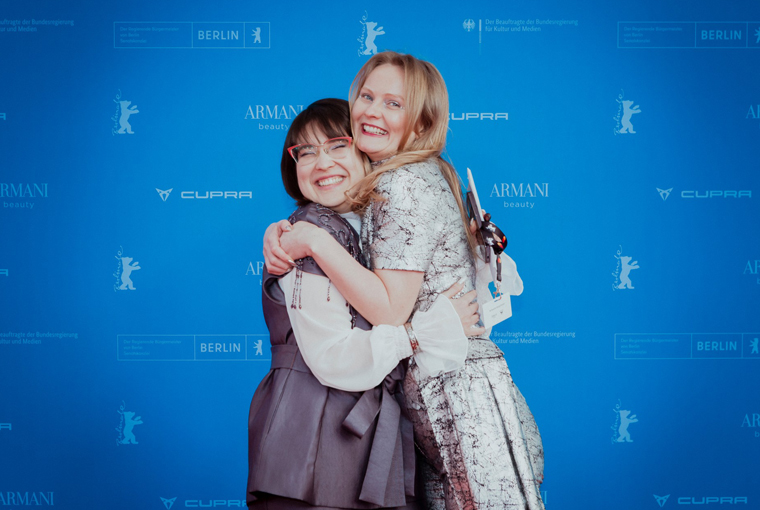
We met Kristina Mikhailova and Dana Sabitova, the director and producer of “River Dreams,” during this year’s Berlinale (February 12-22), where the film was featured in the Forum section. The two filmmakers discuss the difficult process of development, how the film was received by institutions and audiences alike, and changing production circumstances in Kazakhstan.
What inspired you to make a documentary about the rivers and girls of Kazakhstan?
Mikhailova (KM): It was a just a childish curiosity about what a river looks like from beginning to end. And in Kazakhstan, in Central Asia, rivers start in the mountains, they go through different landscapes and then they disappear in the steppes. Later on, we came across the concept of the river looking for the ocean, because our rivers don’t have access to the ocean. So, with our rivers, and with our river girls, we were looking for the ocean, which signifies liberation.
How did you choose the locations and the girls that you interviewed?
KM: For the location, we had a specific river which we wanted to observe, which was my childhood river. So, I spent time there. It’s an extremely ordinary, small river. I don’t know if you Western Europeans would even consider it a river. It’s really small. But then of course, it became bigger and bigger and bigger. And then we just observed everything. And we talked with the people we met by the river. We just observed them, how they live, what they do, and how they treat the river as well.
And we did the casting everywhere. We just used old-fashioned, printout casting announcements. Like, “if you feel the river inside you, come and meet us.” And they came thanks to this simple concept. We were so happy so many girls understood us and what we wanted to do.
Were you surprised by any of the things they said to you? Or did their responses align with your expectations?
KM: I actually didn’t expect anything. I was even surprised when we did the first teaser with Dana [Sabitova]. I asked her how she would imagine herself as a river and I was surprised by her river first of all. And after that, after maybe the first 5 or 10 castings, which were test castings, I just understood – I don’t need to lead anyone in any direction. It was not my intention at all. I was just trying to follow their direction, because it was finally a way for them to say something. So that’s why I was mostly just supporting the narrative they started to provide by themselves. It was a total experiment for me. I never had a plan about what to ask in the interviews and the final topics crystalized in the editing stage thanks to our editor Arya [Rothe] from India. We watched more than 100 interviews and we just found the triggers, we found the topics they mentioned from interview to interview. That’s how we found how they feel as girls and women in Kazakhstan, and how they relate to being a river.
And what kind of rivers do you two feel like?
(Sabitova) DS: I feel like a very wide and deep river. It’s very calm but it’s big enough for ships, so that people can travel and see their loved ones, so that I can be of help. That’s the kind of river I am.
KM: We’re so different. When I first heard about the ships, I was like, okay, I never imagined a river could be that big. I’m a small mountain river which is energetic, but powerful enough to give power to the hydro-electro stations.
So we’re different kinds of rivers, and I guess it was because of Dana’s power to be calm and my power to be unstoppable that we managed to finish River Dreams.
Do people now come up to you and tell you what kind of river they see themselves as?
KM: Yes, and not all people are rivers, some people just wanted to share that they are mountains or volcanoes or steppes or forests or winds. So it’s a new concept, we could make a new film for each of them.
Given that this is such a poetic concept for a documentary, was it easy to convince funders it would work?
DS: To start with the international funds, I think what we experienced was a lack of trust. You know, our region is not well-represented, and when we proposed this experimental idea, they didn’t know if two girls from Kazakhstan could do such a project. So I think we need to really broaden the understanding of our region and that we are powerful enough to do projects like this, so that the situation with international funding can improve.
For local funding, the problem was that we have a co-production. We applied to the state funding body three times and we won three times, but when it came to signing the papers we never finalized it. We always faced the same obstacle, which is that they directly said to us, “Oh, you’re just girls.” They’d say “girls, girls” every time and we even issued a public statement about these issues with the title “We’re not just girls.” And for sure, if we’d gotten state funding we would have faced a lot of censorship. We would have faced limitations in Kristina’s way of filming, we would have had to prove every step of the way that we deserve it and that the film itself needs it. Because in their minds, a documentary film can be filmed in three months. Every day we tried to educate them, to provide them with research about how such films are made. And actually, in the end, we’re really thankful that we didn’t have that much funding because it gave us freedom to do what we wanted to do. Now that the film premiered at the Berlinale, I think we have the trump card. We can say, “We are big now, listen to us.” So I think everything will get better after this.
KM: There’s a funny story about the first international pitching program I participated in. The mentor was a very well-known Kazakh-Russian director. He started in Kazakhstan and then he moved to Russia. He was my mentor and I really like his films but he said to me, “Um, is this actually your original idea?” I said, “Yes, of course, it’s mine.” And he said, “This idea is for a big film that can only go to Cannes or Berlin, but you are such a newcomer, you have no name and you don’t have enough resources and power to do such a film. Don’t even dare, why would you want to do this? I’m not sure if it’s actually your idea originally.” He thought the idea was too deep, too philosophical. I was so angry! I had a scholarship from the program and even though I could barely speak English, I wrote a letter to the organizers saying, “I’m so sorry. You trusted me but I really have to cancel the mentorship, because what he’s saying is extremely misogynistic.” And they were supportive. They said okay, and I never met him again but it’s really funny how we ended up at the Berlinale after all. He led us in the right direction. It gave me anger and anger is something extremely powerful.
Have you had any reactions back home yet? Do you think perceptions about female filmmakers are starting to change?
KM: It depends. Let’s say, in the independent media and among the people who consume it, we’ve had an extremely positive reaction and we did a lot of work to make sure that everyone knows about the film. They all reacted in a good way, except the media where my ex-boyfriend is an editor. They didn’t publish it, but all the others did. And on the governmental side and the institutional side, we contacted everyone because we were out of finances to do the post-production and to travel to Berlin.
We contacted every possible cultural institution and the Minister of Culture. They all rejected us, except the Goethe Institute, which bought the ticket for Dana to come. But for the others it doesn’t matter what we did here – being the first Kazakh documentary in the history of the Berlinale. They found reasons to reject it, and my idea for my next exhibition is to show all the rejections there and the reasons they give for rejecting us, which are extremely funny.
Are you working on any other projects at the moment, aside from the exhibition of rejections?
KM: Yes, actually we have so many materials from River Dreams itself and I would like to do something artistic with them. I had a small part in the Venice Biennale last time, in the collective exhibition from Central Asian artists, which was a really great experience as well. So going in the direction of art also is super interesting to me because you can explore some other opportunities not as a suffering documentary filmmaker – I’m really not happy about this stigma. Even at the Berlinale there aren’t so many documentaries, right? I think the documentary form is something that can offer a lot of perspectives, because I think people can raise bigger questions in documentaries than in fiction. Maybe I’m just pessimistic about fiction, although I have fiction scripts as well. My ideas can also take the form of fiction or art. One project in particular is about an Uyghur artist in Kazakhstan, asking Beyoncé, who is her crush, to stop the Uyghur genocide. It will be a funny documentary, I can see you’re smiling already.
Also in River Dreams I think we also succeeded in dealing with serious topics in a lighter way. Irony is a way for people to heal, it’s a healing process. So, I wanted the girls in the film not to look like victims, but as people who are healing. They are healing from something we are all suffering from. The healing is more important than suffering and actually, when you start the healing, you need to stop suffering. So this is all connected. I prefer to watch these kinds of films myself, so that’s why I make these kinds of films.
From the production side, now that you’ve been through this experience of figuring out the co-production and the national funding, etc., how will you approach your future projects?
DS: There is still a lot of work to do, I would start with that. When we started going to industry events and workshops with River Dreams, filmmakers in our region saw that we were travelling and both Kristina and I were really open to sharing the knowledge that we got from that. We asked so many questions when we travelled and then we passed on everything that we learned in Kazakhstan and Central Asia. So we opened an association for Central Asian filmmakers, Women Make Docs. And with this organization, we are really trying to make a difference for filmmakers in our region. So, I think we will continue working with that so that it will not only be better for producing our own films but it will be better for the production circumstances of every film in our region. Our plan is not only to create production opportunities for our next films, but to make it better altogether.
KM: A lot of filmmakers from Central Asia contacted us, asking us to produce their work, because we have a lack of producers. But it’s impossible to produce with everyone. So mostly, we need to focus on educating people who have the potential to be producers. So let’s say if you have a cohort of producers, it will help to improve the whole industry. Because now people just become producers accidentally, because of some life experience. So there’s a lack of knowledge, a lack of education.
And money-wise, things are a bit complicated. Everyone is talking about how distribution is so bad now, everything is broken. So what can we do? For us, when our European colleagues shared these feelings, we were surprised, because actually this is the reality we’ve faced all the time. So sometimes they asked us how we managed, and we were like, “Actually, we came here to learn from you. We wanted to learn the good way to do things but you’re saying there is no good way anymore.” So there is confusion about how to finance films, how to distribute them, how to do everything. And I don’t know if we are lucky or unlucky to be in this situation with our debut film. I don’t yet, we will see.
And how about the collaboration between the two of you?
KM: I can just tell you the story of how Dana just fell from heaven. She’s my lifesaver. When we started to make other people aware about the challenges of the international industry, I thought, okay, we will just share the knowledge and people will act, react, and they will work in a good way. But actually, you need to have this specific personality and to prioritize your energy. To make a lot of personal sacrifices, which we did. So it’s not for everyone. And unfortunately, we’re still existing in a bubble, and if you want to achieve something you need to overcome the challenges. Not just a normal level of overcoming, like 10 times more so, that’s why we look a bit crazy.
DM: I find strength through love. I love every person in our crew. I love Kristina for sure. And I love her ideas and approach. And I love our film and every person who made the cut and who didn’t make the cut. So this film was born out of love and I think you can feel it from the screen.
Thank you for the interview.

Leave a Comment