

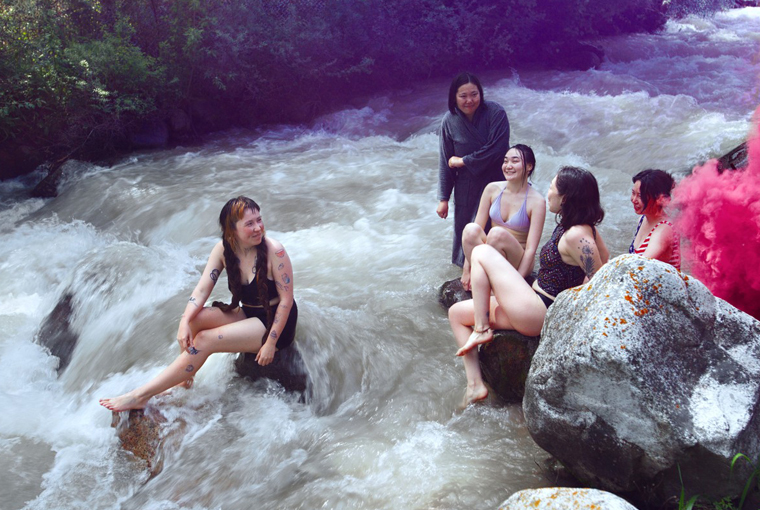
What if a girl were a river, or what if a river were a girl? Undertaking a journey throughout the landscapes of Kazakhstan, in her debut feature documentary River Dreams Kristina Mikhailova enters into a dialogue with the bodies of water and bodies of young women she encounters along the way, painting a poetic state of the nation.
The dreams in the title refer to different kinds, literal and figurative, aspirational and oneiric. In a series of interviews, Mikhailova invites her protagonists – a wide sample ranging from activists and artists to mothers and prison in-mates, spanning women of different ethnicities and social backgrounds – to imagine themselves as a river. Some see themselves as willful torrents, others as gently meandering streams.
Rather than structuring the film according to a strict geographical route or rigid theme, appropriately enough for a work about rivers it has a flowing quality to it. This is apparent both in the overall dramaturgy, and also in the interviews themselves, as, beyond this initial prompt the women are largely given free rein to lead the conversation wherever they feel, and the topics they cover span possibilities and frustrations, plans and desires, language and identity. One girl talks about her love of martial arts, another about her artistic aspirations. Inevitably, the limitations imposed by living under patriarchy are also a recurring theme. Gender-based and sexualized violence is never far away. This intention of giving space to the women to take up however they want is underlined by the editing, as there are very few cuts during the interviews. This dialectical openness is interestingly juxtaposed with the careful and artistic framing of the interview subjects, often combining naturalistic and urban elements in a very stylized way that reinforces the blurred duality of realism and poetry running throughout the film.
Given this free approach, the interactions often take a conversational turn, with Mikhailova’s voice as a director becoming very present. We hear her not only explaining the concept of the film, but also speaking openly about her own experiences and thoughts. She dedicates one section of the film to her own home and family, and, most poignantly, after one interviewee tells a horrifying story of an attempted attack, Mikhailova responds by recounting a similar incident she faced herself. This integration of a directorial first-person perspective feels very natural, creating bonds of empathy with her interlocutors by showing that she’s really listening and engaged, but also demonstrating her willingness to offer up the same vulnerability she asks of others.
The interviews are far from the only visuals, however. There are also many panoramas of rivers and landscapes more generally, some simply beautiful, others showing various types of human-caused devastation. There is a hint at environmental issues in the visual layer, even if the film never addresses them head-on, preferring to give full attention to the topic of women’s lives. As well as some observational materials, for example, girls at a protest in Almaty or hanging out on a river bank, there are many more creative images that add to the dreamy atmosphere. The choice of color palette throughout the film is very bold, with more naturalistic greens and blues combined with striking oranges and pinks. In particular, there is a recurring use of flares, perhaps as a symbol of protest or simply as a gesture of taking up space and acknowledging the presence of women. There are also moments when the film abruptly breaks away from the established visual language, such as a scene of CCTV footage showing a former minister beating his wife to death, which the filmmaker clearly felt was urgent enough to include, again choosing to go with the flow over formal rigidity.
Although one of the interviewees goes so far as to suggest the elimination of men as a means of improving society, men are not completely excluded from the film. Although they aren’t afforded the same individual attention and platform as the women, neither are they depicted in an especially harsh or demeaning manner, even if a lot of them don’t do themselves any favors by implying mildly sexist attitudes in their way of speaking about women. They mostly appear in the context of industrial or military activities, working on or alongside rivers, with a practical rather than a romantic connection to nature. They represent the state the girls would like to see changed, albeit just at the level of the workforce, and perhaps this is also why Mikhailova felt it important to mention the misogyny present in the actual government.
All of these elements come together to create a subtle, nuanced portrait of a generation seeking a better future – as the director says, the way a river seeks out the ocean. Despite the heaviness of many of the issues, the film manages to find a balance between anger, playfulness, and sensitivity. What hope it has to offer comes in the form of the girls themselves, who are shown not as victims but as steadfast and strong, each of them in their own unique way.


Leave a Comment