

Directing From a Distance
Comes Chahbazian’s Here, Elsewhere (2026)
Vol. 167 (September 2026) by Daniel Schwartz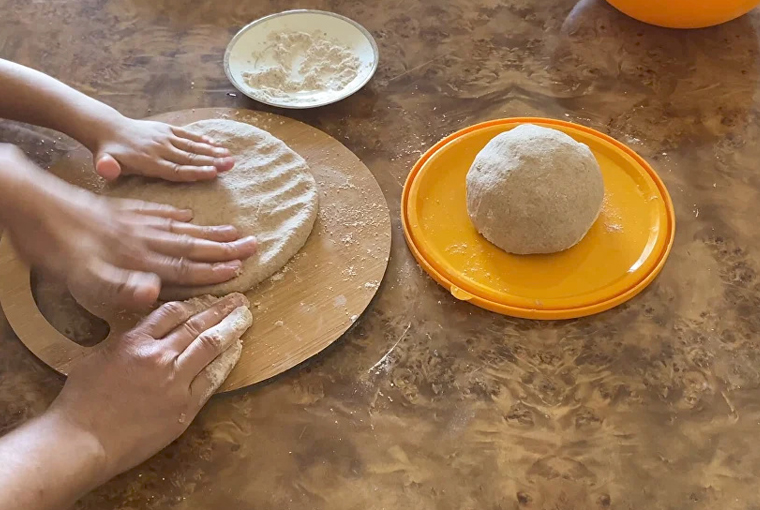
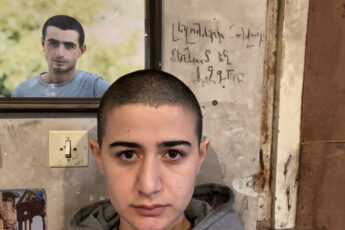
It’s always embarrassing to ask the first stupid question. After a screening of Here, Elsewhere at this year’s Golden Apricot Film Festival in Yerevan, mine was the following: “To what extent is your film influenced by Godard’s Here and Elsewhere?” To which the director Comes Chahbazian replied: “None at all. Godard doesn’t have a monopoly on the words.” Fair enough. The resemblance may only be superficial. Godard and Anne-Marie Miéville’s title refers to the distance between French viewers and the Palestinian fedayeen they are watching on their television screens. Chahbazian’s refers to the distance between Armenians in Armenia (as well as the diaspora) and those living in Stepanakert, the capital of the self-proclaimed Republic of Artsakh, better known to outsiders as Nagorno-Karabakh. In July 2023, Chahbazian began instructing his friends Artsiv and Tatev Lalyan to record their daily lives with an iPhone. The result is a testament to life under siege and the harrowing experience of surviving ethnic cleansing.
Directing from a distance is a process perhaps best captured in Jafar Panahi’s No Bears (2022). One feels like a passive participant in a story in which one is nevertheless deeply implicated. This feeling comes through Chahbazian’s film in its epistolary structure. Not to belabor the French comparisons, but the film’s narrative engine – a series of letters from Artsiv to the director – is reminiscent of Chris Marker’s Sans Soleil. Of course, Marker also doesn’t have a monopoly on this device. Nevertheless, a director cannot prevent the reference from coming to mind. In Here, Elsewhere, the letters quickly establish the relationship between director and cameraperson, absence and presence. One is quickly brought into Stepanakert on the 217th day of siege. There are breadlines, empty streets, barren grocery stores. Artsiv’s wry commentary brings home the strangeness of the scene in the language of Western progress: “Stepanakert has become an eco-friendly capital.”
One thing Here, Elsewhere cannot provide is a sense of the history of the space it is rendering. This would violate the immediacy of the documentary by pulling the viewer out of the protagonists’ daily experience. Yet such a history lesson is important given how little attention is given Nagorno-Karabakh in Western media. It is impossible to deliver in a single paragraph, but here is my best attempt: In 1991, after a failed 1988 referendum to join the Armenian SSR, the Autonomous Oblast of Nagorno-Karabakh declared independence from Azerbaijan just as the Soviet Union was falling apart. The resulting war, which continued conflicts from 1988, led to the establishment of the breakaway Republic of Artsakh in 1994. Never officially recognized by the international community, the republic controlled the area of the former Autonomous Oblast plus seven territories that provided continuity with the eastern border of Armenia. In September 2020, at the outset of the Second Nagorno-Karabakh war, Azerbaijan launched an offensive that would eventually lead to a capture of the seven territories and a blockade of Nagorno-Karabakh. In September 2023, Azerbaijan launched another offensive that resulted in the ethnic cleansing of the enclave in which Armenians had lived for millennia.
The disconnect between this history and the images on screen is difficult to reconcile. If one hasn’t been living with the history for some time, then it can only be brought to the screen with textbook knowledge. In the era of live-streamed genocides, this is one of the potential pitfalls of the iPhone documentary: what it gains in immediacy, it loses in context. It quickly becomes part of the ceaseless stream of horrid imagery, a victim of its own success at disseminating images.
One reason that Chahbazian’s film does not fall prey to this dynamic is that the images it shows are generally not of horrors. It is easy to forget how hard it is to find the presence of mind to record the nightmare one is living in its least sensational aspect. Artsiv and Tatev show us how it’s done. People outside their immediate family are largely absent. We are generally spared gruesome details. Instead, daily routines – cooking, eating, cleaning, sleeping – reverberate with the sounds of war. “I get the feeling God wants to finish us off,” Tatev says. One hears the sound of shelling as the family sits down to supper in the dark.
Stepanakert feels deserted before it’s abandoned. One witnesses the process of letting go, of gathering one’s belongings, of packing the car, of scooping a little bit of soil from the garden into a bag. A child writes a message in Russian on the wall of her soon-to-be former room only to be criticized by her mother: “Do you want the Azerbaijanis to see our spelling mistakes?” Such humor is an essential coping mechanism. In Here, Elsewhere, one observes its development. After the Lalyans have fled, one of their children narrates his experience in the third person. He tells the story of a strange boy and his strange parents. No one listened to this boy and in his city everything was backwards. In his story, one sees the inversion of life become dark humor. It is perhaps the only way to give such traumatic events a sense of resolution.
In Chahbazian’s film, the distance between here and elsewhere is measured physically and emotionally. Along the route out of Stepanakert, one can feel the two locations trade places. What was once here becomes an elsewhere to which one will perhaps never return. “Is this how we mourn the cradle of our fatherland?” Artsiv wonders while observing Christmas festivities in Yerevan’s Republic Square. His question traces a fault line between Armenia and Artsakh. Despite the pain of losing the territory, much of society seems committed to moving on. The continuation of life requires a certain amount of forgetting. Yet this fact is no consolation to those who feel like their lives are being forgotten. Can one honor this loss of homeland without calling for further bloodshed? Or is one obliged to support the continuation of the struggle?
The immediacy of Here, Elsewhere makes approaching such questions difficult, especially for someone who has only begun to familiarize themselves with Armenian history. Despite being about distance, the film is so close to the lives of its subjects that critical distance for an uninitiated viewer becomes difficult to exercise. During the Q&A, one person remarked how much she appreciated the movie because, by chance, it allowed her to catch a glimpse of her old house. Another stood up and recited a poem by Vahan Teryan: “Do not confuse us with your wild, bear-like tribes / Our land lies in ruins, yet it is holy and ancient.” Empires – Babylonian, Assyrian – have come and gone, but Armenian language and culture remain. Such responses speak to the emotional impact of the film as a document of the recent past and a testament to a long and tragic history. It rekindled my sense of what an iPhone documentary can do.

Leave a Comment