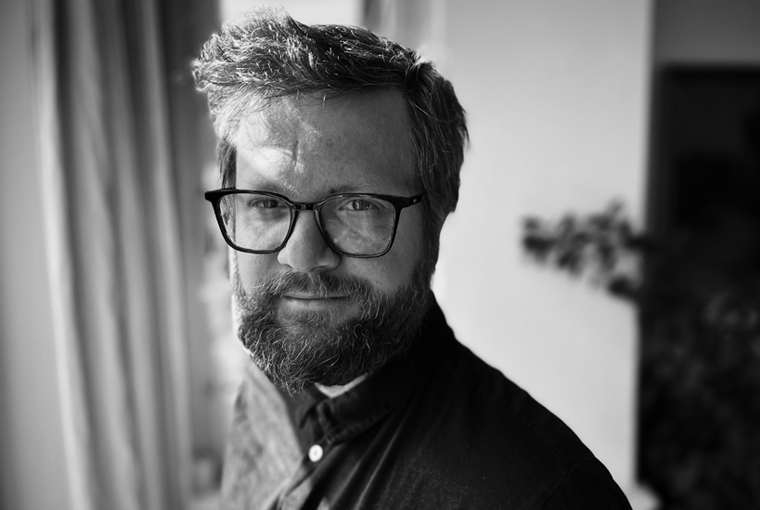
Czech director and screenwriter Jan Těšitel debuted in 2015 with the psychological drama “David,” which achieved success on the domestic and international festival circuit. Since then, he has worked extensively in television and returned to cinemas in 2025 with the crime thriller “All the Good Deeds” and the fantasy adventure “Goldilocks.” Taking “David” as a point of departure, we discussed the consequences of debuting with an art-house film in a small Central European film industry, as well as the necessity of creative flexibility. Těšitel reflects on the changing nature of the contemporary audiovisual landscape, his navigation between arthouse and genre filmmaking, and the tension between an auteur’s integrity and industrial pragmatism.
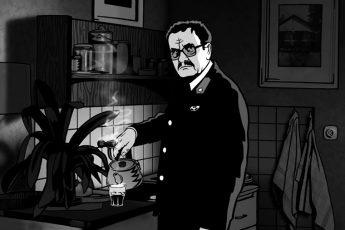
In this issue, I’m taking a retrospective look at your internationally successful graduation film David.1 What was its genesis?
Broadly speaking, David has its roots in my long-term project Plague. It is an adaptation of a comic book trilogy by my wife Milada Těšitelová, developed through a collaboration between illustration and graphic design students at one Prague art university and screenwriting students at another. At its core, it presents a dystopian version of Prague struck by a plague as seen from the perspective of a family trying to cope with the situation. We considered making it into my graduation film and developed it in various directions, but it eventually proved too complex and expensive for it to be completed within two years.
So I told myself I had to come up with something personal that could realistically be shot under those conditions, where limitations strongly restricted both the creative possibilities and the final shape of the project. I wrote a story inspired by the experiences of my mentally disabled brother, and in 2013 we joined the MIDPOINT Institute, an audiovisual training and networking platform. At that point, David was supposed to become a short film and being developed within the MIDPOINT Shorts program. We received the main screenplay award, and it soon became clear that the film had strong potential to become a feature, which I remember as highly encouraging at the time.
The development process itself was far from easy. There was a change of producer, and the budget we managed to put together was extremely minimal even by graduation film standards. We struggled throughout the making of David – the entire crew worked without pay, and it was genuinely a student-like production. Decisive help came from the post-production company MagicLab, whose co-production involvement allowed us to finish the film despite having almost no post-production budget. The film also benefited from the distinctive performance of Patrik Holubář, then an acting student, whose portrayal of David drew a great deal of attention. It was during this process that I fully realized how much I enjoy working with actors and creating the right conditions for their performance.
After graduating from FAMU – the Film and TV School of the Academy of Performing Arts in Prague – you didn’t become an outright ‘art-house’ filmmaker. Your work has been quite varied in that respect. You’ve collaborated with Czech Television for over a decade, worked on documentaries, and your latest feature films include a crime drama and a fairy tale. But back then, during your final years at FAMU, did you see David as the beginning of an auteurial trajectory? Did you want to focus on festival-oriented arthouse films?
Yes. Shortly after David, I began directing for television while simultaneously returning to Plague. We managed to get into the Mediterranean Film Institute, received development support, and pitched Plague at When East Meets West… But then a fundamental problem emerged related to financing – we simply could not convince our Film Fund to back the project. I eventually had to shelve the project, and I honestly no longer intend to return to it.
At the same time, in recent years I’ve reflected quite a lot on my career in the sense that one enters the film industry with certain ideas, but the nature of the industry itself can change rather radically. I remember that during film school my role model in terms of career trajectory was famed Czech director Bohdan Sláma, a filmmaker capable of combining an art-house sensibility with accessibility, someone with both international success and domestic relevance. He showed me that a person could spend two years writing, then direct and edit, and release a film every three or four years. At the time, as a film student and emerging filmmaker, that was roughly how I imagined my own future.
But this rhythm, which suits both art-house filmmaking and me personally, gradually ceased to be sustainable around 2015. As digital technologies made filmmaking significantly cheaper, the volume of produced content grew dramatically. While this created more opportunities across the industry, it also changed the economic reality for filmmakers. Making one personal film every four or five years was no longer enough to sustain a career.
To make a living, many directors, myself included, had to engage more frequently with commissioned work for television, streaming platforms, or commercial projects. The boom in content production opened new professional possibilities, but it also introduced a different challenge: balancing continuous work with the time, focus, and creative energy that more personal projects require. Art-house films often need years of development, reflection, and experimentation – resources that become harder to protect when you are constantly moving from one deadline to another.
I had to figure out how to function – and how to survive – within this rapidly shifting filmmaking landscape. I realized I needed to strive for something different than simply being an ‘auteur filmmaker.’ That original idea, though natural in many ways and heavily shaped by studying directing at FAMU, increasingly revealed itself to be incomplete. If I wanted to continue making personal films, I also needed to build a broader and more sustainable professional practice around them.
I’d say you managed to establish yourself quite firmly as a television creator rather early in your career. Did the success of David help you in the audiovisual industry in any way?
I have to say, not really. In television it turned out to be largely unusable, and the same was true in advertising, where I spent some time as well. The experience of making David would only have been directly relevant if I had continued exclusively along the path of auteur filmmaking.
What is important to understand, however, is that David was developed at a moment when I still believed my future would be centered almost entirely on auteur filmmaking. By the time the film premiered, I had already started to realize that I needed a more dynamic and sustainable career path – one that would allow me to keep working continuously rather than spending years at a time waiting in-between projects.
There is also one relatively under-discussed but absolutely crucial aspect tied to auteur and festival filmmaking: luck. I have classmates who screened short films in Cannes and later made one or two features that enjoyed festival success, but never returned to Cannes or a similarly prestigious festival again. A film can be excellent, resonate internationally, and collect awards – which David did to some degree – but there are so many variables involved that luck inevitably plays a significant role.
I realized that I wanted my career to be built on something more stable than waiting several years for the next personal project and hoping for the right festival outcome. Sustainability, continuous work, and the opportunity to keep developing as a filmmaker became increasingly important to me. Looking at the long term, I found myself drawn less to the idea of one major breakthrough every decade and more to the idea of a consistent trajectory that would allow me to keep making films, learning, and working across different formats.
For example, I’m a huge admirer of director Zuzana Kirchnerová and have followed her work for many years. I was thrilled when she won the Cinéfondation Prize in Cannes in 2008 for her graduation film Bába, and equally happy when she returned to Cannes seventeen years later with Caravan in the Un Certain Regard section. It was one of the most significant international successes of Czech cinema in recent years. I know Zuzana personally and I know how difficult that journey was.
What I admire about her career today is not only the auteur work itself, but also her ability to move between personal projects and substantial commissioned work. She brings her own voice and sensibility into projects she did not initiate, while continuing to develop her own films. To me, that represents an ideal balance. I’m grateful that such a path exists, but I also realized quite early on that I wanted my own career to be more dynamic.
We’ve touched on your work in television several times, and it’s clearly become a major chapter in your professional life. You entered television already during your studies. How did that happen?
Czech Television decided to create a new serial adaptation of Karel Čapek’s short stories Tales From Both Pockets, with young film students directing the episodes. They approached directing students not only from Prague’s FAMU but also from film schools in Písek and Zlín. I think it was a great idea and an opportunity for young filmmakers to enter the television environment and gain hands-on experience with a different mode of directing.
At the time, I was recommended by one of my classmates, who was also working on one of the episodes. At the same time, Czech Television already knew me because they had co-produced my short film People Involved (2010). That co-production happened because the film was shot on 35 mm – bachelor films were still being shot on film stock back then – and Czech Television had laboratory facilities.
You describe it as “a good idea and an opportunity for young filmmakers to enter the television environment.” That gives me the impression that cooperation between television and Czech film students wasn’t exactly common…
Back then, there was virtually no cooperation at all, certainly not on an institutional level. People from Czech Television lecture at the production department, so there is collaboration there. But no systematic cooperation existed with the directing department. And I think that was also because television production wasn’t presented as something relevant or desirable for directing students. Moreover, people at school viewed television as something inferior to cinema. And naturally, for students, cinema and the big screen are far more attractive, which I completely understand. But things were never that black-and-white, even back then, because Western television was already experiencing the boom of artistically ambitious quality TV, which revolutionized the way long-form storytelling worked on the small screen.
At the same time, I think the distrust was mutual. Unfortunately, Tales From Both Pockets remained an isolated experiment and didn’t deepen the trust between television and young filmmakers. Shortly afterward, the management at Czech Television changed, and the new leadership wasn’t interested in working with emerging creators. Instead, they leaned toward established directors and prioritized developing the quality TV model they wanted to promote in the Czech context. Indeed, rare exceptions existed.
The years around my graduation were critical in this respect. If I had the opportunity to study filmmaking again and knew then what I know now, I would seriously consider whether it wouldn’t be worthwhile to create a project that could also function as a package for the developing television market. For example, I would still make David the same way I did back then, but I’d probably think more about how it could potentially be expanded into something like a miniseries.
You’ve directed regularly for Czech Television for more than ten years. You’ve focused primarily on travel documentary series, achieved success in children’s programming, directed dozens of episodes in the Czech Republic, Slovakia, Austria, and France… Did you ever feel that you were losing relevance on the cinematic map?
Definitely. I experienced that as a fairly fundamental problem. The more I worked on documentary productions, the further I drifted away from the world of fiction filmmaking. Even film producers must have perceived me as a ‘television documentary filmmaker.’ I felt this very strongly when I pitched a heist miniseries project to producers at Czech Television. That’s simply how they saw me… But honestly, I understand them. It’s a conservative institution in terms of how it works with new auteurs. Today my position would hopefully be different.
You mentioned the heist miniseries, and later you directed the procedural crime film All the Good Deeds and the adventure fairy tale Goldilocks. Until then, you were known as the creator of the psychological drama David and as a director of travel documentaries. What actually drew you toward such strongly genre-oriented storytelling?
My love for genre filmmaking has been with me since my youth. My three formative films in the 90s were My Own Private Idaho (1991), The Last Boy Scout (1991), and Breaking the Waves (1996) – a mix of auteur, art-house, and highly commercial genre cinema. Both my bachelor’s and master’s theses focused on the work of David Fincher. Genre filmmaking has always been close to me because of its emphasis on storytelling techniques. When there is a certain idea – say, Hamlet – I have always been fascinated by the different adaptations. More generally, I also really enjoy cover versions of songs: one song, one idea, one melody, but countless ways of interpreting it, with creators choosing a particular approach each time. I think genres work in a similar way. At their best, they are different interpretations of the same fundamental human ideas – one theme, one question, but countless ways of telling the story.
For a while, FAMU pushed my interests toward auteur cinema. Hardly anyone there paid much attention to genre filmmaking, and in terms of budgets and shooting conditions, the school certainly does not prepare you for genre production. Gravitation toward personal artistic expression at a young age is entirely natural – and when should one be personal if not in a debut? But later, when I started thinking about my career and what it means to be a director in the Czech Republic, I realized that those who are truly successful tend to have a much broader genre range, like Peter Bebjak, who is capable of adapting virtually any genre whilst maintaining a consistently high level of quality. In recent years, this flexibility and genre range have interested me more and more. I enjoy it because it allows me, as a filmmaker, to explore different storytelling modes, since every genre comes with different demands.
I also feel it gives me a certain universality – the ability to give producers confidence that I can handle different types of storytelling. To function fully within the film industry as a director and make a reasonable living from it is not easy at all… But if I want to make a living from filmmaking, I feel I need a portfolio of projects, which naturally implies they will not all belong to the same category. I also simply enjoy developing very different projects in parallel. Alongside that, I want to have a purely auteur project where development can be genuinely careful and nothing is rushed – and where I am not financially dependent on it, as I was back then with Plague.
After the experience with the heist miniseries, you ultimately turned toward the crime genre and adapted Kristýna Trpková’s novel All the Good Deeds, which follows two investigators tracking the murder of a young girl. How did that happen?
When I pitched my heist miniseries to Czech Television, I could immediately see how unsure the producers were about what to do with it or where it would fit into the broadcasting schedule. Within television, there are designated slots for specific formats, and people who work there tend to think heavily within those structures rather than distinguishing between subgenres. I realized I would most likely continue encountering the same kind of rejection and misunderstanding, so I needed to come up with a ‘pure’ crime story.
I began searching for a literary source and discovered a crime trilogy by the young writer Kristýna Trpková, specifically the middle installment, Village, which deals with missing children. That topic has affected me deeply for a long time, and I always react strongly to such stories in the news… I then read Monster, the first book, followed by Intruder, the final installment. The trilogy consists of three cases connected by one evolving emotional arc between the two central investigators. I was deeply drawn to it and thought it would be fantastic to adapt the entire trilogy.
I managed to convince Kristýna herself, and I also reached an agreement with the producers from Film Kolektiv. For a long time we discussed how best to approach the adaptation; the development process was very demanding and complicated. In the end, we decided to adapt the first book, with the understanding that if the film proved successful, we would continue adapting the remaining installments and complete the whole trilogy.
In All the Good Deeds, one can still sense a certain continuity with David – in the intimate, inward-looking storytelling focused on psychology and relational tensions. Goldilocks, however, is a family fantasy project full of action and visual spectacle. How did you think about the parallel existence of these two modes of storytelling?
Yes, they are two completely different projects in terms of both genre and scale. Almost as if they were made by two different filmmakers – which is really not common. It relates to what we discussed earlier: I love thinking about different forms of storytelling, adapting to different filmmaking challenges, and at the same time building a genre-diverse portfolio, which I see as crucial for my career. That’s the way I approach things.
Goldilocks can be considered a ‘big-budget’ movie by Czech standards, generous even in terms of shooting days – we had 36, which is really reserved only for demanding large-scale productions. All the Good Deeds had roughly half that in both respects.
The offer to direct Goldilocks came at a time when I was already developing All the Good Deeds. Around then, I had started teaching directing at the Prague Film Institute, which is run by producer Viktor Krištof from Three Brothers Production, who offered me Goldilocks. It was an extremely bold decision on his part – at that point, I was only developing my second feature, and I had absolutely zero experience with fairy tales as a genre… Unlike All the Good Deeds, the film was already fully financed and in a very advanced stage of development. We shot Goldilocks between April and June 2024, post-production followed immediately afterward, and All the Good Deeds was shot between February and March 2025. So in practice, the projects directly followed one another.
Genre flexibility is undoubtedly a key characteristic of your work and something you yourself emphasize. On the other hand, is it also important for you to perceive artistic continuities and similarities across your films?
I’ve thought a lot about what kind of filmmaker I am when my body of work can include an intimate personal film, a crime thriller, and an action fairy tale. I think the connection lies in the themes surrounding the characters. I’d say there’s a certain melancholy running through all my films, as well as characters who need to forgive themselves. They possess a strong degree of self-reflection, and in order to move forward, they first have to come to terms with their past. At the same time, formally speaking, what matters to me is creating an emotional experience for viewers that feels physical, ideally something they experience together with the characters. In David, that’s the crane scene; in All the Good Deeds, it’s the hospital scene; in Goldilocks, it’s the execution of the protagonist.
As for similarities in themes and motifs, I think those elements emerge intuitively. Since they exist so deeply within me, they appear in the work almost like an underground current that gives these stories a certain texture and depth. My ambition is always to function within genre conventions while elevating them slightly through this underlying emotional current. Nowadays people call this “elevated genre.” With Goldilocks, for example, viewers get what they expect in terms of spectacle, costumes, and the beauty of the princess, the protagonist is noble and heroic and so on, but at the same time they receive something more…
Goldilocks really isn’t a conventional, cheerful fairy tale, but rather quite a dark and melancholic story, as you say, one where motifs of death and resurrection are rather explicit.
Essentially, what is the story about? The fairy tale tells of the hero Jiřík, who eats a magical snake and from that moment gains the ability to understand animals. But at the same time, from then on, the sword of Damocles hangs over him because he disobeyed his king, and death threatens him throughout the entire story. Yes, it’s a fairy tale in which the hero journeys to find a princess and love ultimately triumphs, but it becomes a very different viewing experience when we know he’s pursuing the princess in order to save his own life.
Did your previous experience in television help you with a project this complex?
It’s very hard to say – something like this can hardly prepare you for such a project… The television projects I worked on certainly required a great deal of flexibility. Working with various producers and creatives, both internal and external; the ability to adapt and compromise or search for common solutions; the ability to assert your own creativity and artistic opinions within different environments. Communication skills are therefore absolutely crucial, which also became apparent during the production of the travel documentaries themselves, when we were constantly on the move and working in the field. Television certainly kept me active; there was truly a huge number of projects…
On the other hand, comparing the directing of a television travel documentary and a large-scale fantasy fairy tale feels very unnatural to me, and I’m not even sure it can really be done… It’s as if you were playing the guitar by a campfire and then suddenly moved with that same guitar into a huge concert hall with an orchestra. Did playing by the campfire help the guitarist? Well, probably yes…
They learned how to hold the guitar…
Exactly… But that’s about it.
For several years now, you’ve worked as one of the principal directing tutors at Prague Film Institute (PFI), a private film school in central Prague aimed primarily at international students. You are one of the key architects of the school’s current educational concept. What does it look like?
I had never taught before, nor had I ever considered that I might one day devote myself to teaching. So I could mainly rely on my own student years at FAMU. Of course, I have no experience in public education, but I can definitely say that at a private school I feel both great freedom in designing syllabi and approaching students, and also a great deal of responsibility.
A lot of young filmmakers solve filmmaking problems intuitively, and when teaching it’s extremely important to find the right terminology for intuition. When you read books on storytelling, authors use different terms for the same thing. And it turns out that the way things are explained matters enormously, because then the ideas can resonate in exactly the right way. Likewise, it’s important to know how to use books on screenwriting or story structure creatively and authorially. Once you find concepts and terms that truly make sense to you, it’s like learning to ride a bicycle; you try and fail, then suddenly it works, and there’s no going back and no possibility of forgetting it.
I place strong emphasis on practical filmmaking education, on hands-on experience. In the mornings I present students with a filmmaking challenge, and in the afternoons, we shoot it and demonstrate different ways it can be approached. For example, a scene around a table, a scene in a car, or characters walking. Regarding sound design, I’ve found it very effective to work with scenes from existing films into which students insert their own sound effects. It demonstrates beautifully and very clearly how profoundly sound can transform the entire conception of a scene. Over the years, this hands-on approach has proven extremely successful for us, students appreciate it, and many of them have grown enormously as filmmakers.
At the same time, I try to explain to students how the theme manifests itself in storytelling and form, and how a proper understanding of the theme can help guide decisions during preparation, production, and post-production. Theme becomes a kind of compass that determines what the project fundamentally is, which decisions are right for the story being told, and which decisions would instead undermine it.
In film education, ‘craft’ and ‘art’ are often presented as opposites. Do you perceive a genuine conflict between them?
That’s an incredibly complicated topic… Almost immediately after I graduated from FAMU, the school experienced a fairly large and publicized crisis centered on the distinction between ‘craft’ and ‘art’ – what students should primarily master, and what a film school should emphasize more strongly.
Personally, I think film is such a specific and autonomous discipline, such a communicative tool, that it almost resembles a language. We need to understand how to use those linguistic, ‘craft-based’ elements in order to precisely convey that which we want to communicate. So I don’t see any contradiction or conflict there. For me, the way something is told is inseparable from the medium itself. Simply put, if you want to get your message across, you should know how to do it effectively. Separating art from craft is like opposing form and content; I see no point in it. Form is the language through which film communicates, and I can’t understand why someone who loves cinema would refuse to engage with the language through which it speaks.
If I draw from my own directing studies, I’d say this issue is also strongly connected to personal taste and worldview. Film school and the environment it creates tend to reinforce this mindset, but the problem is that this mindset won’t actually help you sustain a career in the industry. At PFI, we try to teach students not to become trapped by their own taste. Yes, of course, have your own project and your own perspective, but don’t become blindly enclosed within it. We want everyone to be capable of helping everyone else, regardless of artistic ideals. We want them to help a colleague on a film they personally might never make themselves. And to genuinely want to learn something from that experience.
Throughout this interview, you’ve referred to changes within the audiovisual landscape. Do you also try to prepare students for the clash between filmmaking ideals and industrial reality?
Yes, very often. I try to help them understand that the audiovisual environment is changing dramatically, especially in recent years, and that many of the ideas they enter school with are either unrealistic or gradually ceasing to apply. And honestly, looking back, I have increasing empathy for my former teachers, because the notion that a young person full of ideals will automatically listen to their tutor simply doesn’t always work.
The truth is that students will ultimately have to discover many things for themselves. Even though I genuinely try to provide shortcuts so they might not have to go through exactly what I had to go through. At the same time, I don’t want to look at my own path negatively. I think people need to find a certain flow in which they feel comfortable and capable. And perhaps the ideas they originally had were based on something else entirely, not on who they actually are, perhaps they were based on what the school environment encourages. When you’re twenty-five and studying at an art school, you’re extremely susceptible to influence.
I also try to communicate that what filmmaking is about is more than articulating a ‘statement’ and waiting for ‘inspiration.’ A huge part of filmmaking is simply discipline – for example, the ability to meet deadlines or finish a screenplay. It isn’t glamorous, but that’s the reality. Discipline equals professionalism, and filmmakers simply have to possess it. I find it quite amusing, because I struggled with exactly the same issues as a student myself.
Do you plan to return to art-house poetics?
Yes. In fact, I’m currently developing one such project. But at the same time, it’s not exactly an ‘intimate social drama’ type of project. It’s something positioned between art cinema and genre filmmaking, with strong horror elements. Together with producers, we’re developing a continuation of All the Good Deeds; there are also some fairy-tale projects in discussion; I’m continuing to develop my heist crime project, which I strongly believe in. With Czech Television, I’m also preparing a children’s series combining live action and animation, and we’ll begin shooting relatively soon… Things are in motion… There is the right kind of flow at the moment.
Thank you for the interview.
- The review can be accessed through the following link: https://eefb.org/retrospectives/jan-tesitels-david-2015/. ↩︎
Leave a Comment