

Independent Cinema Moves Wherever It Wants
Ivan Boiko’s The Wind Blows Wherever It Wants (2025)
Vol. 164 (April 2026) by Natalia Ashurovskaya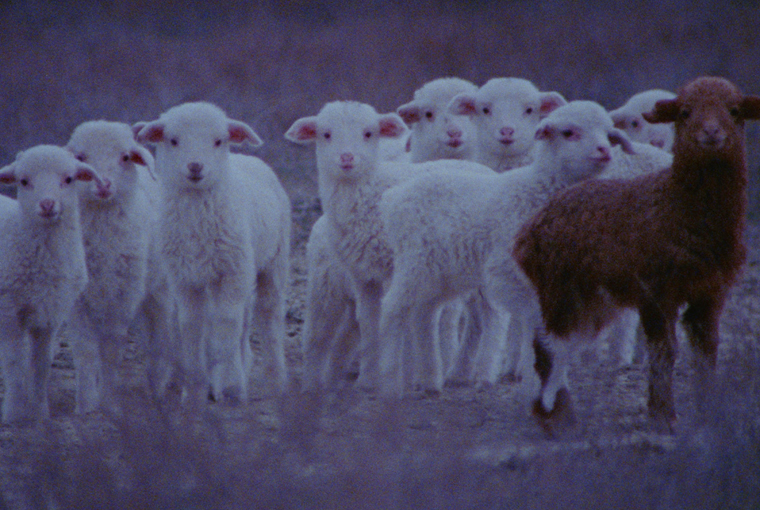
In The Wind Blows Wherever It Wants, Ivan Boiko follows Tushetian shepherds as they guide their flocks across Georgia, from the snow-covered peaks of the Caucasus to the arid steppes of Vashlovani and back again. This seasonal migration is not presented as an event, nor as a narrative journey with a beginning and an end. It is a cycle – repetitive, continuous, indifferent to dramatic structure. The film does not ask where the shepherds are going. It attends instead to the necessity of their movement, not as a destination but as a condition of existence.
In this 69-minute film there are no protagonists. Not among the shepherds, who remain distant figures scattered across vast landscapes, and not even among the animals, despite the camera’s attentiveness to the flock. Sheep fill the frame, disperse into the horizon, condense into shifting patterns that resemble currents rather than individuals. With striking visual sensitivity, the film captures scenes from the everyday life of the herd, revealing a world structured by repetition, rhythm, and subtle variation.
The title, drawn from a biblical phrase, immediately establishes a particular horizon of expectation. The Wind Blows Wherever It Wants signals, from the outset, a work that does not align itself with critical distance or playful self-awareness. Instead, it invokes a register of seriousness that situates the film within a tradition that is less interested in commentary and more in contemplation. The absence of irony is particularly significant here. In much of contemporary cinema, irony functions as a protective mechanism, allowing both filmmaker and viewer to keep their material at arm’s length. Boiko’s film refuses this distance. It does not offer interpretive shortcuts or tonal relief. At the same time, this seriousness does not exclude moments of humor. They appear quietly, almost incidentally. These moments do not break the film’s tone but deepen it, reinforcing its attentiveness to a world that unfolds beyond human control.
The effects of the wind may be observed, but its boundaries cannot be discerned by human senses, and the wind itself can neither be harnessed nor directed by human efforts or ingenuity: we can’t see wind but we can feel it. This fundamental idea permeates the film entirely. If one were to reduce the film to the conventions of a synopsis, the result would appear almost absurd in its simplicity. The wind blows. The sheep move. A lamb is born. The flock continues its passage. At a high mountain pass, a snowstorm does not interrupt the journey. The animals endure. They arrive. The shepherds perform a ritual marking the successful crossing. And then the cycle begins again. Yet such a description fails precisely because it attempts to impose narrative hierarchy on a film that refuses it.
Boiko, who followed the shepherds over the course of sixteen months, does not construct a story. He constructs a sense of duration and aestheticism. What emerges is not a sequence of significant moments but a field of ongoing processes in which human, animal, and environmental rhythms coexist. Shot on 16mm, the film achieves a material density that digital images are fundamentally incapable of producing. Grain, texture, and exposure shifts do not decorate the image but enable it to register nuances of light and color that digital formats inevitably smooth out. Rather than merely representing the landscape, the film seems to absorb it. The surface of the 16mm stock seems to respond to environmental conditions, as if it was subject to the same forces that shape the movement of the flock.
All of the above inevitably places this film within what is often referred to as niche cinema. This is not simply a matter of scale or limited circulation, but of orientation. Films of this kind do not seek to accommodate the viewer through familiar narrative structures or emotional cues. They resist accessibility in favor of a more demanding mode of attention, one that unfolds slowly and without any guarantee of resolution. In the context of the filmmaking industry, such niche films are often determined by financial constraints. Many of these works emerge far away from major production centers. Filmmakers working independently rarely have access to expensive equipment, well-known actors, or big-budget locations. Yet these conditions do not prevent filmmakers from producing works of significant artistic value, films that resonate strongly while traveling the festival circuit and occasionally find their way into wider distribution. Following its premiere at International Documentary Film Festival Amsterdam, the film was screened three times at the goEast Film Festival at Wiesbaden, where it was met with visibly engaged audiences and lively discussions with the director.
Seen in this light, The Wind Blows Wherever It Wants commands particular respect. This Georgian and British co-production was realized by a remarkably small but highly functional team that managed to secure the necessary resources and bring the film to a precise aesthetic level. The music and sound-design remain laconic and clean, never overwhelming the image but supporting its rhythm. The images display a nearly classical sensibility, which Ivan Boiko himself linked, during the press conference, to the influence of F. W. Murnau and German Expressionist painting. Editing, however, is where the film reveals its strongest formal intelligence. The cuts are deliberate and often unexpected, producing connections that feel at once intuitive and paradoxical. Rather than simply organizing the material, the montage activates it, allowing the 16mm footage to unfold in all its richness and complexity.
In recent years, ecological thinking and posthumanist theory have increasingly challenged the centrality of the human subject in both academic discourse and artistic practice. Rather than organizing the world around human intention and meaning, a growing number of films have begun to register the nonhuman – landscapes, animals, plants, atmospheres, temporalities – as primary agents of cinematic experience. Within this framework, the notion of nonhuman cinema does not simply imply the absence of human characters, but rather a displacement of humans as the primary organizing principle of the image. The camera ceases to function as an instrument of human vision and becomes something closer to a participant, embedded in the material and sensory life of the world it records.
The Wind Blows Wherever It Wants can be situated within this emerging field. The film does not foreground human intention or interiority. Instead, it constructs a perceptual field in which humans are but one of many elements. This decision fundamentally shapes the viewer’s experience. The director’s background in photography and geochemistry is evident in the precision of his observational approach. Wind passes through grass, animals adjust their positions, clouds gather at the edge of the frame. Within this flow, human presence appears provisional. Deprived of narrative anchors, we begin to register something else: the slow passage of seasons, the gradual transformation of light, the subtle shifts in tone as wool absorbs the colors of the surrounding environment.
The work recalls, in different ways, the traditions of filmmakers such as Artavazd Peleshyan, Roberto Minervini, Michelangelo Frammartino, Viktor Kossakovsky, and Ildikó Enyedi. What unites these filmmakers is not a shared style, but a shared refusal of convention and attention to non-human subjects (plants, animals, transformation of nature). Boiko’s film operates within this same logic. It does not follow established narrative models or documentary expectations. The result is a form that feels less construed than discovered, shaped not by the demands of storytelling but by the internal logic of the material itself.
In a moment when documentary cinema increasingly seeks to explain, to argue, or to position itself within clear ideological frameworks, Ivan Boiko proposes something far less accommodating. He refuses explanation. He refuses emphasis. He refuses to translate experience into meaning that can be easily consumed.
Instead, The Wind Blows Wherever It Wants insists on something more demanding. It asks the viewer to abandon the expectation of dramatic narration and to accept a different form of engagement, one grounded not in interpretation but in attention. And perhaps this is where the film becomes most radical. It does not attempt to save what it observes. It does not mourn it. It does not explain it. It simply aligns itself with its logic. The wind blows wherever it wants. Independent film exists in much the same way.
Leave a Comment