Limits of Hermits
Miro Remo’s Better Go Mad in the Wild (Raději zešílet v divočině, 2025)
Vol. 162 (February 2026) by Martin Kudláč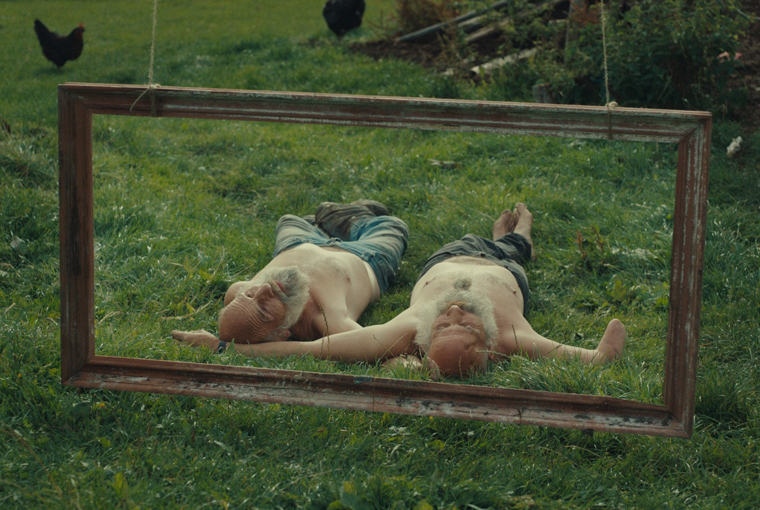
Slovak documentarist Miro Remo won the top honor in the main competition of the 59th Karlovy Vary International Film Festival. His poetic documentary follows sexagenarian twins František and Ondřej Klišík, who live a near-hermit existence in the semi-wild landscape of Šumava in the Czech Republic. Filmed over the course of a year, the work observes their recurring routines: the daily upkeep of their isolated homestead, familiar cycles of quarrel and reconciliation, František’s intermittent impulses to leave, and Ondřej’s commitment to maintaining the fragile equilibrium that keeps their world intact. What begins as a study of eccentric solitude gradually reveals a contained drama shaped by long-term co-dependence, an understated search for the poetic in ordinary life, and the realities of living off the grid in the 21st century.
While inspired by Aleš Palán’s eponymous book on Šumava hermits, Better Go Mad in the Wild narrows its attention to a single microcosm. The initial concept, which aimed to portray several protagonists, shifted after two of them, Mirek Sedláček and Martina Kyselová, died before their stories could be completed. What remains is a portrait of a relationship defined by affection, confinement, and family ties. One brother is impulsive, dreamlike, and dadaist in his sense of freedom; the other is more grounded, pragmatic, and inclined towards care. Together they form a self-contained ecosystem in which tenderness and aggression, irony and attachment continually switch roles.
While Miro Remo established his signature through provocative, at times contentious, observational documentaries, Better Go Mad in the Wild adopts a more deliberately shaped visual and narrative approach. In This Is Not Me (Richard Müller: Nespoznaný, 2016), he examined the pressures and vulnerabilities of Slovak pop singer Richard Müller, allowing the camera to remain present even as the artist descended into the lower arc of his manic-depressive cycle. At Full Throttle (Láska pod kapotou, 2021) followed a couple devoted to regional autocross, centering on a middle-aged Czech driver confronting the aftermath of a difficult divorce and long-term family tensions. Set within the milieu of amateur motor racing, the film blends observational material with stylized elements to portray both an individual and a post-1989 generation seeking a sense of purpose and stability in a life propelled forward at unrelenting speed.
Better Go Mad in the Wild approaches the brothers’ way of life through a poetic lens and filters it with a touch of magical realism. Now in their sixties, the twins inhabit a modest family homestead with a few animals and a house in gradual disrepair. Their daily rhythm is straightforward. Beyond tending to the homestead, the animals, and their own basic needs, they seem content within the simplicity they have chosen. Although they are twins, their temperaments diverge. One is more of a dreamer with a bohemian sensibility, the other more pragmatic and rational. These differing outlooks generate periodic tension, yet the film repeatedly returns to moments in which disagreement gives way to understated gestures of mutual care and a form of sibling closeness that remains intact despite their conflicts.
Remo offers only limited insight into the brothers’ background, so Better Go Mad in the Wild avoids the conventions of a biographical portrait. The film briefly mentions that the twins were dissidents under the Communist regime and signatories of Charter 77, and a short news clip indicates they were later recognized for their underground activities after 1989. Beyond this, they appear to have led largely self-contained lives in near-complete isolation. The documentary does not show them interacting with others, although František notes that he occasionally visits local pubs. His drinking becomes a recurring source of conflict between the brothers, and he remarks that it will likely be the reason he dies first.
The most immediate way to distinguish them visually is František’s missing arm, lost in a sawmill accident. Among the few glimpses into their personal histories is their shared bachelor status. They recount, in their idiosyncratic manner, past relationships and the reasons they ended, which in František’s case appears closely linked to his long-standing alcoholism.
Remo introduces an unexpected narrative device in the form of a cow that speaks in voice-over, performed by Czech actor Jiří Lábus who has dubbed Marge Simpson into Czech for decades. This is the film’s most pronounced departure from documentary convention. The choice introduces a curious eccentricity that slightly disrupts the observational mode by adding a fable-like layer, nudging the work towards a docu-drama hybrid. In this sense, Better Go Mad in the Wild echoes elements of Remo’s early career, notably his multi-awarded poetic short Arsy-Versy (2009).
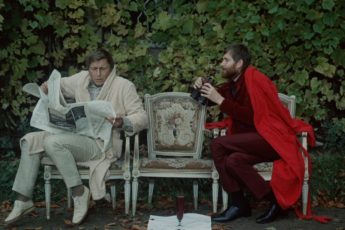
Here, however, the visual design is more considered. Remo employs mirroring as a recurring metaphor, using a large mirror placed around the farmstead and in the surrounding forest to extend the theme of duality. The film is shot by Slovak cinematographer Dušan Husár, who previously lensed Adam Sedlák’s fast-paced miniseries Adikts (2024), centered on a group of addictology students experimenting with altered states, as well as Vojtěch Mašek’s hallucinatory historical drama Arved (Arvéd, 2022) about a Czech occultist who collaborated with both the Nazi and Communist regimes.
Remo combines direct observation steeped in rural realism with more lyrical and surreal devices. Mirrors and reflections function as recurring motifs of duality, reinforcing the film’s focus on the brothers as two distinct yet inseparable halves of a common existence. Animals are not used merely as atmospheric detail but appear as counter-rhythms within the film’s structure. This becomes most apparent in an incident involving the family bull, which evolves into one of the documentary’s few action-driven sequences. The brothers recount a near-fatal encounter in which one of them was severely injured and had to be airlifted from their remote homestead to the hospital, underscoring both the isolation in which they live and the precariousness of their chosen way of life.
The hybrid form and the chosen portrayal of modern-day hermits carry predictable risks, including the aestheticization of poverty, an overemphasis on eccentricity, or a tendency to romanticize the outsider figure. Each of these elements appears to some extent in the film. Remo nevertheless proposes a different perspective on contemporary hermit life. Although hard physical work and a pared-down existence remain central to the brothers’ routine, the film also reveals moments of playfulness and a gently poetic dimension. Both men retain traces of childlike behavior, which surfaces in small, sometimes whimsical projects, such as František’s attempt to build a perpetuum mobile, as well as in decisions that appear impulsive or unwise.
In this way, Better Go Mad in the Wild partially demythologizes life off the grid. It acknowledges the romantic, at times Thoreausque, associations that continue to surround self-sufficiency yet balances them with a more grounded view of the contradictions present in such a lifestyle. The documentary ultimately positions itself more as a social inquiry than a psychological study, offering a patient observation of a way of life that remains firmly outside the mainstream.
Better Go Mad in the Wild brings together two strands of Remo’s practice: the playful, collage-like inventiveness of Arsy-Versy and the more rigorous process-based observation found in his later works. It is, however, his most overtly poetic film to date. The cinematography moves between cinema verité attentiveness and carefully shaped compositions executed with the precision and lyricism of art photography, particularly in the site-specific land art arrangements placed in the forest and around the farmstead.
The film’s win of the top prize in the main competition at the Karlovy Vary International Film Festival carries a somber coda. Only three days after celebrating the premiere, František was found dead in a pond near Prague. His dark premonitions voiced in the film, as well as his brother Ondřej repeatedly warning him about his habits, proved prescient.
In the end, Better Go Mad in the Wild reads less as an ode to simple living and more as an eccentric paean to brotherly attachment, shaped by the fragile balance between closeness and solitude that defined the twins’ shared life.
Leave a Comment