

Balkanized Ballet: Comrades, Corpses, and Ballerinas
Vicky Jewson’s Pretty Lethal (2026)
Vol. 165 (May 2026) by Anna Batori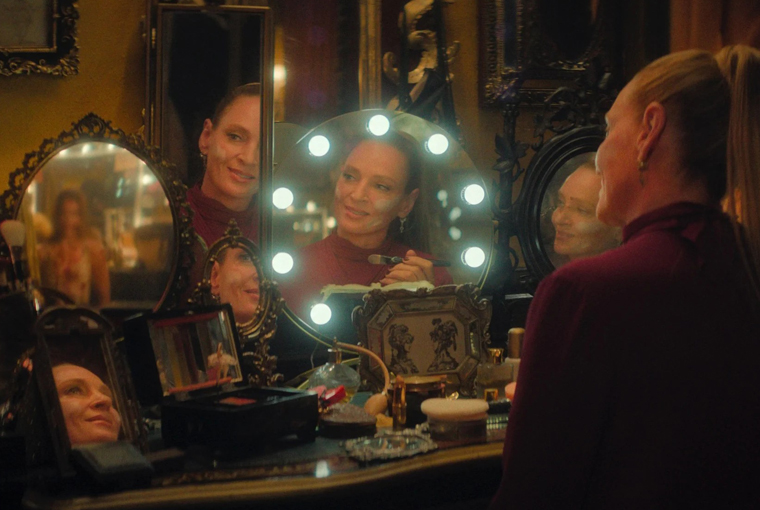
As a devoted admirer of B-horror and exploitation cinema, I usually have a high tolerance – even affection – for films assembled out of awkward editing, uneven performances, narrative absurdity, and directorial excess. What makes Vicky Jewson’s Pretty Lethal problematic, however, is its tonal uncertainty. It remains difficult to determine whether it is deliberately bad – that is, if it consciously aspires to horror parody, or perhaps to a playful exaggeration of body-horror conventions, or whether it takes its own premise seriously and simply ends up belonging to the category of films that are unintentionally, yet entertainingly, bad. This ambiguity becomes the film’s central weakness. Instead of producing irony or tension, it leaves the viewer suspended between incompatible registers of reception. One is never entirely sure whether to laugh at the film, with the film, or despite it.
Pretty Lethal follows a talented ballet troupe traveling to Budapest for a performance. Instead of arriving in the Hungarian capital, however, the young dancers soon find themselves stranded ‘on the other side of the world’ after their bus breaks down somewhere in the countryside. Seeking refuge, they end up at Teremok Inn – an abandoned villa deep in the woods that is, unsurprisingly, exactly the kind of place one instinctively avoids. Its owner, Devora Kasimer (Uma Thurman), presides over a grotesque torture house concealed beneath the villa’s theatrical façade.
From this point onward, the film shows little interest in explaining its own internal logic. Why the fingers of the dead are severed in the basement, what purpose these body parts serve, or how the dancers manage to drift so implausibly far from their intended destination remain conspicuously unanswered questions. Yet narrative coherence is clearly not the film’s primary concern. Its real energy lies instead in visual excess and a deliberately overdesigned mise-en-scène.
Devora’s domain resembles a decadent, almost Romero-inflected nightmare: antique furniture, ballerina relics, saturated red, neon, and yellow lighting, oversized nutcracker figures, and Béla Tarr-like stage performers who intermittently break into distorted, solitary vocal numbers resembling fractured folk songs. The villa functions less as a believable location than as an absurd theatrical chamber in which horror, camp, and spectacle collapse into one another. Within this bizarre world, the tutu-clad dancers are forced to escape through scenes of stylized violence, where slaughter unfolds as an extension of choreography itself.
Pretty Lethal’s most coherent language is movement rather than narrative. Surprisingly, the ballerinas’ murderous choreography often makes one momentarily forget the simplicity of the plot. The dancers move with remarkable precision and airy lightness, while they transform their disciplined bodies into weapons as they slaughter their Eastern European enemies with blades concealed in their shoes. The result is at once entertaining and strangely mesmerizing: imagine Swan Lake, only with scalpels in the dancers’ hands instead of graceful gestures. After all, who would not be captivated by the spectacle of a swan killing?
Between these choreographed sequences, the film offers virtually every conceivable body-horror excess: a severed hand with bone protruding while the blood still pulses, a gouged-out eye, repeated stabbings, a skull crushed open to the bone, and, naturally, vomiting. Jewson’s film is entirely invested in the spectacle of bodily disintegration by pushing it toward fragmentation, exposure, and visceral excess (rather than psychological terror). Yet this emphasis on corporeal destruction rarely develops into the kind of unsettling bodily transformation associated, for instance, with David Cronenberg’s body horror. Instead, the mutilated body becomes another visual prop within the film’s campy aesthetic universe. It is less a site of existential anxiety than an element of grotesque spectacle which brings Pretty Lethal closer to exploitation cinema than to a genuinely disturbing horror film.
And in the midst of all the killing, the film offers so many unintentionally amusing scenes and so many clichéd lines of dialogue that choosing a single favorite would be difficult. Especially so because the characters themselves are built almost entirely out of familiar stereotypes: the ambitious white girl, the African American dancer, the Asian ballerina, and the deaf performer. The film clearly gestures toward contemporary diversity politics, yet tells us virtually nothing about any of them beyond their sudden transformation into Rambo-like killing machines capable of taking down an army of Eastern European bad guys.
Unfortunately, Devora’s character – despite its initial promise – also remains almost entirely undeveloped. All we learn is that she was once a ballerina whose enemy severed her leg (which she, of course, keeps preserved in a jar of formaldehyde in the basement). Devora is clearly trapped in her own past, yet why she runs a torture house at all, and why the film ultimately sidelines her in the finale, remain among the many narrative questions the script leaves unanswered.
Despite all its gestures toward female solidarity and contemporary representational politics, Pretty Lethal reproduces a remarkably undifferentiated and stereotyped image of Eastern Europe. It seems that for Vicky Jewson, only Western identity politics matter – Eastern Europe is best left frozen in a vaguely socialist (?) past. As an Eastern European scholar, it is difficult not to notice how thoroughly the film indulges in Balkanizing simplifications.
For a Hungarian viewer, this becomes particularly amusing. The maximum of three Hungarian words spoken in the film are delivered in an exaggerated and oddly forced Russian accent, and are largely limited to expressions such as “bazdmeg” (“fuck you”), as though Eastern Europe could only be linguistically represented through profanity.
There is no meaningful Hungarian speech, no recognizable Hungarian social texture, yet Vicky Jewson seems entirely unconcerned with such distinctions. For her, Croatian, Hungarian, Serbian, and Russian collapse into one interchangeable Eastern Europe. The male characters – whose names are certainly not Hungarian – call one another “comrades” and embody familiar variations of the drunken, menacing, testosterone-driven post-socialist gangster. Funnily enough, these macho leather-jacketed gangsters speak English (!) to one another throughout. The visual clichés – a bus that looks as though it had been taken straight out of the 1950s, or the insistence on rotary telephones as shorthand for Eastern European backwardness – only reinforce this regressive vision. It is slightly disheartening to see how persistently these outdated images continue to define the region on screen, as though Eastern Europe had never quite moved beyond its Cold War iconography.
Ultimately, Pretty Lethal remains suspended between parody, exploitation, and self-serious horror without ever fully committing to any of them. Its strongest moments emerge precisely when it abandons narrative explanation and allows choreographed violence, grotesque bodily excess, and visual absurdity to dominate the screen. The ballet-inflected massacres are inventive enough to momentarily distract from the script’s many inconsistencies, while the film’s exaggerated aesthetic occasionally generates a peculiar kind of camp pleasure. Yet beneath this visual exuberance lies a film uncertain of its own identity: too narratively careless to function as compelling horror, too culturally superficial to sustain satire, and too uneven to transform its absurd premise into anything more than an eccentric spectacle. In the end, Pretty Lethal is most enjoyable when it stops trying to make sense and simply surrenders to its own absurdity.

Leave a Comment