
If the Shoe Doesn’t Fit
Paul Negoescu’s Atlas of the Universe (Atlasul universului, 2026)
Vol. 165 (May 2026) by Zoe Aiano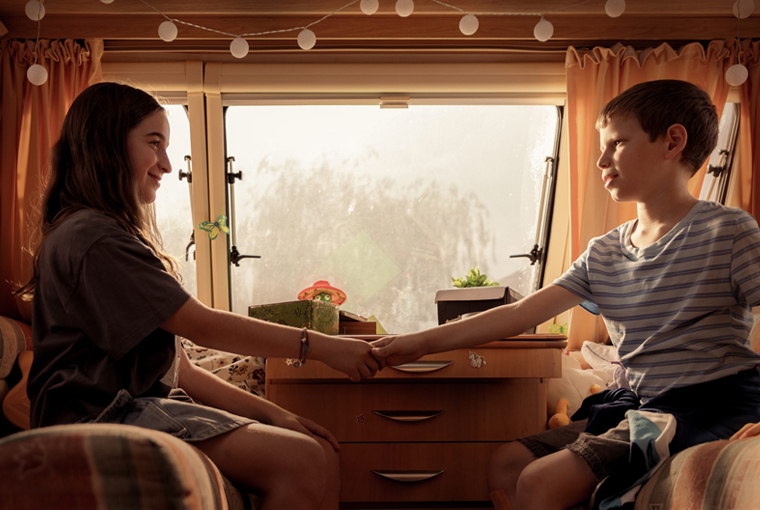
Summer’s almost over, school is about to start and ten-year-old Filip (Matei Donciu) has ruined his only pair of shoes by obsessively playing football. His mother sends him off from their rural home to the nearest big town with strict orders to buy an exact new pair for an exact amount of money, on pain of being banned from watching the national team play. When he gets to the shoe store, however, the only ones left in his size have a problem – both shoes are for left feet. But there’s a clue as to where his missing right shoe could be, a woman in a (not so) nearby village recently bought the same model for her son, so maybe the two pairs simply got mixed up. Determined, Filip sets off on an odyssey to be reunited with his missing right shoe that leads him to numerous encounters with strangers who help him along on his quest.
Everything about the film is constructed on a child’s scale. When Filip first enters the town (alone, his dad having ditched him to go drinking with friends along the way), the shock of the built environment and the buzzing of people feel overwhelming, even though it’s clearly no metropolis. Although we aren’t told how far he walks in terms of concrete numbers of kilometers or hours, we understand what the distances mean to him. Most importantly, this sense of proportion applies to the logic of the narrative – clearly a shoe is not worth a fraction of this much effort, and the punishment Filip is threatened with is extremely mild. In any case, he ends up missing the match while caught up in his mission. This is all immaterial, because the reasoning that drives the story forward is that of a ten-year-old and, as such, completely coherent with the universe being mapped, as per the title. It’s his universe and we’re guests in it.
The structure follows the classical fairy tale journey of discovery, complete with a Cinderella-style shoe and many other evocative elements. Filip undertakes a difficult route he is advised against several times involving a scary forest, looking for a golden church, and constantly overcoming challenges. Historically, fairy tales were cautionary in nature, their purpose being to teach children what and who to fear. Atlas of the Universe subverts this, with almost every character Filip meets proving to be a helper, despite initial appearances. Even the ‘big bad wolf’ blocking his path turns out to be a faithful four-legged friend who goes on to accompany him on his journey. This is potentially a very radical reversal with interesting implications – what would the world be like if we were all taught to trust and support each other? This isn’t to say that the film comes off as propagandistic or ideologically heavy-handed, it’s a straightforward, breezy, and charming children’s story, and the moral remains strictly in the subtext.
This deft handling of potentially unwieldy topics extends to various other facets, the depiction of the countryside serving as a good example. Rural life is not romanticized or fetishized, nor belittled or demonized. Refreshingly, it is simply a place where people live normal lives, and while there are some moments bordering on magical realism – most notably a scene in which farmers are burning the fields in the nighttime – this feels like a case of Filip seeing his surroundings through a folktale lens rather than exoticization. This lack of stigma is also present in the treatment of poverty. A lot of money-related exposition at the beginning of the film makes it clear that it’s in short supply for Filip’s family. Although he always insists his quest for the missing shoe is driven by fear of missing out on football, a sense of pressure related to the expenditure is presumably also a factor. Still, beyond this economizing, the family are not shown to be lacking or living a substandard life, simply one not filled with luxuries. The interaction between the children shows that they understand which of them are in a better financial position – inevitably the ones whose parents work abroad, this being Romania – but they also show generosity to one another and play together without any great divide.
In this low-stakes utopia where everyone is basically good and everything ends up working out basically fine, there’s only one real social critique, namely paternal absence. The fathers who are absent because of labor migration are the lesser problem, however. Their presence is missed but understood. The only character in the film who never undergoes any kind of redemption is Filip’s father, who is also the only significant antagonist – he is repeatedly established as irresponsible and untrustworthy, and his reckless abandonment of his child is what sets the whole chain of events in motion.
Yes, as is only becoming of a fairy tale, Atlas of the Universe has its happy ending, though not the most obvious one, and, yes, the real treasure was the friends we made along the way. But even though it’s basically just a simple, enjoyable children’s story, it does feel important for kids and adults to be exposed to a vision of the world in which we all help each other out and it seems totally normal, especially when it’s done without being preachy or patronizing.

Leave a Comment