

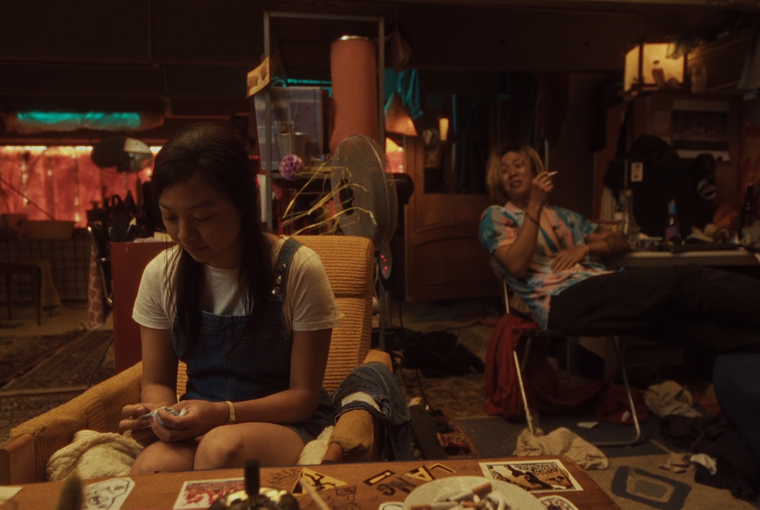
In the heart of Budapest’s Chinatown, brother and sister Lang (Chade Li) and Shanshan (Sissy Cui) have opposite temperaments but are united by the same desire to break away from their father’s clothing shop. Wild and reckless Lang disappears into drink and drugs with no real plan except running away to live in Serbia with his best friend Matyi (Csaba Polgár), who is due to go to prison if he stays in the country. Taking the path of the over-achieving immigrant daughter, Shanshan focusses all her energy on trying to get to France by winning a competitive piano scholarship.
One day, as the two of them are fighting, a cart guided by a cabbage possessed by an evil spirit intervenes, running Lang down and killing him. This is only the beginning, however, as the grieving Shanshan finds herself sucked into a kind of limbo, a black and white version of their father’s warehouse, where she is reunited with Lang, both of them now dressed as if starring in the Beijing Opera, with ornate make-up and costumes. Periodically, a tune plays to announce the appearance of a door. Whichever of them enters it takes control of Shanshan’s earthly body for a while, before being brought back into the mysterious non-place until the music and door reappear. Unrepentant and unchanged by death, Lang uses his time back in the mortal realm to continue his rampage of indulgence with wanton disregard for the effects on his sister’s physicality, which is progressively worn down by drugs, alcohol, and numerous accidents and clashes. Whenever Shanshan reclaims possession of herself, she does her best to mitigate the damage and put her life back on track, but the desperation of both siblings as they struggle in opposite directions brings things to ever greater extremes.
Although it feels like a cliché when discussing a film with Asian characters, even one made in Eastern Europe, it’s impossible to watch My Turn without thinking of Wong Kar Wai (and also Everything, Everywhere All at Once with its multiverses and manic quality). The comparisons are there waiting to be made in relation to the rich, saturated colors, the erratic, constantly flowing camera movement, and the equally erratic characters with their own unpredictable actions and motions. Despite these shared characteristics, Zhang Ge’s work is still entirely original and true to its own logic. Both lead actors are exceptional, but Sissy Cui’s performance as two characters in one body is in a league of its own. There is humor, absurdity, rage, and drama, with a fast-paced narrative that veers off into refreshingly unexpected directions.
The siblings are trapped in worlds within worlds – in their apartment within their dad’s store, within a Chinatown that could be any Chinatown, within a Budapest that could be any European city, within a society that doesn’t seem to have much to offer them. Both the Chinese and Hungarian contexts are recognizable, and both are depicted with a balance of banal and sublime elements, but ultimately their importance lies in their duality, and in that sense they stand in for the universal experience of being divided between cultures without fully belonging to either. Then, of course, there is the actual limbo realm, and the fact that they are trapped within a shared body. There is no escape, but staying still isn’t an option either. Both of them have so much energy but feel confined and torn at the same time, creating a palpable build-up of tension. Most basically, it speaks to the frustration of being bound by expectations, of the burden of family ties, but also their strength.
The whole film feels like a breath of fresh air in the general cinematic landscape, but especially the Eastern European one, with remarkable energy and imagination. It’s interesting to note that My Turn was largely self-funded without any major national or institutional support, the resulting freedom of which perhaps saved it from the risk of becoming homogenized or pigeon-holed through endless labs and applications. Without wanting to romanticize struggle, it does seem like there is some kind of causal relationship between the strong impulse that drove Zhang Ge to make the film at any cost and the intense dynamism of the final piece. This is cinema that feels alive, and it serves as a powerful example of what can be achieved by just making the film you want to make on your own terms.

Leave a Comment