

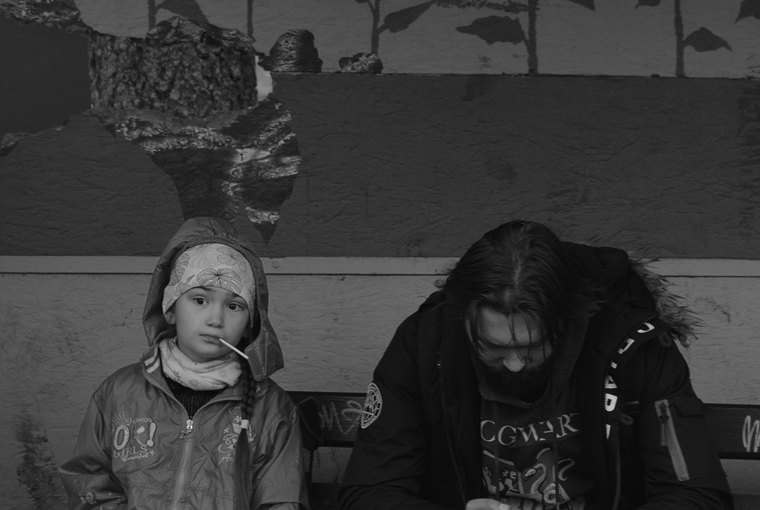
Here is a typical scene from Laila Pakalniņa’s 2024 documentary Termini, a poetic meditation on end stations and bus terminals: the camera tracks a bus as it arrives at its final destination. Once the bus comes to a stop, the camera departs, panning left to contemplate a forest landscape with a construction-site toilet nestled amongst the trees. We hear the rumble of the bus’s engine, the chirping of birds, tires crunching the pavement. After a 360-degree pan, the camera returns to the site of the now absent bus to linger on a disembarked passenger as he walks up a snowy road. This pattern of 360-degree pans repeats itself over the course of Pakalniņa’s film, clockwise and (for the most part) counterclockwise. In winter, spring, summer, and autumn; outside airports, bus terminals, big-box stores, and trolley stations. If the aesthetics and subject matter (transport, waiting, liminal spaces) sound like those of a pretentious student film, that’s because, in many ways, they are. Yet I mean this in the best possible sense. Pakalniņa’s film continues a tradition of filmmaking that can be traced back to the Soviet-era Gerasimov Institute of Cinematography (VGIK) and the Baltic poetic documentary film movement.
To be fair, I’m not sure whether my enthusiasm for Pakalniņa’s style stems from the film itself or from a general fascination with the work of the last (more or less) generation of documentary filmmakers to graduate from VGIK in the late 80 and early 90s – filmmakers such as Sergei Loznitsa and Viktor Kossakovsky, who studied under little-known yet remarkable filmmakers including Nana Djordjadze and Lyudmila Stanukinas. One hears echoes of their films in Pakalniņa’s work – for instance Loznitsa’s moving portraits (Potrait, 2000) in her It’ll Be Fine (2004). There is a unifying aesthetic here that is rooted in the pioneering works of Baltic filmmakers such as Uldis Brauns, Herz Frank, and Henrikas Šablevičius. The question is whether such an aesthetic still has relevance today.
Termini’s nearly constant counterclockwise panning makes it feel as if the film is turning back the clock. The arrival and departure of buses, the surrendering of control to timetables, and the emphasis on waiting all seem to harken back to Soviet times. In a sense, one feels the stagnation of our own moment – the endless wait and scroll – collide with that of the Soviet era. Not that there is any anti-Soviet sentiment in Pakalniņa’s film, nor any nostalgia. It takes the perspective of a distant observer, captures a particular moment, and leaves it without passing judgment.
While Termini returns to some of the earliest themes not only of Pakalniņa’s films, but of the VGIK student documentary (public transport, public services, urban experience, and rural life), it nevertheless speaks in a decidedly post-Soviet idiom of disintegration and fracture – one that manifests itself in durational shots that provide little by way of closure despite their rotational completeness. Her subjects are not united in their experience of taking a bus together but rather cast adrift. In an earlier film (The Bus, 2004), passengers must navigate post-Soviet borders in a trip from Tallinn to Kaliningrad. A (relatively) frictionless trip in Soviet times becomes a bumpy bureaucratic road of starts and stops. Each delay is rendered in painstaking durational detail. That durational aesthetic also runs through Termini, as well as most of Pakalniņa’s documentary films.
All together, these films chronicle post-Soviet life in the Baltic states through a meditation on waterways (The Ferry, 1994), village life (The Oak, 1997), borders (The Bus, 2004; The First Bridge, 2020), and everyday routines (The Mail, 1995). Again and again, we see the same aesthetic techniques: slow pans, durational shots, moving portraits, ambient soundscapes. Liminal spaces and empty stares affectively track the experience of neoliberal capitalism in Eastern Europe, even as moments of irony and lightness punctuate the drudgery of the long haul from one bus terminal to the next.
In Termini, the bus is the protagonist. It loads and disgorges passengers with the indifference of a vending machine, polite announcements wishing passengers a safe onward journey notwithstanding. The consistent hum of the bus’s motor is the pedal point of the soundtrack. There is something Zen-like about this hum that evokes the feeling of being an observer at any point of arrival or departure. One sees passengers in all four seasons texting, smoking, laughing, or conversing, their faces caught in the reflection of windshields and windowpanes. One hears a smattering of Baltic and Slavic languages against the rustling of leaves that remind the viewer of the cyclical, natural temporality that envelops the passengers’ daily concerns.
Over the course of the film, I wondered whether there was a difference between capitalist and Communist forms of waiting. Was this even an appropriate question to pose? While the signifiers of Communist waiting – scarcity, long queues, etc. – were absent, the experience itself seemed to break through the present. Some things haven’t changed. Passengers looked increasingly stranded in a sea of cars and billboards, waiting for a mythical creature that would rescue them from the flow of traffic. This resignation seemed to speak to a general sense of living through our own interminable moment – one that, for lack of a better term, we continue to call neoliberal capitalism.
One wonders if Pakalniņa had Jean-Paul Sartre’s Critique of Dialectical Reason in mind while making her film. Even if she hadn’t, the film seems like an apt illustration of Sartre’s own example of a “series” as opposed to a genuine social group. In Critique of Dialectical Reason, the philosopher asks us to imagine a group of people waiting for a bus. They are physically together and share the same objective (catching the bus), but they do not relate to one another in such a way as to form a genuine collective. Rather, they are related through an external, material organization – the bus route, the timetable, the queue, the scarcity of seats. Each person’s behavior is shaped by this “practico-inert” world rather than by reciprocal relations with the others.
However, if the bus were not to arrive and the passengers decided to collectively march to the depot or organize a protest, they would cease to be a mere series and become a genuine group acting through reciprocal recognition. This reciprocal recognition never arrives in Termini, nor should it. The film accurately captures human relationships through the series, along with the sense of alienation, stress, and boredom that accompanies it. Echoing Chantal Akerman’s From the East (1993), the film deploys pans and tracking shots to create a moving tableau that links the temporal and social experience of disintegrated Socialism with neoliberal capitalism. Of course, life in this holding pattern is not without humor or joy, emotions that occasionally break through in Termini, but are more consistently featured in Pakalniņa’s wonderful and ironic fiction films (Python, 2003; Dawn, 2015).
All in all, Termini is well-worth watching, even if some of Pakalniņa’s earlier films (notably The Bus) deliver the same ideas with more impactful imagery. One might perhaps not appreciate this film without watching the other first. At the end of The Bus, we hear a conversation between two drivers as the credits roll. “Logic my ass,” one driver says. “We just keep driving. We must follow traffic signs, not logic.” The same may be said of the relations between people waiting for the bus. They must abide by the rules of the timetable, not the logic of reciprocal social interaction. The final shot of the film is of a man running toward his bus. As he is about to enter, the doors slam in his face.

Leave a Comment