

Why Men Go to War
Erik Tikan’s Between Borders (Sinikollane, 2025)
Vol. 168 (October 2026) by Antonis Lagarias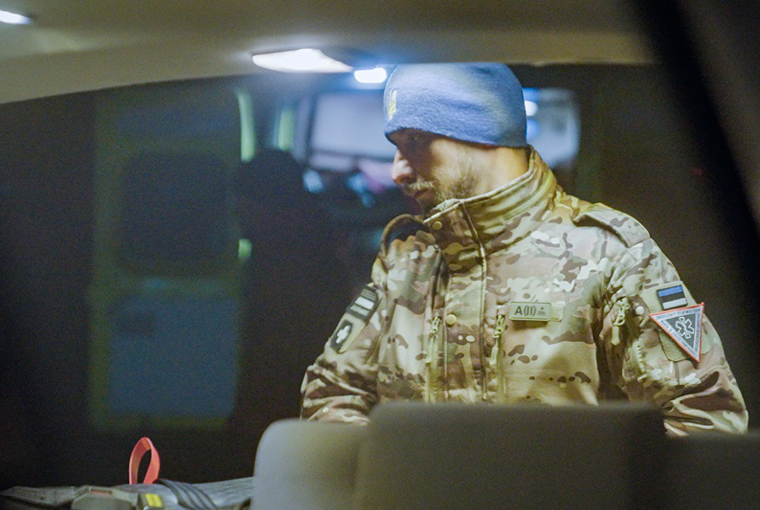
Ever since Russia’s full-scale invasion of Ukraine in 2022, the Baltic countries have been gripped by a geopolitical tension. Like Ukraine, they share borders with Russia, were part of the Soviet Union, and are home to Russian minorities. Their NATO membership, they fear, may not be enough to protect them from facing a similar fate as Ukraine. European-level discourse suggests that the threat of invasion is real, with EU specialists simulating war scenarios,1 while “hybrid aggressions”, understood as acts of “sabotage, disinformation and cyberwarfare”, have been taking place for years.2 This tension has also become palpable in many films from the Baltics, even in those seemingly unrelated to the Russia-Ukraine war.3 Between images of Ukrainian refugees and news from the front, Baltic cinema portrays the war as a permanent backdrop in daily life, the inevitable subtext of every other story. Against this backdrop, it is hardly surprising that many nationals of the Baltic countries have joined the international volunteer efforts in support of Ukraine.
Erik Tikan’s documentary Between Borders sets out to explore the daily life of one of these volunteers, Estonian Erko Laidinen, who has joined a medical assistance NGO on the Ukrainian front. Erko gained unwanted fame after a Russian missile attack on humanitarian workers in Bakhmut in 2023, as he was on the ground during the attack and caught the assault live on camera. Images from the shelling circulated in the news and Erko was invited to share his near-death experience. The film opens with his CNN interview, suggesting that this is how Tikan first took an interest in Erko’s story. Tikan himself is a veteran of the 2001–2021 War in Afghanistan who has also filmed military operations and made commercial productions for the defense industry.
With the exception of the opening scene, Between Borders rarely depicts direct acts of warfare. As the title suggests, Erko spends much of his life crossing borders. The director follows him across Lithuania, Finland, Poland, and Ukraine, as he travels to transport equipment, distribute donations and first-aid kits, and identify vehicles that could be used by his group. While his trips are mostly solitary, once in Ukraine he finds himself surrounded by fighters and volunteers who have formed friendly bonds over the years of struggle. Through fast-paced editing of them talking and laughing during late-night drinking gatherings, the film shows that Erko has found a sense of belonging there, a comradeship he later describes as being acknowledged by his “brothers-in-arms.”
Erko’s wife, however, tells a different story. For her, Erko’s volunteering is far from heroic. While he spends weeks or even months away from home, she must raise their daughter, pay the bills, and take care of their home all alone. At first glance, the film presents the two narratives on an equal footing. Erko’s road-trip monologues describe his commitment to protecting his home against Russian aggression. His wife, he says, is “naïve” for not understanding the broader picture and how the basis of Estonia’s security lies in Ukraine. He has no doubts about the value of his sacrifice. International volunteers, he says, provide the backbone of the fight, ensuring that supplies and medical assistance are available wherever needed. Without them, the war would already have been lost. Further, he has come to truly appreciate the country and its people. We see him getting a tattoo of Ukraine’s coat of arms, the golden trident, and he later tells us that he is thinking of moving to Ukraine once the war is won. His wife, on the other hand, does not seem convinced by Erko’s arguments. During his short stays at home between missions, she sees him becoming increasingly bored, sleeping most of the day, waiting for the next assignment. Why would he stay here, with his “nagging” wife, as she puts it, when he clearly would rather be on the front fighting for what he believes in, with his new comrades? For her, Erko’s dedication to Ukraine is a way of escaping his domestic reality.
According to the producers, Between Borders embraces this dual narrative, showing what it means to be on the “front or waiting at home – and why both sides deserve support.”4 Watching the film, however, one might find it hard to sustain this double stance for long. In many ways, Erko confirms his wife’s version. Being on the front lines makes him feel useful, forget his troubles, and focus on the essential task of helping others. Moreover, while away from home, he spends time with his Ukrainian girlfriend (which his wife knows about), and occasionally brings his daughter along. Among his new friends and amid the constant proximity to death, Erko has clearly found his raison d’être. The film ends with his daughter’s birthday, Erko missing again, stuck in some negotiation miles away. His own ties to the home that he is trying to protect have become very loose. In fact, four years into the war, Erko’s family has fallen apart.
The film can thus be read as an anti-war narrative from a gendered perspective. Even though women also take part, as is the case in Ukraine, war has always been largely considered an affair of men. Raised since boyhood to aspire to heroism, many men have experienced normality as suffocating, and tried to prove their worth by acting bravely, helping others, or fighting for a greater cause, even if that means risking their own lives. Erko has found self-fulfillment, a chance to prove himself, all while escaping his midlife responsibilities. That war becomes the answer to such common feelings is terrifying. The few films that explore this gendered dimension come across as surprisingly powerful, especially when they do not look at the “enemy” but at “us,” and how war (and the official discourse that sustains it) will use everything in its power to gain more bodies for the front lines.5 Heroic fights have always left devastated homes in their shadow. The Trojan War, the quintessential war story of Western literature, already captures this through Clytemnestra and Penelope, two archetypes of how women experience absence. After his long-awaited return, Odysseus on the other hand must leave again, as Tiresias prophesies, this time to appease Poseidon. Staying home, it seems, does not come easy.
Men decide to dedicate themselves to a moral or ideological cause, even if this means leaving behind their ‘naïve’ wives or ‘overprotective’ mothers. The cause is undeniably important, whether it is to stop the Nazi advance in the Second World War, or, to name two recent examples, Russian and Israeli troops today, forces threatening to deprive a people of their home. But when it comes to men, as Between Borders admits, involuntarily perhaps, the very same cause can also serve as a respectable reason for escaping the demands of everyday life. The horror of war does not of course care about the reasons one finds oneself on the battlefield, whether it is to protect a country, through conscription or forced mobilization (often the case for Russian and Ukrainian soldiers), to collect a paycheck, or in search of meaning, as Erko’s story suggests. Once the bomb dust clears, all bodies look the same.
- Kavanagh, J., & Shapiro, J. (2025, December 18). The bear in the Baltics: Reassessing the Russian threat in Estonia. European Council on Foreign Relations. https://ecfr.eu/publication/the-bear-in-the-baltics-reassessing-the-russian-threat-in-estonia/. ↩︎
- Hardy, A. (2026, October 1). As Baltic states face Russian hybrid aggression, our research shows what Europe can do. The Conversation. https://theconversation.com/as-baltic-states-face-russian-hybrid-aggression-our-research-shows-what-europe-can-do-292757. ↩︎
- Take, for instance, Gabrielė Urbonaitė’s Renovation, a film about the existential crisis of a 30-year-old woman in Lithuania, which depicts Vilnius as a city where radios broadcast daily news from the front and Ukrainian refugees have become part of everyday life. ↩︎
- Eesti Rahvusringhääling. (2025, September 23). Estonian medic risks everything on Ukraine’s front lines in new documentary. https://news.err.ee/1609809519/estonian-medic-risks-everything-on-ukraine-s-front-lines-in-new-documentary/. ↩︎
- See, for instance, Takis Kanellopoulos’s Glory Sky (Ouranos, 1962), which depicts the Greek campaign to ward off the Italian invasion during World War Two – one of the building blocks of modern Greek national identity that is treated as a heroic moment of collective resistance in public discourse – as a bleak story of loss, of families broken by sending their sons to war. ↩︎

Leave a Comment