

Beyond the Postcard: Peripheral Lives, Western Gaze
Mate Ugrin’s Petty Thieves (Sitni lopovi, 2026)
Vol. 168 (October 2026) by Anna Batori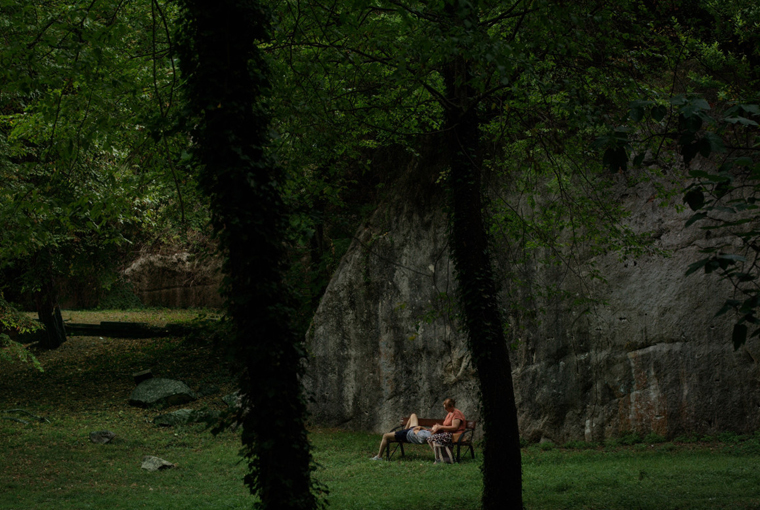
Built around static long takes, deep-focus compositions, meticulous framing, and non-professional performers, Petty Thieves embraces minimalist realism with remarkable rigor, making Mate Ugrin’s debut one of the most austere films on the contemporary festival circuit. Beyond its stylistic bravura, Petty Thieves offers a quietly devastating account of the monotonous everyday lives of the seasonal workers whose invisible labor sustains the tourist industry.
Set along the Istrian Coast during the height of the Adriatic tourist season, the film follows Rio (Gavrilo Jović), a solitary young kitchen worker struggling to make ends meet. His grandfather’s physical and cognitive decline requires constant care, yet neither Rio nor his grandmother can provide the supervision he needs. Living on a meager income and unable to afford professional care, Rio begins stealing from affluent foreign tourists staying at the local hotel. When Andrea (Tea Ljubešić), a fellow employee, discovers Rio’s secret, she proposes an unlikely partnership: while she monitors the guests’ movements, Rio slips into their rooms to steal their valuables. What begins as a pragmatic criminal arrangement gradually develops into an intimate emotional relationship, while exposing the precarious existence of local workers trapped within a tourism-driven economy.
Petty Thieves does not aim to tell a conventional crime story. Instead, theft serves as a means of survival in a local economy sustained by international tourism, which offers little security to those who work within it. Illustrating how the tourist economy commodifies not only labor but also the body itself, the exploitation of seasonal labor reaches such an extent that Rio ultimately resorts to prostituting himself to wealthy male tourists. Andrea, on the other hand, follows a different trajectory. While initially joining the thefts out of economic necessity, she gradually begins to steal for the thrill of it. Even after the pair have divided their earnings, she continues to steal on her own, transforming what began as an act of survival into a form of personal gratification.
This reading, however, necessarily remains tentative, as Petty Thieves maintains such a rigorously observational style that it deliberately resists psychological intimacy. Ugrin favors emotional distance over subjective identification: he uses close-ups sparingly, reduces dialogue to a minimum, and allows moments of emotional significance to unfold with the same understated neutrality as the protagonists’ everyday routines. Rather than inviting the spectator into Rio’s or Andrea’s inner world, the film consistently positions us as detached observers of everyday routines.
The connection between the two young protagonists is also more structural than emotional. They are linked more by shared abandonment and financial instability than by romantic feelings. Both have been left to face adulthood alone, and their criminal partnership serves as an improvised survival strategy rather than a true emotional refuge. Throughout the film, their bond is deliberately kept from becoming a traditional romance.
At first, these restraints appear to preclude genuine psychological intimacy. Ultimately, however, they prove to be the film’s greatest strength, functioning not merely as an aesthetic choice but as a formal strategy that reinforces its critique of the colonial dynamics of tourism.
The wealthy visitors – predominantly Italian and French tourists – occupy a position of unquestioned privilege throughout the film. Whether enjoying comfortable accommodation, lavish meals, or sexual services, as in Rio’s case, they consume not only the region’s natural beauty but also the inexpensive labor and bodies of the local population. Tourism thus becomes a form of economic extraction, sustained by a stark imbalance of power between affluent Western visitors and economically vulnerable locals.
Rather than presenting tourism as a source of prosperity, Ugrin thus exposes it as a profoundly unequal system in which economic dependency permeates every aspect of social life. The film’s observational distance ultimately proves essential to this critique. By resisting psychological immersion, Petty Thieves encourages the spectator to recognize the structural inequalities that shape its characters’ existence. Rather than reducing their experiences to individual moral choices or personal tragedy, the film reframes them as symptoms of a broader socio-economic condition.
One particularly revealing scene encapsulates the asymmetrical power relations at the heart of the film. While working as a manicurist, Andrea politely asks a wealthy Italian tourist whether she is enjoying the Croatian coast. The woman casually remarks that she has seen far more beautiful places elsewhere, then asks Andrea whether she likes working at the hotel. Yet before any genuine exchange can emerge, the conversation simply collapses. Andrea responds with a hesitant ‘Well…’, and the dialogue dissolves into an awkward silence. The imbalance is immediately apparent: the tourist remains the subject who observes, evaluates, and consumes, while Andrea is reduced to the object that serves. The scene quietly exposes the colonial logic of tourism, in which the visitor’s perceptions carry weight whereas the local worker’s own experience is rendered inconsequential.
The colonial dynamics of tourism do not end in the workplace. Rio’s grandmother has for years maintained a secret relationship with an Italian man, which gradually develops into a romance, while Rio himself is increasingly drawn into sexual encounters with affluent male tourists. In both cases, relationships between locals and Western visitors become shaped by economic asymmetry rather than equality. Seen from this perspective, Petty Thieves becomes a compelling study of what Milica Bakić-Hayden terms “Nesting Orientalisms” and what Maria Todorova identifies as “Balkanism.” The film repeatedly constructs the Croatian coast as a peripheral space whose primary function is to service Western mobility and consumption. The protagonists’ labor, criminality, sexuality, and even emotional relationships exist within structures defined by Western economic power.
At the same time, Petty Thieves never entirely escapes the representational framework it seeks to critique. Rather than consistently interrogating these conditions, it occasionally reproduces the familiar imagery through which Eastern Europe has long been marketed within the international festival circuit: poverty, petty crime, transactional sexuality, and economic dependence on Western capital emerge as the dominant signifiers of regional identity. In this sense, the film risks participating in a broader process of self-Balkanization, reaffirming precisely those narratives of deprivation and marginality that have repeatedly been legitimized – and rewarded – by international art cinema over the past two decades.
Characterized by recurring deep-focus compositions and meticulous framing, the visual style of Petty Thieves is remarkably disciplined. Ugrin repeatedly encloses his characters within secondary frames created by windows, doorways, fences, and architectural barriers. These compositions frequently disrupt the balance of the frame itself. In one particularly striking scene, as Rio, Andrea, Rio’s grandmother, and her Italian companion share dinner together, Ugrin abandons the establishing long shot in favor of a composition filmed from behind a doorway. Rio is pushed to the left edge of the frame, while an expanse of empty space opens behind him, creating a deliberate visual imbalance. Such formally inventive compositions function as visual metaphors for the characters’ psychological isolation and the invisible barriers that structure their lives.
This pervasive sense of confinement is further reinforced by the film’s restrained camera style. Aside from a handful of deliberate pans, the camera remains almost entirely static, allowing time and space to unfold with documentary-like patience. Rather than directing the spectator’s attention through movement, Ugrin compels us to contemplate the characters’ physical and emotional entrapment within the frame. The decision to cast non-professional local performers further strengthens this realist aesthetic. Their understated performances avoid theatricality and lend the film an unaffected authenticity that perfectly complements its austere visual style.
Few debut features display the directorial confidence evident in Ugrin’s work. He demonstrates a remarkable instinct for omission, knowing precisely what should remain off-screen and what merely needs to be suggested. Whether depicting Rio’s sexual encounters with male tourists, the thefts themselves, or seemingly uneventful moments such as Rio and Andrea’s evening card games, Ugrin consistently cuts away before scenes become either repetitive or self-indulgent. His elliptical editing trusts the spectator to complete what is left unseen, lending even the most ordinary moments an understated dramatic weight. Unlike many contemporary European auteurs, who frequently allow scenes to linger beyond their dramatic necessity, Ugrin exhibits an impressive sense of rhythm and restraint. His scenes end exactly when they should.
Yet Ugrin occasionally appears to counterbalance the film’s rigorous realism with a more overt symbolic register. The recurring image of the wild boar emerges as the most conspicuous metaphor in Petty Thieves. It repeatedly devastates the grandmother’s garden before reappearing in the final scene, where Rio encounters the animal after being violently assaulted by the foreign tourists he had previously robbed. The juxtaposition clearly invites symbolic interpretation. The boar may evoke untamed nature, instinct, or the eruption of violence beneath the film’s otherwise restrained surface. However, unlike the film’s carefully developed realist aesthetic, this symbolic motif never acquires a coherent dramatic or thematic function. It remains suggestive rather than fully integrated, thus introducing an interpretive ambiguity that sits somewhat uneasily within the film’s otherwise rigorously controlled formal structure.
There is much to admire in Petty Thieves. Its formal precision is exceptional; its minimalist visual language is realized with remarkable consistency; and its use of non-professional performers generates extraordinary authenticity. Yet its rigorous aesthetic discipline also creates a certain emotional distance, while its representation of the Balkans never entirely escapes the imagery long favored by the international festival circuit. The result is an accomplished work of minimalist cinema whose formal brilliance is tempered by its tendency to reaffirm – rather than fundamentally rethink – familiar narratives of Eastern European marginality, economic precarity, and dependence on Western capital.


Leave a Comment