

Systems of Punishment
Bálint Szimler’s Lessons Learned (Fekete pont, 2024)
Vol. 161 (January 2026) by Anna Batori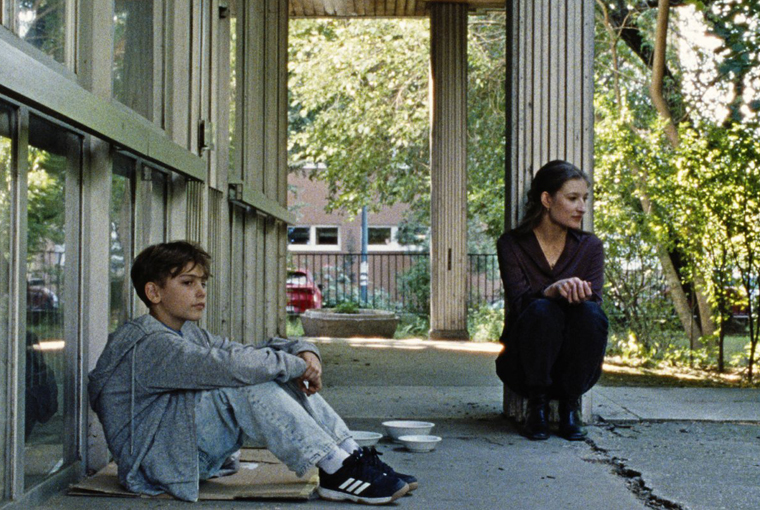
Since the rise of Viktor Orbán’s populist government, Hungarian filmmakers who do not align with the ruling right-wing party – often those with liberal or critical views – have been increasingly pushed to the margins and forced to pursue independent, low-budget productions. Lesson Learned by Bálint Szimler is a prime example: a film made in the spirit of a grassroots creative collective, with cinephiles sacrificing their time and energy in support of a project they deeply believe in. Szimler’s film not only captures the moral void at the heart of Hungary’s contemporary educational system, but uses this rigid, archaic, and authoritarian institution as a powerful allegory for modern Hungary at large.
Lesson Learned centers on ten-year-old Palkó (Paul Mátis), whose family has just returned to Hungary from Berlin. The young boy begins elementary school in a dilapidated building nestled within a forest of high-rise housing blocks – a visual landscape that speaks volumes about the system it houses. The school, like its crumbling concrete walls and dangerously jutting windows, is frozen in time, seemingly untouched by progress for the past hundred years. Operating under an archaic and oppressive disciplinary regime, the institution assigns “fekete pont” (black marks) for minor transgressions – tardiness, questioning authority, or even subtle acts of self-assertion. These marks accumulate and carry harsh penalties: exclusion from school trips, the loss of various privileges, public humiliation, and eventual expulsion. To make the system even more insidious and disturbing, the black marks aren’t assigned by teachers, but by specially designated students. This creates a self-surveilling structure in which every child becomes both observer and observed – each pupil has someone watching them, while they themselves are tasked with monitoring and penalizing someone else. If the system evokes memories of Socialism or Orwellian dystopia, it’s no coincidence: the education model depicted here operates in a closed ideological universe, where suspicion is institutionalized, and conformity is enforced not only from above but laterally, through peers.
For Palkó, the transition from the free, liberal atmosphere of Berlin to the rigid and repressive environment of his new school is deeply disorienting. He is stunned to learn that speaking in class is forbidden, self-expression is punished, and obedience is mandatory. The parallels of the education system with Viktor Orbán’s nationalist regime are unmistakable. This is a culture of fear, silence, and conformity where voicing dissent – even mildly – can threaten one’s future.
Juci (Anna Mészöly), Palkó’s newly hired, idealistic literature teacher, represents a sort of salvation in this corrupt system. At first, she complies with the system and truly believes that she can make a difference from within. But as she witnesses the psychological toll the system takes on her students, her moral discomfort deepens. When Palkó gets hit by the sports teacher and he becomes burdened with multiple black marks for seemingly harmless behavior and ultimately isolated, anxious, and withdrawn, Juci’s optimistic stance that she can make a change disappears. Despite the teacher’s attempts to intervene, her concerns are constantly dismissed by senior staff, the headmaster, and parents, who all insist on order and discipline above all else. As Juci pushes back, she finds herself increasingly ostracized by her colleagues and threatened with consequences for her noncompliance. Eventually, she must choose between protecting her students and preserving her career in a system that punishes dissent.
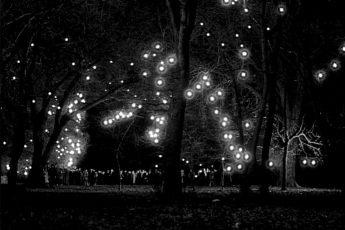
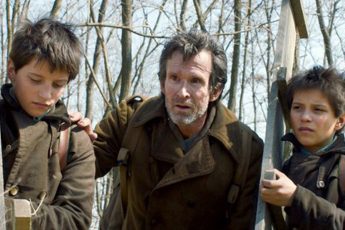
Szimler’s film depicts exactly what the novels of the recent Nobel laureate László Krasznahorkai (Sátántangó, 1985; Melancholy of Resistance, 1989) and the films of Béla Tarr (Sátántangó, 1994) predicted decades ago. That is, in a system built on surveillance and complicity, everyone becomes an accomplice – not only those who assign the black marks, thus obeying the punitive (rather than educational) logic of the system, but also those who remain silent when someone is unjustly accused. When one of the teachers is suddenly dismissed without explanation by the school inspectorate, not a single colleague speaks up in the frozen silence of the staff room. Rumors circulate that the fired teacher may have posted something critical of the system on social media – an incident that mirrors real-life cases in Budapest, where several teachers were dismissed for similar reasons – yet still, no one says a word. As originally laid out by Krasznahorkai in Sátántangó, everyone retreats into quiet endurance, until the silence becomes so complete, so internalized, that they come to realize: they, too, have become complicit.
In this system, Palkó is merely a symbol of innocence and of resistance. The emphasis is on symbol, as the young boy barely speaks throughout the film. Instead, he communicates through body language: as the story unfolds, his shoulders slump lower, and the dark circles under his eyes grow deeper. Szimler approaches this portrayal of social and institutional abandonment with remarkable elegance. The film’s imagery – captured by Emmy Award–winning cinematographer Marcell Rév – functions like a series of observational portraits, almost factual in tone. There’s a distinct cinéma vérité quality to the film, amplified by Szimler’s improvisational directing style that allows actors to explore scenes freely and organically. The camera frequently pans and oscillates, which lends the film a documentary-like atmosphere. The fact that Lesson Learned was shot on film further intensifies the matte, drained lifeworld the narrative inhabits.
Structured episodically, and allegorical in scope, Lesson Learned is a document of its time. By providing a realistic portrayal of a web of parents, children, teachers, and school janitors, Szimler’s film offers a broader reflection on how the entire machinery of contemporary Hungarian (and Eastern European) society functions. In doing so, it also gestures toward an answer to how Orbán’s regime has become so deeply entrenched over the past decade. Szimler never resorts to didacticism or moralizing. Instead, he builds his world with quiet restraint and refined storytelling and maintains a dignified distance throughout. It is no surprise that Lesson Learned became one of the most acclaimed Hungarian films of 2024 – joining the rare lineage of independent productions that dare to criticize Hungarian society.

Leave a Comment