

Buried Guilt
Hana Jušić’s God Will Not Help (Bog neće pomoći, 2025)
Vol. 160 (December 2025) by Savina Petkova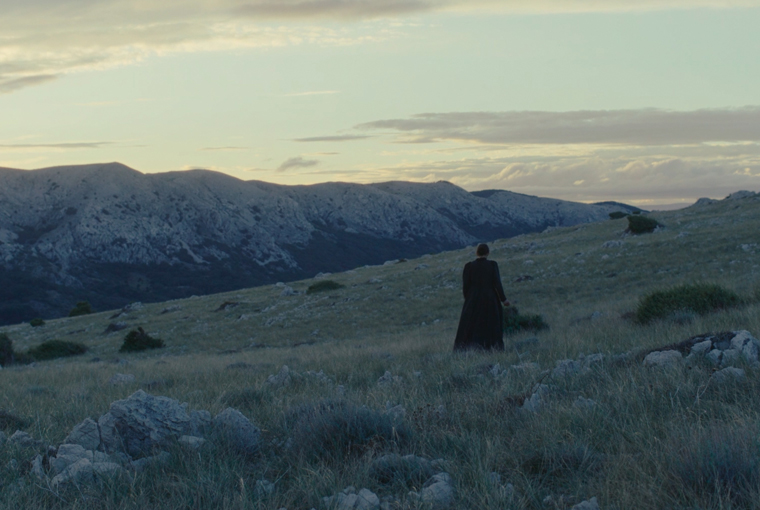
Hana Jušić’s debut feature Quit Staring at My Plate already announced, back in 2016 at the Gironate degli Autori in Venice, the advent of a major new talent on the European festival circuit. For her first feature-length film, the Croatian director zoomed in on a family at the exact moment when a rigid dynamic was about to shift, as a teenage daughter was to become paterfamilias. Nine years later, Jušić graced the festival screens of Locarno’s International Competition with a sophomore film of impressive magnitude and gravitas, bearing the definitive title God Will Not Help. Family is also at the center here, but orbiting around the theme of blood ties we have questions of community, boundaries, and redemption, all through a feminist lens. God Will Not Help is truly one of a kind in the way its narrative offers a meeting ground for two distinct cultural contexts – Croatia and Chile – amidst an early 20th century setting, somewhere in the Croatian mountains. What seems like a rather whimsical conceit solidifies into a throbbing, vital piece of art, which dares to excavate both soil and guilt with equal conviction through an impossible dialogue made probable: the encounter between a shepherd girl and the Spanish-speaking widow of her émigré brother.
Teresa (Manuela Martelli) is a woman on a mission – brusque and a little scary, she marches on to a tiny village tucked away between the mountaintops in a country far, far away from her own. No flashbacks of her transatlantic journey to tell stories of troubled waters, no scars or tears on her black, Victorian gown to testify on her behalf, but a glimmer of anger in her eyes suggests a secret backstory that may or may not unravel by the end of the film. It’s in Teresa’s posture, aura, and iron will that one locates the kernel of her character – unknowable to both the villagers and the audiences, even if the latter have the benefit of subtitles translating her Spanish speech. Her sister-in-law Milena (Ana Marija Veselčić) is not as lucky, and the first act of the film is organized around the two women getting to know each other by breaking through the language barrier. The narrative works in tandem with both of those stellar, yet calibrated performances, to make a revelation out of that meeting; using the prop of a prayer book and the objects surrounding her, Teresa can point to an image and speak the Spanish word while Milena does the same in Croatian. It would be a beautiful language game to behold, if it wasn’t all about the death of a husband and brother, enhanced by the seriously somber atmosphere of the film built on a strict use of natural light and gas lamps at night, a desaturated color palette, and ghostly, alternative score by Stavros Evangelou, Iris Asimakopoulou, and Vasilis Chontos. Yet one unembellished line of dialogue perforates the film with a sense of stinging grief, as Teresa forms her first sentence in Croatian to say she wants to bury what’s left of her late husband: “Marko – kosti – zemlja” (Marko – bones – earth).
Precision seems to be the guiding principle behind God Will Not Help, but not in the calculated, stone-cold meaning of the word; instead, we see a film world that is meticulously crafted as a period piece (an Eastern European period piece, even rarer!) steeped in the air of uncertainty. Precise uncertainty may sound like an oxymoron, but a viewing of this film and its mesmerizing use of a simple panning shot will convince you otherwise: the Croatian writer-director cloaks her characters in unknowability, but the film syntax does the talking.
In its second half, the film gradually opens up to members of the isolated community, introducing them one by one and as a group, making space for (period-accurate) xenophobia and misogyny exhibited by the shepherds, but also for a certain curiosity towards the Other. Here, Jušić doubles down and ventures into the territory of more-than-realism (which is not the same as the catch-all term magical realism), ripe and suitable for a type of horror-adjacent period setting. By embracing, rather than demystifying, the occasional barbarity of a period that’s untouched by arthouse cinema (with the big exception of Goran Stolevski’s 2022 film You Won’t Be Alone) and beloved by the governmentally funded mainstream film and TV in all of Eastern Europe, Jušić shows that elevated genre is made up of more than just a set of do’s and don’ts. At its best, it digs into the dry turf of buried traumas to reveal the worms still wriggling underneath.


Leave a Comment