

Back to the Past and Back
Vytautas Katkus’ The Visitor (Svečias, 2025)
Vol. 162 (February 2026) by Margarita Kirilkina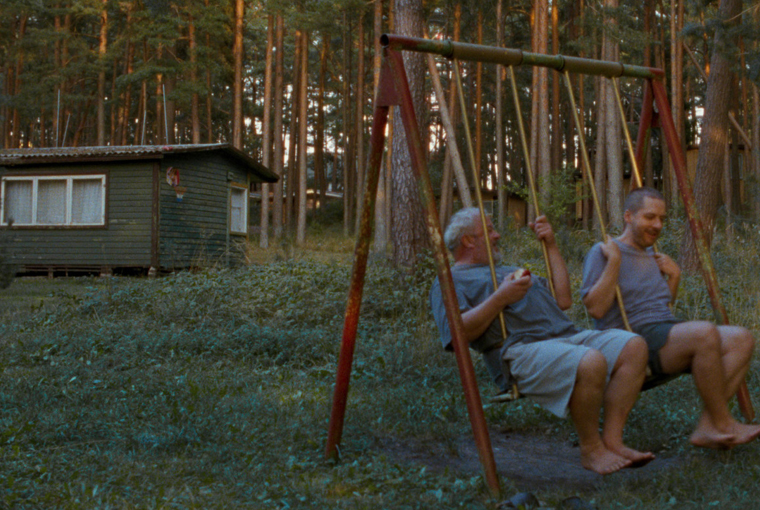
The Visitor is the first feature film directed by Lithuanian filmmaker Vytautas Katkus, who is better known as a cinematographer. Credited for his work on Saulė Bliuvaitė’s Toxic, released in 2024 and screened at numerous European and international festivals, Katkus is also the cinematographer of Renovation by Gabrielė Urbonaitė, which is traveling the festival circuit this year just like The Visitor. In The Visitor, Katkus relates the story of thirty-year-old Danielius (Darius Silenas), who returns home to a small resort town from Norway, where he lives a new, fulfilled life: he has a family, friends, and a job. This is a constellation familiar to many Lithuanians who have lived abroad since more than thirty years of independence. Katkus’ return is guided not by nostalgia, but by a rational reason – to sell the apartment of his recently deceased father.
Back in his hometown, surrounded by forest, Danielius settles into the apartment for the time being. From his window, he sees the windows of other people. Windows within windows, reflective mirrors, open doors offering views into other parts of the apartment – this is how Katkus frames the environment, making it fluid, shifting from one place to another, constructed as a mosaic in which the protagonist is placed. In these windows within windows live other characters, each with their own daily routines and duties. Everyone in the film seems to be lonely, and everyone strives to meet another person. Sometimes these encounters even seem to be pushed onto the film by the script – unreal, strange, slightly fairy-tale-like as they are.
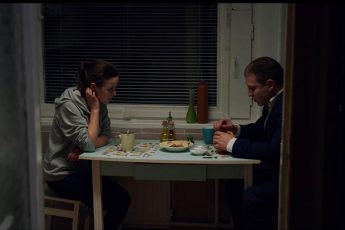
The first person to visit the apartment as a potential buyer is a woman waiting behind the door upon his arrival, having come by chance a day earlier than planned. She wants to buy an apartment for her daughter who has moved to the US, hoping to attract her back. She does not end up buying it, but offers to clean the apartment instead, as it looks untidy. During this time, Danielius goes for a walk with her son, creating a subtle yet meaningful bond that resembles a family relationship – buying him ice cream, holding his hand. Another encounter is with his ex-girlfriend, who asks him to take care of her dog while she goes to pick up her child from kindergarten. While walking the dog, he meets her father and begins to follow him, forming a friendship that develops to a point where Danielius asks him to become his father. Later, a young couple visits the apartment to buy it; they ask Danielius to stay a little longer, end up spending the night there, and in the morning they all have breakfast together like best friends. And thus impossible relationships are created.
As the encounters are strange, so the landscapes are surreal. While Danielius is swimming in the sea, the water is covered with red apples floating on the surface. The apples fall from a small island, which exists either out there in the open or in Danielius’ dream. This island becomes a symbolic projection of his feeling of being in the small world of his childhood. The sea itself expresses his emotions – calm or turbulent – disturbed by encounters with old friends from his youth. Reality turns into a dream, landscape into emotion. In an everyday scene of a mother playing with her child, a group of performers suddenly bursts onto the beach as the film transforms into a musical. This continues in a song sung by neighbors from the windows of the same building about their shared neighborhood.
All these burlesque encounters and dreamlike landscapes fill the 16mm film with surprises, accompanying Danielius’ return to his childhood as a place of adventure. His return to the past is not painful, but rather sweet – like the ice creams he eats throughout the film. When the apartment is finally sold, the mission of his journey is complete and he returns to Norway. Thus the voyage into a land of memories seems to have ended happily. New relationships allow Danielius to overcome the feeling of solitude caused by the loss of his real father and his home – both of which he ends up replacing. The film thus turns into a magical, dreamlike adventure with fluid boundaries between reality and imagination, consciousness and subconsciousness.
Leave a Comment