

What’s A Girl to Do?
Judit Elek’s A Hungarian Village (Istenmezején 1972–1973-ban, 1973)
Vol. 166 (Summer 2026) by Zoe Aiano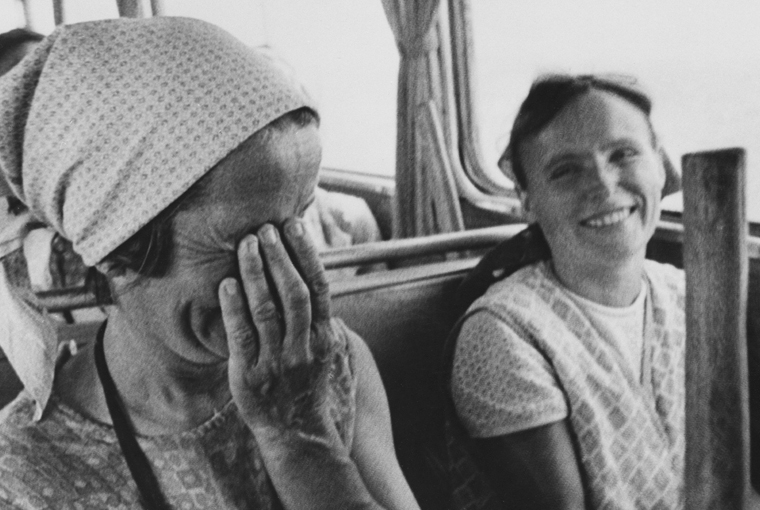
The original title of Judit Elek’s A Hungarian Village is pretty explicit in situating the documentary’s time and place. It not only refers to the year that it was shot in, but also to the name of the village in question, Istenmezején, which translates to ‘field of God,’ poetically and slightly ominously. What it notably fails to mention is the topic, which is very specifically girls and the limited choices they face as they transition into adulthood in this Hungarian village in 1973. Starting with their graduation from high school, the film follows two girls with very different personalities attempting to follow two very different paths, which are, however, essentially the only ones open to them. Neither is especially promising and both are stigmatized in their own ways, making womanhood effectively a no-win predicament.
Fun-loving 15-year-old Ilonka is unexcited at the prospect of breaking her back working in the fields, which has been the fate of most of the women around her. She is brimming with lust for life, and also for her boyfriend Lali, a miner, the main job open to men in the area. The two of them want to marry, but both households are alike in dignity, which is to say snobbery – Ilonka’s family disapproves of Lali because sometimes he skips work to go to the cinema, while Lali’s step-mother has been watching Ilonka at the pub and has noted that she often drinks several more than one beer while she’s there. On the logistical side, there’s also the question of her dowry and how they would be able to furnish a home together, which is the main thing that stops them from just eloping.
By contrast, Ilonka’s classmate Marika categorically doesn’t want to get married and is firmly convinced men are good for nothing except drinking and fighting. In general, she is much more serious and would like to continue her education to pursue a career in some kind of technical or industrial work. This is a viable possibility but would mean leaving the village and, notably, separating from her mother, who has her own work and family-related traumas. Her husband, Marika’s father, killed himself in shame after being accused of stealing, leaving her alone with the children and the lingering town gossip. A bright woman, she had the opportunity for further training to advance in her career at the factory where she works, but the burden and exhaustion of raising a family on her own meant she wasn’t able to take it. All this is looming over Marika as she contemplates her future.
Aside from a slightly slow start, the documentary is very engaging, with a certain freshness and humor to it. Inevitably, this is partly ascribable to the appeal of the two main protagonists, but it also has a lot to do with the familiarity and ease achieved by Elek in relating to all of the people involved. This comes through strongly in the relaxed, conversational nature of the interviews, during which her interlocutors are often sprawled on a couch or arranged in some other very informal setting. Elek’s perspective feels embedded in village life, as if she were a neighbor or family member who has just dropped by, and the way people relate to her seems very frank and unguarded. At the same time, her presence and that of the camera is not at all passive or feigning objectivity. She speaks her mind, she meddles – notably, she also joins the ranks of people trying to prevent Ilonka and Lali from marrying by sitting them down and giving them a stern talking to. There’s an honesty in this act of taking a stance and making it explicit within the film that also suggests a concern beyond that of a mere filmmaker and her subject.
The framing of the topic means we never get to find out what became of the girls in later life, and while of course this is frustrating it’s also fitting, the fixed shooting period adding to the sense of immediacy. As is often the case, the intense specificity has a universalizing effect. The decisions being faced by these two girls in this place at this moment naturally triggers the question of the other possibilities and constraints facing girls everywhere. Moreover, whether it was intentional or not, including the date in the title immediately conjures up thoughts of what was happening in women’s movements worldwide in the 1970s – 1973 was also the year in which the now overruled Roe v. Wade decision was made that legalized abortion in the US – situating the eponymous Hungarian village in a global context. Watching it now, the film serves as a fascinating time capsule, a piece in a much larger puzzle, but it shouldn’t only be considered valuable through this lens. Elek was likely more interested in triggering discussions among contemporary audiences than preserving anything for posterity, and the fact that it is still so watchable at a distance of more than half a century is due precisely to how rooted it is in the present, the future being so uncertain.


Leave a Comment