

Soft Porn for Refined People
Son of Saul within the History of Holocaust Representation
Vol. 69 (November 2016) by Pau Bosch Santos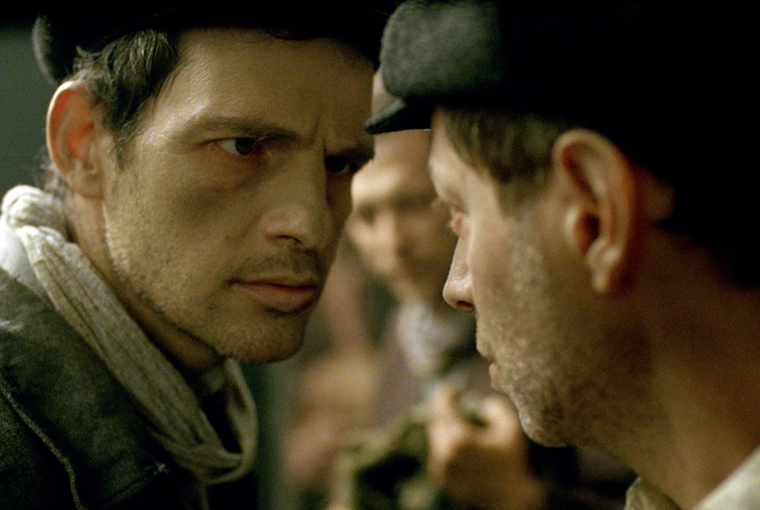
Making friends as usual, Roberto Bolaño had this to say about the generation of new Latin-American writers to which he himself belonged:
We come from the middle classes or from a more or less settled proletariat or from families of low-level drug traffickers who’re tired of gunshots and want respectability instead. Respectability is the key word. As Pere Gimferrer once wrote: in the old days, writers came from the upper classes or the aristocracy, and by choosing literature they chose, at least for a certain period that might be a lifetime or four or five years, social scandal, the destruction of learned values, mockery and constant criticism. Now, on the other hand, especially in Latin America, writers come from the lower middle classes or from the ranks of the proletariat and what they want, at the end of the day, is a light veneer of respectability. That is, writers today seek recognition, though not the recognition of their peers but of what are often called “political bodies,” the powers that be, whatever their sign (young writers don’t give a damn!), and thereby the recognition of the public, or book sales, which makes publishers happy but makes writers even happier, because these are writers who, as children at home, saw how hard it is to work eight hours a day, or nine or ten, which was how long their parents worked, and this was when there was work, because the only thing worse than working ten hours a day is not being able to work at all and having to drag oneself around looking for an occupation (a paid one, of course) in the labyrinth, or worse, in the hideous crossword puzzle of Latin America. So young writers have been burned, as they say, and they devote themselves body and soul to selling. Some rely more on their bodies, others on their souls, but in the end it’s all about selling. What doesn’t sell? Ah, that’s an important consideration. Disruption doesn’t sell. Writing that plumbs the depths with open eyes doesn’t sell.1
Needless to say, the same is true of the Old World, especially of artists or would-be artists at its margins (which is to say anywhere that is not Paris or London or Berlin), and even truer today, when economic and social inequalities are the starkest mankind has ever experienced, than some fifteen years ago when Bolaño wrote these words and we Western peoples were still living in a bubble. Needless to recall, too, the much-craved veneer of respectability is granted and ultimately fabricated by and for the culture industry (be it in the form of public or critical recognition, sales or awards), and therefore the quest for respectability more often than not comes at a price.
If respectability is what László Nemes was after, he has nailed it with his debut feature. The Wikipedia entry “Son of Saul” lists 26 awards, among them the Oscar, the Golden Globe, and a second position in Cannes. On top of that, Nemes and his leading actor, Géza Röhrig (also a debutant), have just won the Kossuth Prize, the most prestigious cultural award in Hungary. As for the monies (aka public recognition), the Jewish Telegraphic Agency proudly reported on February 2, 2016, “worldwide ticket sales for the Golden Globe-winning film are north of $2 million, already exceeding the film’s slim $1.6 million budget.”2 Since then, with the Oscars in between, data in Box Office show gross in the US alone more than doubling. Then come the critics: 96% “fresh” according to Rotten Tomatoes (with only seven “rotten” ratings out of 164) and a “metascore” of 89/100 according to Metacritic’s selection of 39 reviews. Last but not least, the film was also given a warm welcome by Holocaust scholars. The French Mémorial de la Shoah, for instance, deems it “an invaluable pedagogical resource,” and has issued a dossier to accompany eventual broadcasts of the film in schools.3 In short, Son of Saul has earned László Nemes not just a light veneer of respectability, but quite a thick one. So much so that Anthony Lane from The New Yorker went as far as saying of him and Röhrig that “if neither of them made another movie, this one would suffice.”4
Such an overwhelming consensus, whether or not one laughs at Bolaño’s remarks, is nearly as disturbing as the film itself―and the film is easily the most vivid and grisly plunge into what it might have felt like to work in a Birkenau Crematorium during its most frantic period (the action is set in an imaginary time frame between August and October 7, 1944, a time when, according to Yad Vashem, some 424,000 Hungarian Jews were deported to Auschwitz-Birkenau, most of them to be gassed and burned right away).5 In a nutshell, the story begins as Sonderkommando Saul Ausländer decides that a young boy found breathing after a gassing6 (and immediately suffocated by an SS doctor) is his son. Throughout the whole film we’ll be closely following Saul―the camera never more than three feet away from him, except for the film’s opening and closing takes―as he “steals” the corpse and single-mindedly looks for both a rabbi to say the kaddish and a burial place, while the other members of the Sonderkommando, in the background, prepare the October 7 revolt. What we’re dealing with, then, is a film whose aim is to give us the feeling that we’ve come as close as one can get to what is regarded as the touchstone of Pure Evil or, as a real member of the Sonderkommando put it, “the Heart of Hell.”7
In other words, Nemes has made a movie that is sort of a wonderland for the “voyeur of utter destruction” David Bowie sang about. This is clear enough from the filmmaker’s declarations that he wanted to “take the viewer in a visceral journey in the concentration camp,” instead of conforming to the kind of external, God-like standpoint typical of “the usual Holocaust films.”8 Even clearer is the overall tenor of praises for the film: “You don’t merely witness horror, you feel it in your bones” (Rolling Stone); “bringing home the reality of the Nazi horror while also leaving much terror to the imagination” (Toronto Star); “an immersive experience of the most disturbing kind, an unwavering vision of a particular kind of hell. No matter how many Holocaust films you’ve seen, you’ve not seen one like this” (Los Angeles Times); “There are numerous powerful Holocaust movies available but I don’t think I’ve ever seen anything that offers the kind of grim, you-are-there perspective of Son of Saul” (ReelViews); “a beat-the-clock thriller wrapped around an allegory” (New York Times).9
That the mainstream culture industry should make such a fuss about this kind of soft porn of the sancta sanctorum of Horror is all but unsurprising, and it all could have well ended here ― with Son of Saul getting the Oscar just like Schindler’s List, Polanski’s The Pianist, Benigni’s infamous Life Is Beautiful, last year’s Ida or, for that matter, 12 Years a Slave. What I think is deeply disturbing is that the refined elites of Holocaust experts should fall prey to the same enthusiasm. A case in point, and perhaps Son of Saul’s most remarkable feat, is the consensus it has brought about between two sacred cows of debates about Holocaust “representability” whose positions are (or were hitherto) at the farthest ends of the spectrum―namely, filmmaker and writer Claude Lanzmann and art historian and theorist Georges Didi-Huberman. This startling consensus warrants closer attention. For one thing, it gives us a clue as to the fact that Son of Saul’s hybrid nature (soft porn for refined people) is best fathomed within the context of the so-called representation debates. These are, I think, the film’s natural milieu, or rather its environment of evolutionary adaptedness, as biologists say―i.e. the place where Nemes originally evolved his adaptations, and so where they can be more fully appreciated.
1. The representation debates
For those unfamiliar with them, the representation debates roughly amount to two questions that are theoretically unsolvable, but which have been solved over and over in practice. The first one is whether the destruction of the European Jews, as Raul Hilberg tactfully named it, can be represented at all, which is as much as to ask whether that event is unique in nature and therefore intrinsically incomparable to any other event whatsoever―something beyond human language and understanding, as is sometimes said. The second question is: since we cannot help but go about remembering it, telling its history, building monuments and museums to its victims, writing books and making films about it, in short, representing it, what is the more adequate, decent, honest, faithful to reality, respectful towards the victims, etc., way to do it? (These debates are actually part of a larger discussion concerning the “normalization” of the Nazi past, which encompasses a whole other set of questions―like what is the function of Holocaust representations? Who do they benefit and how? How do they bias public awareness not only of the Nazi past but of other events past and present? What are the political uses of the rhetoric of victimization, the rhetoric of uniqueness and the unspeakable, of America’s “good war,” Britain’s “finest hour” or Germany’s “guilt complex”? Are the so-called Americanization of the Holocaust and the industry behind and around it nothing more than sheer pornography and brainwashing?)10
Depending on how you answer the first question, you will be holding either a moralistic, or fundamentalist, view of the Holocaust (if you insist on its uniqueness and claim, e.g. like Elie Wiesel, that it “cannot be explained nor can it be visualized,” because it “transcends History”),11 or a normalizing or liberal one (if, in trying to understand how something like that could ever happen, you choose to speak e.g. of how evil had become banal under the Third Reich, like Hannah Arendt, or of why most Nazi perpetrators were somewhat “ordinary men,” like historian Christopher Browning).12 Normalization, in turn, can be called for with pretty different political agendas in mind and through various strategies. Simplifying a bit, those on the political right typically endeavor to relativize or minimize the event’s significance, often to restore a damaged or lost sense of national pride. Those on the left, on the contrary, usually seek to challenge the Holocaust’s aura of exceptionality in order to universalize or expand its relevance by comparing it to other genocides or massacres, or by focusing on broader forces at its roots. On the other hand, artists, who often claim not to be pursuing any specific political or moral goal, have resorted to the aestheticization of the Nazi regime (e.g. in the form of satire or counterfactual history) to assert their creative freedom against the straitjacket-realism the uniqueness credo imposes.13
As to the second question (i.e. how best to represent the destruction of the Jews, since we cannot keep from doing it), the different answers that have been given to it (in cinema but also literature, philosophy, history, memoirs, museums, memorials, etc.) make up the history of Holocaust representation. In this history, most scholars routinely discern three more or less distinct moments or components, which we can dub, following Michael Rothberg, “realist,” “modernist” and “postmodernist.” As Rothberg makes clear, and as we will see with our film, which incorporates them all, these moments or components need not be strictly chronological nor mutually exclusive. Rothberg writes: “a text’s ‘realist’ component seeks strategies for referring to and documenting the world; its ‘modernist’ side questions its ability to document history transparently; and its ‘postmodern’ moment responds to the economic and political conditions of its emergence and public circulation.”14 Each moment or preoccupation, it goes without saying, is, or can be said to be in hindsight, a child of its own time, of a society’s priorities, needs or obsessions, of what people are hungry for or fed up with.
2. Realism and “historical drama”
Initially, then, i.e. since the aftermaths of WWII and all the way till the 60’s, when the first survivors felt compelled to write their accounts of the horrors they had been through, and hence to reflect about how best to present those horrors to those who hadn’t been there and, for the most part, could hardly believe what they were hearing, the prevailing paradigm was a realist one. Indeed, precisely because survivors had to struggle to make themselves heard and believed, the model for testimonies was judicial deposition: the statement under oath of the Nuremberg Trials or of the Krakow trial of 1946, which had three Sonderkommandos as witnesses. With few exceptions, for the 18,000 or so testimonial accounts that had been written by the late 50’s (including today’s classics of testimonial narrative like Primo Levi, Elie Wiesel, David Rousset, Robert Antelme, Charlotte Delbo, Tadeusz Borowski…), as for the Sonderkommandos who buried the so-called “Auschwitz Scrolls” in the soil of the Crematoria, literature, seen mainly as fiction, was ruled out as a suitable form of expression.15 The same preoccupation with factual truth, or fidelity towards the historical record, is apparent in Auschwitz survivor and filmmaker Wanda Jakubowska, who in 1947 made the first film inside the concentration camp (The Last Stage or The Last Stop), as well as in Alain Resnais’ Night and Fog (1956), commissioned by the French Comité d’Histoire de la Deuxième Guerre Mondiale and the Réseau du Souvenir to describe the living conditions in the camps. Gillo Pontecorvo’s somewhat awkward Kapò (1959), on the other hand, was concerned with verisimilitude rather than factuality, i.e. with the view silted in collective imagery by the wave of testimonies of those years.
Kapò’s species of realism, however, which Nemes thinks of as the drive to show as much as possible through a “combination or universe of different points of view,” has remained the constant approach of what he disdainfully terms “historical dramas,” most notably the kitsch NBC miniseries Holocaust (1978), Schindler’s List (1993) and The Pianist (2002), but also the only film before Son of Saul to address the subject of the Sonderkommandos: Tim Blake Nelson’s The Grey Zone (2001). Partly based on the eyewitness account of Mengele’s pathologist, Dr. Miklos Nyiszli, The Grey Zone tells the story Son of Saul leaves in the background: the concocting of the October 7 revolt. Furthermore, in Nelson’s version there’s also a survivor from a gassing, in this case a young girl (as reported by Nyiszli). But where Nemes shallowly focuses on one single man, Nelson keeps track of many characters, and through a multiplicity of points of view. Thus we have several story threads: the Sonderkommandos from different Crematoria (among them David Arquette and Steve Buscemi) striving to organize the uprising; the women from the munitions factory (among them Mira Sorvino and Natasha Lyonne) who sneak in the gunpowder to blow the Crematorium; the Hungarian transport carrying the girl who’ll survive the gassing; and Oberscharführer Erich Mühsfeldt (Harvey Keitel) trying to extort information about the upcoming rebellion from Nyiszli (Allan Corduner), while the latter tries to save his wife and daughter held at a camp soon to be liquidated. The camera also centers on many details Son of Saul leaves out or only hints at: the SS introducing Zyklon B in the gas chambers; the Jewish band playing a Strauss valse while victims enter the Crematorium; the water canal, red with blood, running by the furnaces to facilitate the sliding of corpses; the feasts the Sonderkommando enjoyed thanks to the victims’ stuff; prisoners working by the burning pits; prisoners tortured into confession; prisoners executed with a bullet in the back of their head―Nelson’s camera is even the first and only in the history of cinema so far to have ventured, albeit just for a few seconds and in a flashback of the revived girl, into the operating gas chamber.
The Grey Zone is thus an almost complete gallery of the most gloomy things we know happened in Auschwitz-Birkenau on a daily basis, the whole marinated with long travellings and vantage points of the camp and a Hollywood cast speaking English with either American (the prisoners) or German (the SS) accent. No wonder Nemes, who thinks “less is more and the right way [is] to rely on the imagination of viewers to reconstruct something that cannot be reconstructed,” claims his film is “an anti-Grey Zone.”16 In short, Nelson’s movie (and by extension all “historical dramas”) is the kind you watch to give you an idea of what the destruction of the Jews was supposedly like, just like you’d watch, say, Ben-Hur or Spartacus on a Sunday afternoon for a quick introduction to the Roman Empire―whereas Son of Saul won’t do you any service in this regard unless you’re already somewhat conversant with the topic. Herein lie part of its “postmodern component” and the key to Holocaust authorities’ excitement: Nemes is at bottom more realist than realists―he goes as far as reconstructing Auschwitz’s Babel of languages (of which precisely English was one of the rare ones to be absent) and even gives plausible numbers to prisoners. But his realism is not one the camera focuses on. It is not something you see. It is meant to be felt. It is realism for connoisseurs.
3. Modernism and unaware teens
A commonly accepted turning point from the “realist” representation regime is the Eichmann trial held in Jerusalem in 1961. Contrasted with Nuremberg, where it had been at stake to determine where and to what extent there had been military crimes and the newly coined “crimes against humanity” (whence its positivistic ideal), the outcome of the Jerusalem trial being known beforehand, the goal here was to place the destruction of the European Jews in the forefront of the public eye. The real object of the trial, in other words, was not so much Adolf Eichmann himself as public awareness and recognition of a distinct event theretofore downplayed, if not downright overlooked―the event we’ve come to call “The Holocaust,” “Shoah,” or “Hurbn” of the European Jews. This was partly accomplished by giving human face and voice to historical data, i.e. by the proliferation of individual victims’ micro-stories that, as Arendt complained, were often irrelevant, when not absolutely unrelated to the case (which to her was the trial of that one single man). Jerusalem thus signals the coming on stage of subjective experiences and traumatic memories per se, rather than for the sake of establishing objective facts.17
For those who like to seek in historical coincidences some secret meaning or sign of the Zeitgeist, 1961 is also the publication year of Raul Hilberg’s landmark The Destruction of the European Jews (the crowning of fifteen years of factual research) and, more importantly for our purposes, of one of the first novelized accounts by a survivor: Piotr Rawicz’s Blood from the Sky. Whereas the Jerusalem witnesses, for all their idiosyncratic elements, remained faithful to the realistic imperative, Rawicz is perhaps the first to probe the limits of the representation of so thorny a topic as the Holocaust by the means of “literary modernity” (indeed, he is the first ever to present his account as not being “a historical record”), and decidedly the first to turn the established values of two decades of testimonial narrative on their head. Thus, in a gesture of supreme self-derision, opening his story “as one would open a shop,” Rawicz wasn’t just desacralizing the survivor’s word―he was also suggesting that this word, to be heard (or purchased) and survive in turn, needs to be fashioned and transmitted by a language professional―but don’t you think literature itself, described as “the art, occasionally remunerative, of rummaging in vomit,”18 was spared by Rawicz’s carnage. In yet another reversal of testimonial literature’s tenets, Rawicz’s survivor is not a mere victim, and his story does certainly not recount the triumph of Humanity and Culture over bestiality and barbarism, as was the case e.g. in Wiesel’s Night. Instead, the burden to bear witness is imposed upon the hero by the Judenrat’s president when the latter gives him permission to flee the ghetto using fake documents―and so the veracity of his word, acquired at the expense of the community he’s left behind, is decoupled from moral integrity. It is a consequence of (rather than a pharmakon against) his dehumanization. To further underscore indignity, Rawicz, who in real life was caught while running away and ended up spending three to four years in Auschwitz and Leitmeritz (albeit not as the Jew he was, but as an Ukrainian Christian political prisoner, thanks to some fake documents justifying his circumcision), chose to have his antihero get away with his false identity and freedom at the end of the novel.
Rawicz’s demolition of the testimonial canon is also apparent at the formal level―in the multiplication of voices (narrator + protagonist + some characters’ writings), of styles and genres (narration, poetry, journals, satires, puns), or in the somewhat unconnected succession of episodes―thus thwarting the conventional dichotomy between fact and representation, content and form, and the capacity of any given form, voice or genre to fully grasp an event touching at once the extremes of the tragic and the grotesque, exceptionality and banality.
Another writer to reverse testimonial conventions, and a decisive influence for Nemes, is the late Imre Kertész. A Hungarian Jew aged 14 when he was deported to Auschwitz and then Buchenwald in 1944, Kertész waited until 1975 to have his first novel published. Based on his own experience, and despite preserving the unity of narration, voice and style, Fateless (or Fatelessness, as it was newly translated) is first and foremost a book about the incapacity of its hero to realize the full extent and import of what’s befallen him. Unlike the majority of earlier memoirs, then, Kertész’s narrator couldn’t be the historian’s or the judge’s assistant, since he gets everything wrong. On the evening of the day he is arrested and while awaiting deportation, for instance, the only thing he can think about is his “stepmother’s face when it finally dawned on her that it would be pointless to count on seeing [him] for supper.” Again, in one of the book’s most aberrant moments, right after the selection upon arrival at Auschwitz (which he “succeeds” because some prisoner tells him to lie and say he’s sixteen instead of fourteen), the hero expresses thus his first impressions: “From what I saw of the area on this short walk, on the whole it too won my approval. A football pitch, on a big clearing immediately to the right of the road, was particularly welcome. Green turf, the requisite white goalposts, the chalked lines of the field of play―it was all there, inviting, fresh, pristine, in perfect order.”19 Kertész’s discovery of camp life is thus the obverse of e.g. Primo Levi’s. Where each step of the latter furnished the reader with ever more detailed information about the camp’s functioning, Kertész’s progress is but a series of misinterpretations and mistakes, placing the reader at once in the same defamiliarized or estranged perspective as the naïve hero and in an unbearably despairing and agonizing position―since the reader presumably knows a lot more than the hero.20
“Modernism” in cinema can be seen in films that explore the aftereffects of deportation on survivors. Sidney Lumet’s The Pawnbroker (1964), Alan Pakula’s Sophie’s Choice (1982), or still Liliana Cavani’s sadiconazista (roughly the equivalent of American Nazisploitation) The Night Porter (1974), all deal with individuals unable to overcome or work through their traumatic experiences, in all cases with devastating consequences. The fractured man in Lumet’s grim and ruthlessly hopeless picture is a former University professor who has interiorized fear and worthlessness to such an extent that he has opened a pawnshop in East Harlem, the ultimate pigeonhole of the penny-pinching Jew, and goes by reduced to a nearly complete denial and silence. As memories start rushing in, he keeps pushing all those who care for him away, sinking ever further into despair. As the cherry on top of his shame and guilt cake, his assistant will be killed during a robbery while keeping him from receiving the bullet that would put an end to his suffering. The somewhat similar Sophie in Sophie’s Choice will choose madness and torment as companions in the form of a severely schizophrenic partner who undergoes ever more acute crises of jealousy and paranoia, with whom she’ll end up committing suicide. In Cavani’s wanton and bizarre portrait of the Nazis, trauma surfaces when captor and captive meet by chance years later, in this case as the resurgence of a sadomasochistic romance to which they will give in entirely while giving up on their respective reformed lives, only to be shot in the end by the ex-SS’s Nazi protectors. Much like Rawicz’s novel, then, all three films oppose sheer victimization―the latter by blurring the line between victim and perpetrator, the former two by depicting a victim who more or less wittingly or fatalistically contributes to his or her own disgrace. In this sense, too, all three highlight the need of normalization while at the same time pointing towards the difficulty of attaining it.
Whereas these films deal with traumatic experiences après coup, a film dealing with its genesis, and adopting a perspective somewhat similar to Kertész’s, is Elem Klimov’s Come and See (1985). In Klimov’s nightmarish fairytale, the oblivious hero is a Belarusian teenager eager to join the Eastern front during WWII, who, in fulfilling his yearning, will step by step plumb into a crescendo of warfare horrors. Despite the growingly distressing series of misadventures he will endure during the three days covered by the film, though, the careless smile will only be wiped out of the boy’s face once and for all in the scene before the last, as a Nazi Einsaztkommando burns an entire village with its inhabitants to ashes before his eyes. Just like Fatelessness is about the failure to measure the Final Solution’s significance, then, Come and See is about a kid’s inability to anticipate the brutality of war.
Both Kertész and Klimov being avowed references for Nemes, it shall come as no surprise to find such estranged perspective exploited in his film too. Indeed, perhaps under the influence of the Hungarian writer and the Russian director, Nemes has come to believe that “being lost is part of the experience,” i.e. that “the experience of the concentration camp is something very limited, you can hardly find anything more limited than that, and also very claustrophobic.” It seems only natural that he wanted to have that feeling in his movie.21 In Kertész and Klimov, though, the estranged perspective is so to say “organic,” serving an essential narrative function without which the characters wouldn’t develop the way they do (in Klimov, e.g., both hero and viewer are constantly disoriented, as the enemy remains invisible until the very end, with bombs falling from the sky, land mine casualties, gunfire coming from an anonymous distance, or a whole village found slaughtered only belatedly). In Son of Saul, in contrast, such perspective is somewhat ad hoc, a sort of byproduct stemming from Nemes’ conception of the camp’s experience and from what he calls his ethical and aesthetical decision to show less, but without a substantial narrative function (moreover, while the viewer is surely at a loss, Saul doesn’t seem to be at all).
The purpose of Nemes’ restrained point of view is rather to offer the viewer what he and critics have termed an “immersive experience,” a “visceral journey” in the shoes of one of those men who often said of themselves they’d turned into robots or automata.22 Son of Saul’s modernism or subjectivism thus constitutes its soft porn component―Saul the robot doesn’t see the obscene parts of the Holocaust anymore, and so they are spared to the viewer in Saul’s shoes. But unlike the self-destructive characters in Lumet’s, Pakula’s and Cavani’s films, who defied mere victimization only because their guilt complex kept them from assuming their own victim condition, Saul’s madness consists in his refusal against all odds to become a mere victim―in his refusal, too, to be but a simple man. In the midst of an environment especially designed to produce infra-men (beasts, ashes or robots), Nemes presents us with a near super-man―a man whose machinelike obsession with the most humane of tasks raises him to the status of a hero (Orpheus) or an angel.
4. Postmodernism, the Holocaust Industry and the memory boom
Indeed, just like The Grey Zone was a nearly complete catalogue of horrors in Auschwitz, Son of Saul is a catalogue of heroic deeds. There’s foremost Saul’s quest to give a dignified burial to the kid, but also the Sonderkommando uprising, the only one that took place in the history of Auschwitz-Birkenau, as well as the taking of the photographs of the burning pits from inside the gas chamber by one of them, and even what the viewer can guess are two members burying their manuscripts in the first, out-of-focus take of the film. “In fact, the movie represents different forms of resistance,” Nemes clarified in an interview.23
Such exalting picture of life in the Crematorium, though, merely mirrors the one encouraged by the establishment of Jewish thought. However comforting, or precisely because it is comforting, and not only for the Jews themselves but also for the perpetrators, as Raul Hilberg denounced during his whole career, the picture is actually misleading and morally dubious. For one thing, Hilberg argued, attributing heroism or martyrdom to every European Jew diminishes “the accomplishment of the few who took action.” Even worse, representing those few acts of resistance as emblematic obscures the fundamentally bureaucratic nature of the destruction process, the oft-noted and most troubling fact that Jews walked like sheep to their own slaughter, and the actual reasoning and survival strategies of Jewish communities in the ghettos and camps―which prompted them to rush to the trains in the far away Netherlands, but also sustained their discredit regarding death camps in places as close to them as Warsaw, Bialystok or Lvov.24
On yet another level, Saul’s heroism reproduces the American (and neoliberal) myth of the self-made man. Thus Nemes doesn’t center, as did Nelson, on the collective endeavor that was the October 7 revolt, but on the lone wolf who, if he doesn’t willfully run counter his fellows’ enterprise, is almost hindered by it, or uses it only to his own advantage (e.g. as an excuse to leave the Crematorium’s facilities to go fetch a rabbi). It is at all these levels of analysis―as well as the allegorical one that will be analyzed below, and in its veiled or background, meant-to-be-felt realism, not to mention the subject chosen and its formal, soft porn plus thriller or action-film treatment―that one can read Son of Saul’s response “to the economic and political conditions of its emergence and public circulation,” which is how Michael Rothberg in the quote above described a representation’s “postmodern moment.”
“Postmodernity,” though, is a slippery concept, and the way Michael Rothberg characterizes it is, to say the least, not quite straightforward. The preoccupation with the conditions of public circulation is an upshot or, better still, a mood of postmodernity rather than a defining trait. Postmodernism is more commonly associated with a certain unserious or relativistic or even antirealist attitude that springs from what the man who coined the term saw as the death of “metanarratives.”25 What this was supposed to mean is roughly that there is no longer any form of discourse or representation that could claim superiority or greater value above any other (e.g. that the Enlightened West brings reason and freedom to the world through science and democracy). Every discourse or metadiscourse, it is said, is equally biased and relative, carrying with it a moral or ideology that cannot prove its legitimacy outside or beyond its own system of beliefs and values. Once one has recognized this, the most urgent task is to “deconstruct” the dominant discourses and representations (e.g. Religion, Fascism, Communism or Neoliberalism) to make visible the ideology and the economic and political interests (which are always those of a happy few) animating them. And once deconstruction is over, all faith in a constant truth eradicated, and the cut-off heads of all ideologies mounted on a pike and displayed in full daylight for public shame (as it is allegedly the case today), conventional wisdom has it, the only thing left to do is have fun by playing with their remnants to produce any sort of hodgepodge or patchwork whatsoever. The two moments, deconstruction and play, however, should be kept separate at least conceptually―with scholars, usually in philosophy and literary and cultural studies, content to remain within the boundaries of deconstruction, and artists indulging besides in play.
Interestingly, Postmodernity and the Holocaust are said to be in a way consubstantial. Saul Friedlander, in the introduction to a collective volume devoted to the issue, puts it clearly: “it is precisely the ‘Final Solution’ which allows postmodernist thinking to question the validity of any totalizing view of history, of any reference to a definable metadiscourse, thus opening the way for a multiplicity of equally valid approaches.” On the one hand, Friedlander reasons, any given representation or discourse seems insufficient and impotent in the face of the Tremendum embodied by the historically unprecedented, “willful, systematic, industrially organized, largely successful attempt totally to exterminate an entire human group,”26 and in this sense the Holocaust would be calling for a multiplicity of aesthetic approaches to so to say fill the vacuum as much as possible. On the other hand, the fact that multiple approaches are needed, and therefore valid, renders an event already difficult to apprehend like the Holocaust all the more elusive, as it continues to slip through our fingers no matter what we do. Thus, according to Friedlander, we are left with this uneasy dilemma: we need a stable truth or narrative about the events but cannot avoid acknowledging the opaqueness of those events and of language. Among the many responses proposed to this conundrum, ranging from pure silence to the unadorned, realist compilation of “bare” facts and the different “modernist” strategies questioning the transparency of bare facts, a kind of tacit ethical compromise has been reached that however difficult it is to fully and thoroughly represent it, we owe it to the victims and ourselves to keep on trying.27
Even more interesting, and perhaps predictably, since postmodernity, or its neoliberal variety, has become in turn the dominant metanarrative, its deconstructive or critical side has lost momentum. To put it bluntly, a corollary of the relativistic dogma is that any discourse or representation must be allowed to join the public arena on equal grounds with all others. That is, since it is commonly admitted that there is no secure basis for ascertaining the supremacy of any discourse or position whatsoever, the anathema of our days, a synonym for outright authoritarianism, is precisely to do the opposite, to dismiss or reject or rebut any point of view one doesn’t “agree with” or “like” (subjective opinions and gut feelings―and things strictly biological in general―being the only reliable guide left). The only entity that can rightfully determine which point of view should prevail, we are told, is the faceless, blind and invisible hand of the market―a sort of blind spot where basic human needs, opinions and tastes meet and magically metamorphose into each other. One is left wondering why we still have laws or police departments and what they can possibly add to such godlike regulator. The sad “truth” being that the balance of power hasn’t changed a bit, or rather that it has, but only for the worse. And that postmodernism has become one of neoliberalism’s main ideological weapons.
Thus it is no coincidence if a byword for postmodernity is “the end of ideologies,” and if, as Norman Finkelstein bitterly decries in his most contentious The Holocaust Industry, talk about “ideology,” “power” or “interests” has given way to “the bland, depoliticized language of ‘concerns’ and ‘memory.’”28 In short, with the end of ideologies came the “end of history” (aka the planetary triumph, after the fall of the Berlin Wall, of what some call “parliamentary democracy,” and others, more upfront, the “market-state”), and with the end of history came the “memory boom.”29 Considered by many a sort of paradigm shift within the humanities and social sciences, the memory boom, or “industry,” basically boils down to the realization that the way history is written has political and social implications (something Herodotus and Thucydides already knew), together with the discovery that there is money to be made not only out of classical “national treasures,” but also national and international catastrophes. The boom thus translated into an upsurge of political and scholarly debates about the “concerns” determining who and what is to be remembered where and when and how. It translated into the emergence of identity vindications by ethnic, political or economical minorities, who naively thought the time was ripe for “integration” or “real democracy.” In sum, where there had once been “power politics” and “class struggle,” we now have “identity politics” and meek demands for “tolerance” or “acceptance of the difference.” Where people called for revolution, they now call for “recognition” (or respectability). And instead of Herbert Biberman’s Salt of the Earth, we now have Steve McQueen’s 12 Years a Slave. On the other hand, and exploiting the understandable thirst for strong emotions this bland and meek “political correctness” does not afford, the memory boom also translated into “dark tourism,” i.e. the recreational visitation of sites associated with violent death, disaster or depravity, as well as into a host of museums, memorials, monuments and festivities in those same sites or elsewhere.30 Finally, and since The Holocaust was appointed as the epitome of man-caused cataclysms, the memory boom translated into the Holocaust Industry.
Now as even the most amateurish salesman knows, a better marketing strategy than ascertaining your product’s usefulness or quality is to claim its exceptionality or radical novelty. And so, as Finkelstein points out, the Holocaust Industry gave birth to the “uniqueness doctrine.” This creed must not be confused with the fact that the destruction of the Jews is unprecedented in nature and scope (which no one, except negationists, denies). It consists rather in the idea that the Jews were the unique target of Nazi hatred (gypsies and Slavs being only collateral damages), and in the much more controversial one that the fate of the 6 million assassinated by the Third Reich evinces a unique evil by essence incomparable to the fate of any of the other 180 million victims of political violence during “the century of genocide”31 or at any other time in history. Following the scholastic dictum individuum est ineffabile, advocates of Holocaust uniqueness, like Claude Lanzmann or Elie Wiesel, frequently claim it to be unspeakable and unrepresentable, transcending history and rational comprehension, silence being the only decent reaction to it. Terrence Des Pres condensed the dogma in three commandments: those wishing, in spite of all, to speak about the Holocaust should represent it, “in its totality, as a unique event, as a special case and kingdom of its own, above or below or apart from history;” “be as accurate and faithful as possible to the facts and conditions of the event, without change or manipulation for any reason;” and approach it “as a solemn or even sacred event, with a seriousness admitting no response that might obscure its enormity or dishonor its dead.”32
This “sacralization of the Holocaust” (as Peter Novick put it), to be sure, did not go unchallenged―hence triggering the so-called “uniqueness debate.” Among uniqueness opponents were most notably “universalists” like Finkelstein, a political theorist, who wanted to draw attention to some questionable claims put forward by many Jewish institutions on behalf of “needy victims,” as well as to Israel and US violence in the Middle East and the fact that putting the Holocaust at center stage automatically dooms present-day criticism of anything Jewish to be labeled “anti-Semitic” without giving it a second thought. Other universalists, often historians or social scientists like A. Dirk Moses, simply wish to understand the mechanics of genocidal outbursts and bring other massacres into consideration, whereas still others, coming mainly from philosophy or art theory, like Georges Didi-Huberman, focus their attacks on the unspeakability and unrepresentability dogma. On the other hand, “relativists” in Post-Cold War Eastern Europe and Germany for the most part sought to “de-Judaize” the Holocaust and thereby restore a “healthy” national identity.33
Ironically enough for its contenders, the uniqueness thesis, or rather the debate as a whole―coupled with the memory boom and the aforementioned compromise that in spite of the opaque nature of representational media and the event itself an effort is due to try and represent and understand the Holocaust―just provided more grist to the Holocaust Industry’s mill. And so dozens of papers, scholarly and literary books, and films bearing on the topic, the Industry’s indispensable educational and attention-focusing arm, keep coming out year after year.
In cinema, besides the standard “historical dramas” persevering in the idea of heroic survivors (The Pianist) or rescuers (Schindler’s List, Divided We Fall), the memory boom/Holocaust Industry has crystallized into countless features dealing in one way or another with individuals trying to “work through” or “come to terms” with their past. In Stephen Daldry’s The Reader (2008), it is a German lawyer who, in his teens, had a summer romance with what years later he’d find out, while attending her trial, happened to be an ex-SS responsible for the deaths of many hundreds (an illiterate one who enjoyed being read to, for that matter, to further stress Nazism as purely barbaric). Significantly, he will only make up his mind and lend her a hand after letting her rot in prison for twenty years (during which time she has learned to read by herself with the help of the audio books he recorded and sent her throughout the years), thus indicating a possible way for Germans to master their past. In Paweł Pawlikowski’s Ida (2013), it is a Polish girl who grew up as an orphan and is soon to become a nun. Before that, though, her only living relative summons her and instructs her as to her Jewish blood and her parents’ fate. Together they will embark into a journey to the past, and will only refrain from claiming the real estate that was lawfully theirs in exchange for the recovery of the parents’ bones. After duly burying them, the aunt, who had been burdened by the past all those years and apparently had no other goal in life than restitution, will commit suicide, whereas Ida will return to the monastery and take her vows―thus showing the right way for Poland to appease its ghosts and be able to pursue undisturbed its overwhelmingly Catholic present. In Lars Kraume’s recent biopic The People vs. Fritz Bauer (2015), the hero is the unrelenting Nazi prosecutor who infringed Germany’s laws and defied the perversely oblivious mindset of the time by having Adolf Eichmann kidnapped in Argentina and brought to trial, albeit not in his home country as had been his wish. At a moment when Germany is little less than strangling its European debtors, the film is an elegant way to find solace in a neglected national hero, a man who had the courage to do the right thing regardless of the reigning attitude among his countrymen. Finally, in what seems an in-purpose exemplification of Finkelstein’s theses, Simon Curtis’ The Woman in Gold (2015) presents us with the odyssey of the elder Maria Altmann (a Jewish Viennese from a well-to-do family who fled to the US leaving everything behind) to have the famous picture Gustav Klimt made of her aunt restituted to her by the Austrian government who had inherited it from the Nazis.
Contrasted with these films, each invoking the Nazi past to its own normalizing or moralistic purposes, each consequently sparking controversy in some way or other, Son of Saul is a strange creature. As mentioned at the outset, its major feat might well be to have engendered consensus not only within the culture industry, but also within Holocaust scholarship, and most notably between a notorious proponent and a notorious opponent of Holocaust uniqueness and unrepresentability. It is such unheard-of and most unlikely achievement that best attests Nemes’ true craftsmanship.
5. A reconciliation of extremes
On the dark or moralistic end of the representability spectrum, then, we have Claude Lanzmann, who famously decreed that there are no images of the Holocaust (first because there are no images of Jews dying in the gas chambers, second because of the thoroughness with which the Nazis tried to erase every single trace of their crimes) and who has spent his entire cinematographic career making a series of documentaries dealing with the subject, including the 9 hour-long Shoah (1985), in which not a single archive image is allowed―leaving us instead with the testimonies’ memories and vacant death camps’ footage. Lanzmann, much like the late Elie Wiesel, stands as sort of a godfather to all those who maintain that the Holocaust is absolutely unrepresentable, if not The Unrepresentable par excellence. Now that this same man, who has never approved any Holocaust film but his own, visibly moved after Son of Saul’s second screening at Cannes, should embrace Nemes and tell him something like “You are my son,” you might need to see to believe. Shortly thereafter, in an interview with the French magazine Télérama, he proclaimed that “Son of Saul is the anti-Schindler’s List”―Lanzmann also famously launched a campaign against Spielberg’s shameless way of depicting the camps, chiefly against the infamous shower scene in which the viewer, for a minute, is led to believe that the camera has finally dared to enter, and in such a cheesy way, inside the gas chambers. Lanzmann also declared that “Nemes has invented something,” although he didn’t explain what. In any case, he concluded, the director “has been smart enough not to try and represent the Holocaust.”34
On the other, normalizing end of the spectrum, we find Georges Didi-Huberman, who devoted a whole book to the analysis and exaltation of the four photographs taken by the members of the Sonderkommando in the Crematorium V in August 1944 (the film reconstructs the taking of two of them), and who spent more than half of that book arguing, against the attacks directed at him by Lanzmann himself and his acolytes, about the value of those images as testimonies and acts of resistance and about the need to imagine Auschwitz despite the difficulty of doing it and the impossibility of fully and thoroughly doing it. According to Didi-Huberman, far from being unimaginable, we must say that Auschwitz, precisely because the Nazis tried so bad not to leave a trace, “is only imaginable.”35 Well, just as moved or even more so than Lanzmann, Didi-Huberman has written Nemes a letter full of praises, which was published coinciding with the film’s release in France (and as part of its promotional campaign―but shouldn’t we say that each cultural product symbiotically promoted the other, in a win-win situation advertising-wise). And whereas Lanzmann didn’t say what it was that Nemes had invented, Didi-Huberman argues at length about the new genre the film has, according to him, invented, which he dubs “documentary tale.”36
“Documentary” not only because Son of Saul is almost 100% faithful to what is known about Auschwitz’s historical reality―the Crematorium’s structure, all the tongues one could hear at that time in the camp, the taking of the photographs, the Sonderkommando revolt, the mass shootings when the Crematoria were overstressed, even the prisoners’ numbers are meant to be plausible, and the instructions given by Oberscharführer Voss as to how best to position the corpses in the ovens so that they burn faster are extracted from a witness37―but also because of what, in literature, is called psychological realism from Proust, Joyce and Virginia Woolf onwards (cognitive narratologists today call it “cognitive realism”), which in the film translates into the aforementioned “you-are-there perspective” or “visceral journey in the concentration camp,” i.e. the ethical and aesthetic choice, as Nemes puts it, to adopt exclusively the hero’s point of view, to let the audience see, hear and understand only what Saul sees, hears and understands, so that all the historical reality, all the documentary part, is left in the background and so to speak “filtered,” or meant to be felt, through Saul’s subjectivity.
On the other hand, according to Didi-Huberman, the film is a tale that he compares to Kafka’s parables and to Jewish Hassidic stories―in which there’s always a rabbi who teaches his disciples or some disbeliever, in a veiled and mysterious manner, the secret of mystical union with God. Only in the film, Didi-Huberman says, the Hassidic parable is, as in Kafka’s myths, frustrated: the first rabbi won’t help Saul, the second one isn’t able to (because he is shot), and the third one is simply a phony who doesn’t even know a couple of verses of the funeral oration.
The film thus functions (this is already my thesis) as an allegory of that upon which almost all Holocaust commentators agree: the moral imperative to bear witness, to remember, to represent, etc., together with the difficulty or impossibility to satisfy this imperative (or to satisfy it thoroughly). Saul moves heaven and earth to have the kaddish pronounced, going so far as to sabotage (involuntarily, when he loses the gunpowder) the world of the living, the present-time preoccupations of his fellows trying to organize the revolt, in order to commemorate the dead. He is in this sense an angel of testimony (in much the same way as Walter Benjamin talked of an angel of history): he is the one who saves the photographs, the one who knows where his fellows have buried their manuscripts, the one to get out of the Crematorium and see the rest of the camp. And yet the boy’s corpse ends up dragged by the current of the river that has engulfed the ashes of all victims, whilst the kaddish, which had to raise him to eternal life (a quintessential metaphor of memory, representation), remains unpronounced. At this point, the camera can let go of Saul, who hands over to the Aryan (or Polish) kid, to the innocent generations to come, the task of transmitting this message―the duty to represent, etc., plus the impossibility to satisfy this duty.
As an allegory, then, the film not only says nothing new, it merely echoes what’s become the most easy and dog-eared of commonplaces about Holocaust representation. It is like the magician’s hat―the rabbit appears to be gone but then we find it exactly where it was―the uniqueness/unrepresentability doctrine comes back as the final message. It shall come as no surprise, by the way, to find out that the only institution to provide funding for the film besides the Hungarian National Film Fund was the Conference on Jewish Material Claims Against Germany (aka the Claims Conference), one of the most fearsome arms of the Holocaust Industry according to Finkelstein.38
But the film can also be read as an allegory of postmodernity as it is most commonly understood: the discourse that cannot be pronounced is no other than the kaddish―i.e. it is precisely the religious discourse, the only one that promises eternal rest, and with it any dogmatic or unilateral worldview, that the current of Auschwitz’s river carries away.
This is then Son of Saul’s “postmodern moment” and a third generation’s good pupil’s recipe for respectability: by incorporating each moment or phase of the history of Holocaust representation, Nemes has come up with a perfect pastiche or potpourri suitable for all, even the most demanding audiences, giving each ear what it wants to hear and each eye what it wants to see.
To the culture industry and the “uneducated” masses, a heavy dose of soft porn and strong emotions, “an oasis of horror in a desert of boredom,” as Baudelaire put it, through Saul’s visceral and fidgety journey across Birkenau.
To the refined elites of Holocaust connoisseurs, he proves he’s been down their road by means of an unprecedentedly accurate, but at the same time discreet, meant-to-be-felt realism.
To picky postmodern intellectuals, he demonstrates he’s understood what our time is all about after the end of ideologies.
To neoliberal zealots, he presents a textbook self-made man, a most “proactive” lone wolf unremitting in the pursuit of his interests.
To the orthodoxy of Jewish thought and to sensitive souls, he feeds yet another heroic picture of resistance against all odds in the most hellish of settings.
For uniqueness and unrepresentability foes, he renders a most vivid and grim picture of the Holocaust.
And for uniqueness and unrepresentability ministers, he gives the final, soothing message that, no matter how hard we try, the kaddish that would finally put the dead to rest is one that cannot be pronounced.
To all of us, finally, he is the whip we can self-flagellate with for 107 minutes before going back to our couch and forget or reflect about the atrocities mankind is capable of.
In short, one can hardly imagine a cultural product better adapted to “the economic and political conditions of its emergence and public circulation.” Hard to imagine a film less scathing or mordant, more harmless and innocuous to “what are often called ‘political bodies,’ the powers that be, whatever their sign,” to take up Bolaño’s words. At all events, representability and respectability-wise, one has to admit Nemes is an A+ student. For all we know, he might well be nothing but a fraud. The saddest thing is that he probably is not. That he probably is as honest and naïve as one can be in his search for recognition and respect, like so many minorities from the geographical or social or economic outskirts of the West who have given up dreaming about a real transformation of society, or maybe, even sadder, who have never even dared to dream about such transformation, to whom it has never even occurred to dream about it (but who could?), and instead just wander around timidly asking for acceptance and integration, conscientiously following word by word every norm and precept presented to them from atop, struggling with all their energies to elicit a smile here and a compliment there, a “Nice job!,” an “Awesome!,” hoping someday it will be them uttering those words, unaware that they are the real martyrs of our time.


Leave a Comment